BCE
-0.4100
Since the beginning of 2026, a diplomatic thriller has been unfolding around the Arctic island of Greenland. US President Donald Trump, who already wanted to buy the island in 2019, has made his claim state doctrine in his second term in office. He justifies this with geopolitical and security policy arguments and threatens European allies with punitive tariffs. Although the US and NATO have drawn up a preliminary framework agreement in Davos, the situation remains tense – and the inhabitants of Greenland continue to reject the takeover.
A conflict with a history
Trump had already started a trade war with the EU in the spring and summer of 2025. At that time, the Union relented in order to protect its ailing economy. With the mediation of Chancellor Friedrich Merz, Brussels accepted an asymmetrical agreement that abolished all tariffs on US goods, while Washington imposed a basic tariff of 15 per cent on imports from Europe and even higher tariffs on certain products. This ‘tariff turnaround’ served as a model for how the US president uses economic pressure to achieve political goals. When Trump renewed his threat in January 2026, he once again took a heavy toll on the trade front: from 1 February, tariffs of 10 per cent were to be imposed on goods from Germany, Denmark, France, Great Britain, Norway, Sweden, Finland and the Netherlands, rising to 25 per cent from 1 June – unless Denmark sold Greenland. For Germany's export-oriented industry, whose shipments to the US had already slumped by almost ten per cent in 2025, further tariffs would be a severe blow. Industry association representatives warned that the loss of confidence caused by Trump's unpredictability was jeopardising investment.
Threats and military signals
Trump justifies his demand for the takeover of Greenland by pointing out that Russia and China could gain a military foothold there. On 9 January, he declared that the US would not allow other powers to occupy the island; if Denmark did not sell, Washington would have to act ‘in a pleasant or more difficult manner’. In his short message service, he emphasised that the US had subsidised Europe for decades and that it was ‘time to give something back’. Words like these provoke memories of the Alaska and Louisiana purchases of the 19th century.
Europe responded to the threat not only with outrage, but also with action. Because talks between Denmark and the US had remained fruitless, several NATO countries sent a reconnaissance contingent to Greenland in mid-January; 15 German soldiers also took part. The mission was intended to assess the conditions for joint manoeuvres and to draw a ‘red line’ in the ice. The EU also issued a joint statement: it stood by the principle of sovereignty and territorial integrity, customs threats endangered transatlantic relations, and it would respond in a united and coordinated manner. Vice-Chancellor Lars Klingbeil warned that Europe must not allow itself to be blackmailed. At the political level, individual states reacted differently: French President Emmanuel Macron and British Prime Minister Keir Starmer openly condemned the threats, while German Chancellor Merz initially remained silent. Italian Prime Minister Giorgia Meloni called the tariffs ‘a mistake’ and called for de-escalation.
Trump's actions were also controversial in the US. Senate Minority Leader Chuck Schumer announced his intention to stop the additional tariffs, with both Democrats and Republicans warning that higher tariffs would increase prices for families and businesses. Several governors – including Andy Beshear of Kentucky and Gretchen Whitmer of Michigan – described Trump's claim to Greenland as ‘stupid’ and emphasised that Americans did not want a takeover. Even Republican Governor Kevin Stitt admitted that the US could already establish military bases on the island and did not need to own it.
The supposed breakthrough in Davos
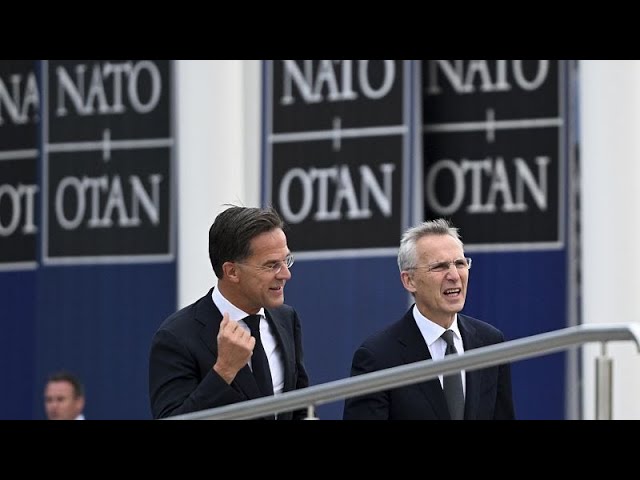
On the sidelines of the World Economic Forum in Davos, Donald Trump met with NATO Secretary General Mark Rutte on 21 January 2026. He then made a surprise announcement that a ‘great solution’ was in sight: a framework agreement had been reached, so the tariffs planned for 1 February would not be imposed for the time being.
Rutte confirmed that there was a rough plan and that further talks would follow. According to information from participants, the draft consists of four points: First, Washington will refrain from imposing the planned punitive tariffs for the time being; second, the 1951 stationing agreement is to be revised, taking into account the ‘Golden Dome’ missile defence project for a greater US presence in the Arctic; Thirdly, the US will have a say in investments in Greenland in order to prevent influence from China and Russia. Fourthly, European NATO countries will commit to greater involvement in the Arctic.
However, many questions remain unanswered. Neither Trump nor Rutte mentioned the sensitive issue of sovereignty, which Rutte said was ‘not an issue’. Observers therefore warn that this is merely a rough draft. European governments are urging caution and view the turnaround more as a respite. The EU special summit on the customs crisis is to take place despite the supposed deal in order to discuss a joint strategy.
Why Greenland is so coveted
Greenland is the world's largest island, rich in rare earths, gold, diamonds, uranium, zinc, lead and potential oil and gas reserves. Strategically located on the shortest route between North America and Europe, it already hosts a US air force base with an early warning system for ballistic missiles. Climate change is opening up new shipping routes, making the Arctic more economically attractive. For Washington, it is crucial that no other major power gains a foothold on the island. The Biden administration has already agreed on extensive access to the base in stationing agreements with Denmark; expansion would be possible even without a change of ownership.
Greenlanders say no – the people are fighting back
While politicians haggle over geopolitical treaties, the people of Greenland are speaking out. A survey conducted by the opinion research institute Verian on behalf of the Greenlandic newspaper Sermitsiaq and the Danish daily Berlingske found that 85 per cent of residents reject integration into the US; only six per cent would agree to annexation, while nine per cent are undecided. Deutschlandfunk also reported on a survey according to which 85 percent of Greenlanders reject the US plans.
Former head of government Múte B. Egede already stated in early 2025: "We don't want to be Danes. We don't want to be Americans either. We want to be Greenlanders." This statement sums up the mood of many citizens who have been campaigning for greater independence from Denmark for years but do not want to accept a new colonial ruler. Greenland's current head of government, Jens-Frederik Nielsen, is also pursuing a cautious path to independence. On 17 January 2026, under his leadership, thousands of demonstrators marched to the US consulate in Nuuk to protest against Trump's claims.
Europe between dependence and self-assertion
The Greenland dispute highlights how dependent European security is on the US. Several guests on the ZDF talk show ‘Maybrit Illner’ pointed out that Europe would not be viable today without NATO; the US provides the nuclear umbrella and many important capabilities. Experts therefore warned against an escalation that could lead to a breakdown of the alliance. On the programme, CDU foreign policy expert Norbert Röttgen remarked: ‘What is he supposed to do if the Greenlanders say no? Should he send 10,000 soldiers into the ice?’ Former Foreign Minister Annalena Baerbock, now President of the UN General Assembly, referred to the United Nations Charter: states have no right to invade the territory of other states, and the law of the strongest must not apply.
Nevertheless, there is a growing desire in Europe to become more independent. During Trump's first term in office, the EU laid the foundation for a European defence union with the ‘Permanent Structured Cooperation’ (PESCO). But true military sovereignty is still a long way off; many states fear they would be vulnerable without US support. At the same time, observers point out that Trump's pressure could also be directed against European regulations such as digital taxes or data protection guidelines.
Analysis and short-term outlook
The announcement of a framework agreement in Davos has defused the conflict over Greenland, at least for the time being. However, the alleged deal is based on vague wording. The central issue of sovereignty has been left out, and even US negotiators admit that the details still need to be worked out. The four agreed pillars – suspension of tariffs, reassessment of the stationing agreement, US say in investments and stronger European engagement – could be delayed indefinitely in practice. As long as Washington is not granted the right to annexation, Trump will continue to exert pressure.
For the EU, it remains a balancing act: on the one hand, it does not want to jeopardise its most important economic relations with the US; on the other hand, it must show that it defends the sovereignty of its members and partners. The conflict has reignited the debate on European autonomy. At the same time, cracks in the transatlantic partnership will not heal by themselves.
Meanwhile, the people of Greenland have made it clear that they are not prepared to sell their island. As long as this attitude persists, Trump will not be able to impose his will without resorting to massive force. And as Norbert Röttgen mockingly asked on a talk show, this would probably require sending 10,000 soldiers into the snow – a scenario that is not very popular even in Washington. In this respect, it seems likely that the dispute over Greenland will continue to strain transatlantic relations until a solution is found that respects both the security interests of the US and the sovereignty of the island's inhabitants.