RYCEF
0.4000
China's attempt to buy its way out of Nvidia's orbit has reached a revealing moment. The country is no longer short of chip projects, state funds or data-centre blueprints. It is short of the one thing industrial policy cannot order into existence on a deadline: a complete, efficient and trusted computing platform.
That distinction matters because the phrase silicon bubble can easily be misunderstood. China's semiconductor campaign has not failed, and its domestic AI hardware industry is not disappearing. Huawei, Alibaba, Baidu, Cambricon and a growing field of specialist designers are shipping real products in meaningful volumes. Chinese accelerators accounted for about 41 per cent of the country's AI accelerator server market in 2025. DeepSeek has shown that advanced models can be designed around severe computing constraints, and its latest systems have strengthened the commercial case for Huawei's Ascend platform.
The bubble lies elsewhere. It is the belief that enough capital, deployed fast enough, can reproduce Nvidia's advantages within a few investment cycles. It is also the belief that every provincial computing centre, every newly listed graphics processor company and every heavily subsidised fabrication project will earn an economic return. That proposition is now colliding with weak utilisation, duplicated investment, supply bottlenecks and valuations that have often moved far ahead of revenue. The result is not a sudden implosion. It is a reckoning.
The bill for strategic independence
China's expenditure on semiconductor autonomy is vast, even before corporate investment and local subsidies are counted. The third phase of the state-backed China Integrated Circuit Industry Investment Fund was established with registered capital of 344 billion yuan. It is slightly larger than the first two phases combined. Across all three phases, registered capital exceeds 686 billion yuan. AI infrastructure has added another layer. State funding for Chinese AI data centres has exceeded 100 billion dollars since 2021. Thousands of computing centres have been licensed, many of them backed by local governments eager to attach themselves to the next strategic industry. A further blueprint under discussion envisages roughly 2 trillion yuan of national data-centre investment over five years, with state telecoms groups operating much of the network and domestic suppliers providing most of the technology.
This spending has created assets at extraordinary speed. It has also repeated a familiar weakness in China's investment model. Local authorities are rewarded for announcing projects, securing land, arranging finance and meeting construction targets. They are not always rewarded with equal force for proving that a facility has enough customers, the right chips, suitable software or a commercially sensible power profile.
By the middle of 2025, at least 7,000 computing centres had been licensed. A nationwide review followed as unused capacity and financially fragile projects became harder to ignore. The proposed answer was to connect surplus computing power through a state-coordinated cloud system. That may improve utilisation, but it also reveals the underlying problem. Computing capacity is not a uniform commodity. A cluster built with one accelerator, network architecture and software stack cannot always absorb a workload designed for another. Latency, data location, security rules and the cost of rewriting code further limit the value of spare capacity.
China therefore faces an unusual combination: too much undifferentiated computing infrastructure in some places, and too little frontier-class computing in the laboratories and companies that need it most.
The moat around Nvidia
Nvidia's position is often described as a chip monopoly. That is incomplete. Its real advantage is a system composed of processors, high bandwidth memory, networking, interconnects, compilers, libraries, development tools and years of accumulated engineering practice. CUDA remains central, but the moat extends well beyond a programming language. It includes the ability to make thousands of accelerators behave as one dependable machine and to keep that machine busy.
This is why comparisons based on peak arithmetic performance can mislead. A domestic accelerator may approach or exceed an older Nvidia product on a selected workload, yet deliver less useful output once cluster efficiency, memory movement, software compatibility, power consumption, debugging time and failure rates are included. For a cloud operator, the decisive measure is not the specification sheet. It is the amount of billable work completed per unit of capital, electricity and engineering labour.
Huawei has made the strongest progress in closing that systems gap. Its Ascend chips and large supernode designs compensate for limitations at the individual processor level by connecting more devices at scale. The approach is technically credible and increasingly deployable. It is also demanding. More processors, more networking equipment and a less mature software environment can increase power use, operational complexity and staffing requirements.
Other Chinese vendors face an additional obstacle: fragmentation. Alibaba's T-Head, Baidu's Kunlunxin, Cambricon, Moore Threads, MetaX, Biren, Iluvatar CoreX and Enflame all contribute to substitution, but each platform introduces its own tools and migration costs. A protected domestic market can support several suppliers during an early expansion. Over time, however, customers will resist paying repeatedly to port, test and optimise the same models.
This is where Nvidia's absence becomes both an opportunity and a discipline. Domestic suppliers gain guaranteed demand, especially in state-funded projects, but they also lose the convenient benchmark of competing for customers who can freely choose the global market leader. Procurement rules can create revenue. They cannot by themselves create developer loyalty.
The H200 contradiction
The clearest evidence of China's unfinished escape from Nvidia is the continued appetite for Nvidia hardware among its largest technology groups. Beijing has spent years promoting domestic substitution and has restricted foreign chips in state-funded infrastructure. Yet it has also considered allowing Alibaba, ByteDance, DeepSeek and other leading companies to buy a limited number of H200 accelerators. The latest plan under consideration could permit fewer than 200,000 H200 chips, less than half the quantity previously sought. Even a restricted allocation would be strategically revealing. China's strongest AI companies are not asking for imported chips out of habit. They are asking because frontier model training still rewards the performance, memory bandwidth, networking and software maturity of Nvidia's platform.
This does not mean domestic substitution has stalled. In calendar 2025, Chinese vendors shipped about 1.65 million AI accelerator cards, while Nvidia shipped roughly 2.2 million and retained an estimated 55 per cent share. By the end of Nvidia's 2026 financial year, however, the company described itself as effectively excluded from China's data-centre computing market. The apparent contradiction reflects different periods, different product categories and a rapidly changing policy environment.
The strategic direction is clear even when individual licensing decisions shift. China wants domestic chips to become the default, particularly for government-backed infrastructure and high-volume inference. At the same time, it does not want its most capable model developers to fall further behind because the best available domestic systems cannot yet satisfy every training workload. That tension will persist. Total separation is politically attractive, but technological competition punishes self-imposed scarcity.
DeepSeek changed the arithmetic
DeepSeek's rise altered the debate because it demonstrated that algorithmic efficiency can substitute for part of the brute force traditionally supplied by larger clusters. Its technical report for DeepSeek V3 recorded 2.788 million H800 GPU hours for full training and placed the compute cost of the final training run at about 5.6 million dollars. That number became a symbol of Chinese efficiency. It was also widely overinterpreted. It did not represent the full expense of the company, the cost of earlier experiments, salaries, data preparation, failed runs, infrastructure, inference or the acquisition of its underlying chip inventory. DeepSeek did not prove that frontier AI could be built for a few million dollars. It proved that careful architecture, sparse activation, engineering discipline and lower-cost hardware could materially reduce the cost of a successful training run.
The distinction is crucial for investors. If model developers can achieve more with less compute, the revenue assumptions behind every planned data centre and every accelerator start-up become harder to defend. A facility that was justified by forecasts of endlessly rising training demand may find that customers need fewer premium GPU hours than expected. A chip company valued on scarcity may discover that its buyers can optimise around the shortage.
At the same time, efficiency can expand the market. Lower costs make AI services cheaper, encourage more applications and shift spending from occasional training runs towards continuous inference. This is the paradox at the centre of the current cycle. DeepSeek weakens the case for indiscriminate infrastructure spending while strengthening the long-term case for a broad AI economy.
Its later development also complicates any simple claim of failure. DeepSeek's V4 model was adapted closely to Huawei's Ascend architecture, and Huawei processors were used in part of the training process. The launch triggered a surge of interest in the Ascend 950 series among major Chinese technology companies. DeepSeek is also developing an inference chip of its own, although that effort remains at an early stage and still faces the same foundry and memory constraints as other Chinese designers.
A seven-hour service outage in March exposed operational strain, but it did not invalidate the company's technical achievements. Fast-growing AI services fail for many reasons, including software updates, networking problems and sudden demand. The more useful conclusion is that model quality, chip availability and reliable service delivery are separate capabilities. China has advanced rapidly in the first, is making uneven progress in the second and is still learning to industrialise the third at global scale.
Progress with hard limits
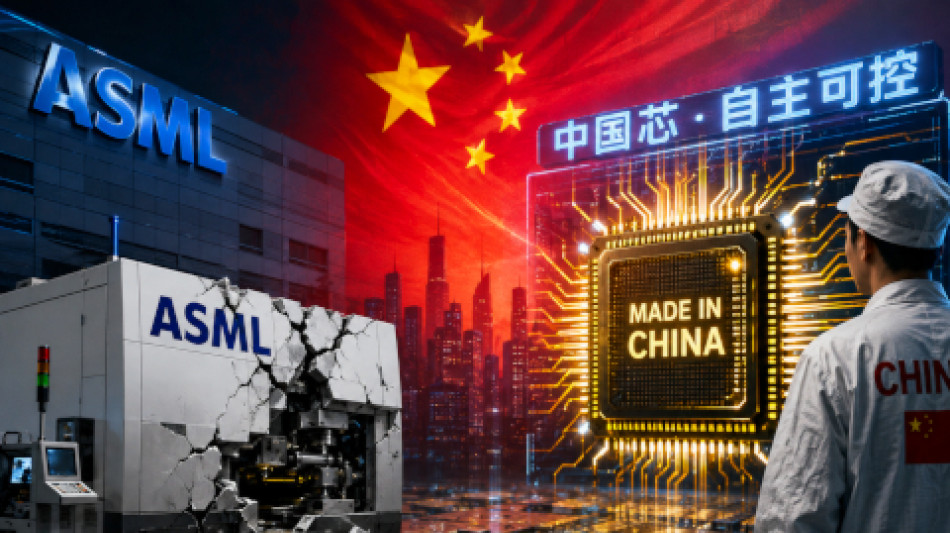
The most serious obstacles are no longer confined to chip design. They run through the entire supply chain. Advanced AI processors require leading-edge fabrication, high yields, sophisticated packaging and large quantities of high bandwidth memory. China can design accelerators that are competitive for selected tasks, but manufacturing them consistently and in volume is more difficult. Restrictions on advanced lithography equipment and overseas foundries constrain the available process technology. High bandwidth memory remains a particularly stubborn bottleneck because it requires both advanced memory production and complex packaging.
Domestic foundries can compensate through engineering ingenuity, larger systems and aggressive optimisation, but compensation has a cost. Lower yields raise unit economics. More chips increase power demand and network complexity. Limited memory constrains the size and speed of models. Delays in one component can strand investment in another.
These constraints explain why inference is becoming the preferred battlefield. Inference chips can be tailored to narrower workloads, designed around known models and deployed in large volumes without matching the full flexibility of Nvidia's most advanced training accelerators. ByteDance's interest in domestic processors from Huawei, Cambricon, Iluvatar CoreX and potentially Kunlunxin reflects this shift. It is a genuine commercial opening. Training remains the harder test. Frontier models demand large, tightly connected clusters, dependable software and the freedom to experiment across rapidly changing architectures. That is precisely where Nvidia's integrated platform delivers the greatest advantage and where the shortage of H200-class capacity is most painful.
When capital outruns commerce
China's policy has created a market for domestic chips. Capital markets have sometimes treated that protected demand as if it guaranteed attractive profits. Moore Threads entered the public market at a valuation equal to 123 times its 2024 sales after recording combined losses of about 5 billion yuan over three years. MetaX was priced at roughly 50 times its 2024 sales, then jumped about 700 per cent on its first day of trading despite holding only a small share of the domestic market. Valuation ambitions for other chip units have also multiplied far faster than their revenue.
Such pricing does not prove that the companies will fail. Semiconductor development is expensive, long term and unusually sensitive to scale. Early losses are normal, and strategic customers may support suppliers through several product generations. The danger is that investors confuse national importance with shareholder return.
A company can be valuable to China's security strategy and still destroy private capital. A factory can improve supply resilience and still operate below an economic rate of utilisation. A domestic accelerator can be good enough to meet a procurement mandate and still be too costly for an open commercial market. This gap between strategic and financial value is the centre of the bubble. Beijing may rationally accept duplication and low returns as the price of resilience. Investors buying highly valued shares do not have the same protection. Their return depends on margins, repeat customers, manufacturing access and sustained software adoption.
The next phase will therefore favour companies with captive demand, strong balance sheets and control over more than one layer of the stack. Huawei is best placed because it combines chips, systems, networking, cloud services and a large engineering organisation. Alibaba and Baidu can design hardware around their own models and cloud workloads. Smaller suppliers will need a distinct technical niche, a large anchor customer or consolidation.
A harder phase begins
The bursting of China's silicon bubble should not be confused with the end of China's semiconductor ascent. The country has already built a durable domestic market, trained large numbers of engineers and reduced its exposure to a single foreign supplier. Export controls have slowed access to the frontier, but they have also accelerated procurement, financing and software work that might otherwise have remained marginal. What is ending is the easy phase, when announcing a project could be mistaken for creating capability, and when a shortage of Nvidia chips could lift almost any domestic alternative. The next phase will be judged by utilisation, yield, software adoption, power efficiency and cash generation. It will be less spectacular and more consequential.
China is unlikely to escape Nvidia completely in the near term. A more probable outcome is a dual system. Imported Nvidia hardware will be used where licences permit and where frontier training justifies the political and financial cost. Domestic accelerators will take a growing share of inference, public-sector computing, industrial AI and workloads that can be optimised for a specific platform. Custom chips from model developers will add another layer.
That settlement would still represent a major strategic loss for Nvidia. A market once dominated almost completely by one supplier is becoming structurally plural, and Chinese developers are learning to build around restrictions rather than wait for them to disappear. Yet it would also confirm the central lesson of the past several years: replacing Nvidia is not a matter of copying a processor. It means recreating an ecosystem.
China's billions have bought time, capacity and resilience. They have not bought an exemption from the economics of semiconductors. The projects that survive will be those that turn political urgency into dependable products and dependable products into repeatable revenue. The rest will become evidence that even a strategic industry can be overbuilt. The bubble is not bursting because China has stopped trying. It is bursting because the market has begun to distinguish ambition from execution.