Zürcher Nachrichten - Rip-offs at the petrol pump?

EUR -
AED 4.234455
AFN 76.098978
ALL 93.355439
AMD 420.285222
AOA 1058.469724
ARS 1714.008452
AUD 1.639998
AWG 2.075431
AZN 1.956048
BAM 1.953846
BBD 2.314296
BDT 141.888125
BHD 0.433271
BIF 3409.805301
BMD 1.153017
BND 1.474751
BOB 13.644534
BRL 5.853524
BSD 1.149036
BTN 109.541893
BWP 15.667402
BYN 3.342572
BYR 22599.134983
BZD 2.310999
CAD 1.617972
CDF 2623.113712
CHF 0.932826
CLF 0.026966
CLP 1064.753984
CNY 7.784364
CNH 7.786682
COP 3615.031425
CRC 521.882692
CUC 1.153017
CUP 30.554953
CVE 110.156287
CZK 24.211399
DJF 204.61629
DKK 7.475024
DOP 66.66392
DZD 153.149529
EGP 59.173759
ERN 17.295256
ETB 183.619494
FJD 2.552722
FKP 0.855386
GBP 0.855994
GEL 3.015164
GGP 0.855386
GHS 13.432743
GIP 0.855386
GMD 84.748706
GNF 10086.957729
GTQ 8.767348
GYD 240.362787
HKD 9.04245
HNL 30.788348
HRK 7.533351
HTG 150.246934
HUF 364.183866
IDR 20741.624449
ILS 3.531633
IMP 0.855386
INR 109.721373
IQD 1505.288325
IRR 1585542.627216
ISK 142.005664
JEP 0.855386
JMD 181.907321
JOD 0.817498
JPY 180.481814
KES 148.853615
KGS 100.831094
KHR 4649.572652
KMF 492.338702
KRW 1647.817137
KWD 0.356444
KYD 0.957547
KZT 544.477934
LAK 26022.318653
LBP 102900.855012
LKR 385.739315
LRD 207.401718
LSL 19.005943
LTL 3.40456
LVL 0.697448
LYD 7.351681
MAD 10.734107
MDL 20.080183
MGA 4914.107663
MKD 61.463542
MMK 2420.824769
MNT 4144.56416
MOP 9.282578
MRU 46.180225
MUR 54.249696
MVR 17.825371
MWK 1992.41641
MXN 19.969677
MYR 4.715604
MZN 73.689228
NAD 19.005778
NGN 1568.771776
NIO 42.287899
NOK 10.939653
NPR 175.265511
NZD 1.958198
OMR 0.443199
PAB 1.149026
PEN 3.894106
PGK 5.144878
PHP 70.320162
PKR 319.118096
PLN 4.307269
PYG 6851.179173
QAR 4.200455
RON 5.248186
RSD 117.273246
RUB 91.498579
RWF 1686.820652
SAR 4.315315
SBD 9.317652
SCR 15.571531
SDG 691.810534
SEK 10.968537
SGD 1.477378
SLE 28.486023
SOS 656.640573
SRD 43.562709
STD 23865.12585
STN 24.475633
SVC 10.053991
SZL 19.003081
THB 38.415055
TJS 10.605549
TMT 4.04709
TND 3.377966
TRY 54.813854
TTD 7.802232
TWD 37.190547
TZS 3045.737304
UAH 51.285342
UGX 4314.741794
USD 1.153017
UYU 46.23357
UZS 13754.306627
VES 859.800697
VND 30309.36027
VUV 136.851421
WST 3.152915
XAF 655.304599
XAG 0.019812
XAU 0.000284
XCD 3.116086
XCG 2.070838
XDR 0.814989
XOF 655.304599
XPF 119.331742
YER 274.763661
ZAR 18.999766
ZMK 10378.514816
ZMW 21.584511
ZWL 371.271033
  • CMSC

    0.0300

    21.84

    +0.14%

  • RBGPF

    0.0000

    69.21

    0%

  • VOD

    -0.3600

    15.78

    -2.28%

  • RIO

    -0.3300

    96.85

    -0.34%

  • AZN

    -1.7000

    169.64

    -1%

  • BCE

    -0.0200

    21.68

    -0.09%

  • BTI

    -1.0400

    60.65

    -1.71%

  • GSK

    -0.3800

    51.69

    -0.74%

  • NGG

    -0.4200

    79.97

    -0.53%

  • RYCEF

    -0.3100

    19.55

    -1.59%

  • CMSD

    0.0900

    22.11

    +0.41%

  • BCC

    1.0000

    76.38

    +1.31%

  • JRI

    0.0900

    12.96

    +0.69%

  • RELX

    -1.1900

    35.42

    -3.36%

  • BP

    1.0000

    45.22

    +2.21%

Rip-offs at the petrol pump?

Rip-offs at the petrol pump?

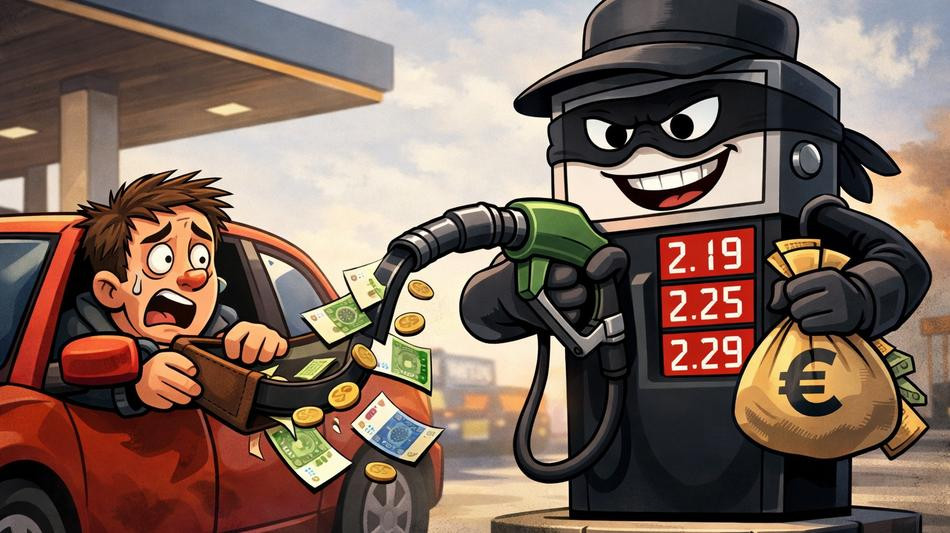
Fuel prices in Germany have become a political flashpoint. Since war broke out in Iran and the Strait of Hormuz was temporarily closed, global oil prices have surged. Crude oil quotations rose by around 20 percent to 84 dollars a barrel, and the wholesale price of diesel in Rotterdam climbed by 26 cents per litre – almost 50 percent. As a result, German motorists were paying an average of Euro 2.156 per litre for diesel and Euro 2.037 for Super E10 in mid‑March 2026.

Petrol‑station leaseholders emphasise that they do not set their own pump prices. The industry’s lobbying group accuses the oil majors of selling fuel they bought cheaply at a huge mark‑up – behaviour described as “predatory capitalism”. Leaseholders receive none of the extra margin yet face the anger of customers. Convenience‑store sales are also collapsing because angry motorists buy nothing after filling up.

Chancellor Friedrich Merz’s government has responded with a package of measures. Filling stations may raise prices only once a day at noon; price cuts are allowed at any time. Part of the national oil reserve will be released, and the competition authority will get more powers. Critics say this does not go far enough. The social welfare organisation SoVD warns that without a price cap consumers remain at the mercy of suppliers and calls for targeted relief for low‑ and middle‑income households. SPD politicians demand a price cap to ensure that consumers are not “fleeced”, while economy minister Katherina Reiche rejects the idea of a state‑financed fuel subsidy.

Text size:

Comments on social media reveal widespread anger. Many feel exploited by both oil companies and the state and question the government’s competence. Some want full transparency on profit margins and stronger oversight. Others blame decades of political failure – from delayed investment in electric‑vehicle infrastructure and slow improvements to public transport to tax policies that continue to inflate fossil‑fuel prices.

Political actors respond differently. The governing CDU points to global market forces. The Left Party demands a swift competition‑law probe. Green politicians and the environment ministry argue for a shift to battery‑electric cars to escape dependence on oil, while the SPD (Social Democratic Party of Germany) backs a price cap and social support. Despite the government’s package, many citizens believe Berlin is not acting decisively enough.

Public frustration has already translated into protests. Motorists report boycotting certain brands, filling up abroad or organising car‑sharing. Regional media report aggressive customers venting at station staff. Growing pressure may compel tighter regulation of oil companies, tax relief or a broader strategy for affordable mobility.