QR codes and cranes: Japan embraces modern cemeteries / Photo: Behrouz MEHRI - AFP
Masayo Isurugi settles into a booth on the sixth floor of a sleek Tokyo building, scans an ID card and waits for an automated system to deliver her late husband's ashes.
More and more people in Japan are breaking with traditions on burial and mourning, swapping hometown graveyards for modern takes on cemeteries.
As the 60-year-old waits in one of ten mourning booths on the floor, cranes behind the walls move almost silently and retrieve the "zushi" box with the urn containing her late husband Go's ashes.
Chic wooden doors inside the booth quietly part like an elevator at a luxurious hotel and a gleaming, dark-stone altar emerges with Go's zushi box as its centrepiece, while a photo of him appears on a monitor.
"Initially, I thought maybe these facilities might feel cold and that I might prefer a traditional grave on soil," Isurugi told AFP.
"Now I feel it's better to have a place where I can visit whenever I want and offer prayers, rather than having a family grave that I could rarely visit."
Her family considered a traditional cemetery, but it was a two-hour train ride away. The Kuramae-ryoen facility is only brief bus ride from Isurugi's house and she can visit after work.
Traditionally in Japan, cremated remains are placed in family tombs used over many generations and tended by the family's eldest sons.
But Japan's disproportionately greying population makes for an imbalance between the number of new graves needing tending and the young people willing and able to do it.
Families are increasingly moving to urban areas far from ancestral graveyards, and many elderly don't have sons who can take on the traditional responsibility.
- 'A new style' -
Tomohiro Hirose, resident monk at the temple that supervises the Kuramae-ryoen facility, has a traditional cemetery with some 300 graves.
"But about half of the graves no longer have anyone in the family to look after them," he told AFP.
To address the problem, a crop of modern, indoor cemetery facilities have emerged, offering to store remains for a set period, often up to three decades.
The ashes are eventually transferred to collective memorials, but individual names or QR codes are engraved on plaques to provide some personalisation, and monks pledge to continue offering prayers for the souls of the departed.
Facing a busy boulevard in the Japanese capital, Kuramae-ryoen features warehouse-style industrial stacking racks that can store 7,000 zushi boxes, each of which can hold two urns or the bagged ashes of up to eight people.
Hirose decided to build the site after the temple's old building was badly damaged in the 2011 earthquake.
He felt the new building, which includes a temple, his living quarters, and the cemetery facility, would revitalise a site that dates back to 1608.
"This offers a new style. Many families find it easy to visit their graves," Hirose said.
The cemetery uses machinery developed by Daifuku, a firm that produces storage, transport and collection systems for factories and warehouses.
"Our company has built systems for around 60 (cemetery) facilities across the country," said Hidenobu Shinnaka, a senior official at Daifuku.
The first order came in the 1990s, and more recently there has been interest from other Asian markets too, he said.
- 'A warm-hearted manner' -
Modern cemetery sites are not only often more convenient, but cheaper.
An average spot costs around $7,100, roughly half a traditional gravesite, according to Kamakura Shinsho, a company that helps connect customers with cemeteries.
Other modern cemeteries are not big enough to need machinery, but incorporate other novel features.
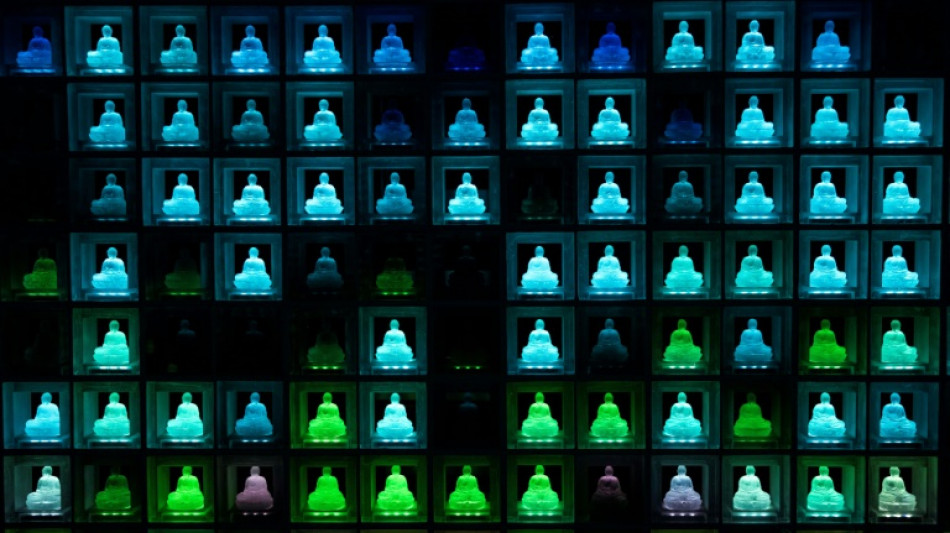
Kokokuji temple, founded in Tokyo in 1630, has created a unique octagon-shaped space with walls of floor-to-ceiling displays of individual glass Buddha statuettes.
Each of the statues -- over 2,000 in all -- symbolises an individual whose ashes are stored there. When visitors scan an ID or enter a family name, the Buddha assigned to their loved one is illuminated.
The entire display can also be lit, and the system can produce various mosaic patterns with different statues illuminated in a variety of colours to produce a calming ambience in the dim sanctuary.
The display is meant to show that each of us is surrounded by many more, and all will join Buddha in the after-life, said resident monk Taijun Yajima, who built the Ruriden facility with artists and engineers.
He says mourning remains the same even in modern cemeteries.
"Children should look after the graves and the souls of parents... But in some people's reality, it is simply not possible," he said.
"I thought about how those people can be laid to rest in a warm-hearted manner, and this is the answer."
T.L.Marti--NZN