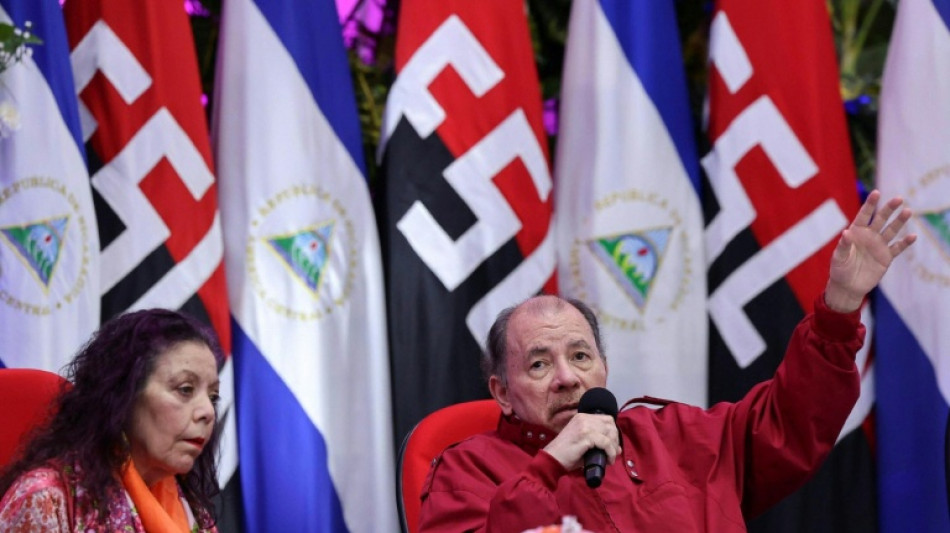
Nicaragua ramping up repression of exiles: UN experts / Photo: JAIRO CAJINA - El 19 DIGITAL/AFP/File
While ramping up its repression at home, Nicaragua's government is also going after exiles abroad, with hundreds if not thousands of people affected, UN investigators said Tuesday.
In a fresh report to be presented to the United Nations Human Rights Council next week, the experts also concluded that husband-and-wife co-presidents Daniel Ortega and Rosario Murillo, and other top officials, were "responsible for serious, systematic and widespread human rights violations".
Those violations, including "some amounting to crimes against humanity", were being committed "against a broadening segment of the population", the report warned.
The Nicaraguan government "has formalised repression through constitutional and legislative reforms, enabling generalised impunity by blocking any form of accountability and exposing victims and justice-seekers to severe reprisals", it said.
The independent UN Group of Human Rights Experts on Nicaragua, which was created by the rights council in 2022 to investigate allegations of widespread abuses in the country, highlighted the growing targeting of Nicaraguans in exile.
"The extension of the repression beyond the borders of Nicaragua has affected the lives of hundreds -- if not thousands -- of exiled Nicaraguans and their in-country relatives and associates," the report said.
- 'Stateless' -
The experts said that since 2023, the government has deprived 452 Nicaraguans of their nationality, while rendering possibly thousands of other exiles "de facto stateless" by refusing to renew or provide necessary documents, and barring many from re-entering the country.
The team of experts, who were mandated by the rights council but do not speak on behalf of the United Nations, also highlighted reports of "at least a dozen cases of killings or attempted killings of exiled critics".
One of them was Major Roberto Samcam, an exiled retired Nicaraguan army officer and fierce government critic, "who was shot eight times in his home in San Jose (Costa Rica) on June 19, 2025", the report said.
The preliminary investigation, the experts pointed out, "indicates that the homicide was carefully planned, following prior surveillance and threats against the victim, and bore the hallmarks of a contract killing".
The experts charged that Nicaragua's government was financing its expanding repression of opponents through the illegal diversion of public funds, creating a vast transnational surveillance and intelligence network.
That network had been used to monitor, intimidate and attack many of the hundreds of thousands of Nicaraguans who live abroad, the report found.
"Repression and institutional corruption have become the governing method in Nicaragua under the control of the Ortega-Murillo family," Jan-Michael Simon, who chairs the team, said in a statement.
"Political persecution is financed by the state, executed through its institutions, and extended across borders to ensure that no-one -- absolutely no-one -- stands in the way of the regime," he said.
- Ensure accountability -
The investigators, who said they relied on dozens of interviews and extensive documentary evidence for their report, found that government funding earmarked for social assistance and operational expenses had been "redirected to fund violent security operations".
They also highlighted allegations from a dozen sources that current co-foreign minister Valdrack Ludwing Jaentschke Whitaker had helped direct and coordinate transnational repression efforts while he served in senior diplomatic positions from 2021-2023.
"Diplomatic and consular structures have been instrumentalised to track, monitor and intimidate exiled Nicaraguans," team member Ariela Peralta said.
"This is a deliberate policy to eliminate dissent wherever it may be."
The experts called on Nicaragua's government to "take immediate steps to dismantle the architecture of repression", and to "ensure accountability, restore civic space, and take meaningful measures to guarantee the rights of all Nicaraguans, including those in exile".
R.Schmid--NZN