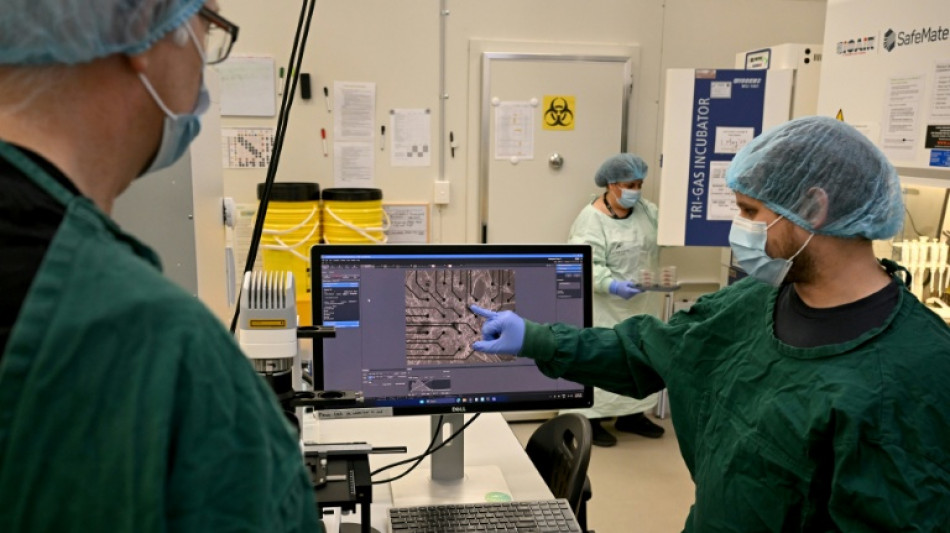
Australian researchers teach brain cells to play 'Doom' / Photo: William WEST - AFP
Australian researchers have trained lab-grown brain cells on a silicon computer chip to play the nineties shooter "Doom" and say they are just scratching the surface of what the neurons could be capable of doing.
It's the science-fiction work of biotech boffins at Cortical Labs, who researched and developed the technology that harnesses the workings of the brain's networking system.
Each so-called "biological computer" contains around 200,000 living human brain cells, grown from stem cells that were harvested from blood donations.
Having mastered the simple computer game "Pong", where a paddle is moved up and down to send a ball across a screen, the brain cells have moved on to bigger things.
Initially, the neurons were at the "level of a beginner who's never played a video game before," Alon Loeffler, Cortical Labs' senior application scientist, told AFP.
"Doom" involves a chaotic 3D game-world where the user is required to explore its surroundings and dispatch enemies -- no easy task for a clump of cells.
"They were walking into walls a lot, shooting the walls, turning around, doing funny things like that," Loeffler said.
"And then eventually they started targeting the enemies more regularly and correctly."
It's not the cleanest execution, however. One demon takes several attempts to slaughter, with shots fired in multiple directions before the target is hit.
But the mind-bending research proves the neurons can adapt to stimuli in real time and complete goal-directed learning, Cortical Labs say.
- 'Scratching the surface' -
The researchers converted the digital environment in "Doom" into patterns of electrical signals the neurons on the chip could understand.
When an enemy appears, specific electrodes stimulate the neurons on the special chip called a CL1, causing them to react.
Different patterns of neuron activity produce specific responses, such as firing the gun or moving left or right.
Researchers monitor the electrical activity of the neurons from a computer screen connected to the CL1, represented by thousands of tiny dots.
From this data, the team adjusts their input to influence and train the neuron's activity.
The CL1 isn't limited to computer games -- the chip can be coded to perform a range of applications, from drug screening to AI-like machine learning.
"We are just scratching the surface of what these neural cultures can achieve when integrated in systems like our CL1," said chief scientific and operations officer Brett Kagan.
"Our neural cultures have been explored for a variety of tasks," he said -- everything from "robotics, real-time learning tasks that are similar to AI, as well as healthcare, medicine, disease modelling, drug screening and even personalised medicine".
- Not 'wacky science' -
Kagan describes the CL1 chip as "a more sustainable and more powerful form of intelligence".
The human brain runs on an estimated 20 watts of power, a level of efficiency that silicon computing and artificial intelligence have not yet been able to replicate.
While it's "not aimed to replace what AI is doing" it's intended to "give us abilities that we've never had before", Kagan said.
The cells have a six-month lifespan and aren't yet capable of producing consistent, programmable results.
But analysts say the project's value could lie in its more sustainable power consumption compared to regular chips.
"We need better ways to manage that power envelope and get higher levels of efficiency," William Keating, CEO of semiconductor research company Ingenuity, said.
"This isn't wacky science or some bunch of scammers. This is real science and it's making real progress."
B.Brunner--NZN