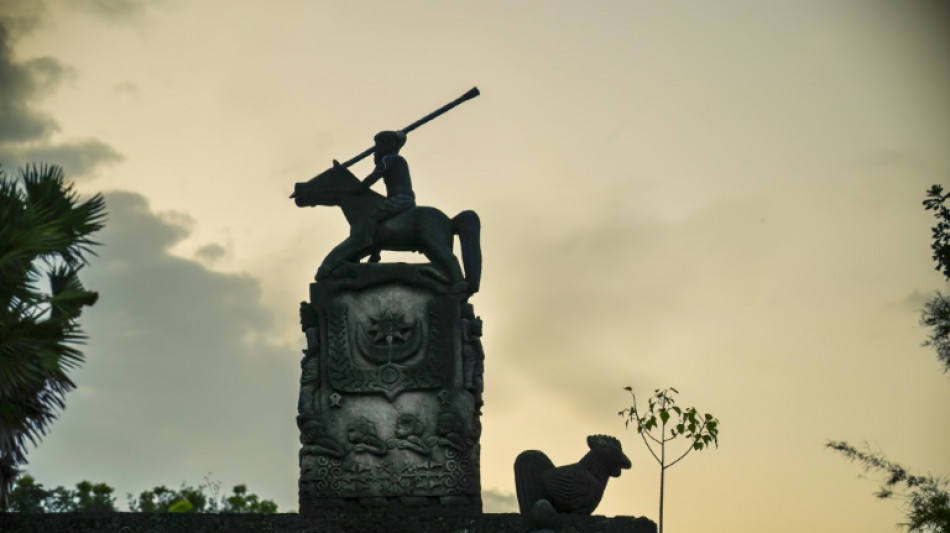
Inside Indonesia's slave island: 'I want my children to be free' / Photo: BAY ISMOYO - AFP
Two hours from the tourist beaches of Bali, slavery is alive and well on the Indonesian island of Sumba, where people are still born into bondage.
They work from dawn to dusk without pay, are passed on in marriage and are sometimes beaten and raped by their masters.
Yet most are resigned to their fate because their status "cannot be wiped away", as one young slave -- or "ata" -- Kanisius Kanyali Hambarita told AFP.
Slavery has been illegal in what is now Indonesia for more than 160 years, but it survives in Sumba's rigid caste system, particularly in the island's east.
Kanisius and his master Umbu Ana Rara, 31, who is three years younger than him, live in the village of Tenggedu, whose turquoise waterfalls draw intrepid tourists looking for a "hidden tropical paradise".
It is a place out of time, reached by a rocky road between arid hills and the sea where you have to dodge stray cows, goats and wild horses. There's no mobile phone signal and food is cooked over a wood fire.
Umbu Ana said he treats his slave "like a member of the family" as the two sat chewing betelnuts -- a mild stimulant that stains the gums red -- in the late morning heat, with chickens and geese wandering at their feet.
Both master and slave sleep on mats on the floor of one of the village's towering traditional thatched houses -- built to resemble buffalo horns -- that are often grouped around the tombs of the masters' ancestors.
Umbu Ana allows his "ata" to earn a little money as a motorcycle taxi driver and to grow his own food on a small plot of land.
"I don't object to it, that's how it is," said Kanisius of his status as a slave. "It's not a weight on our shoulders. It's only the symbol of a tradition inherited from our ancestors."
Others tell a different story away from their masters.
"I was beaten from childhood if I didn't work enough," said an ata in his 40s from the nearby village of Napu.
"They would hit me, throw water on me," he said, forcing him to work in the fields after school, feeding the pigs or cooking for his master.
"I tell my children: 'I don't want you to go through what I went through.'"
- From generation to generation -
Eight of out 10 of Sumba's population of 685,000 people are Christian, but its older "marapu" belief system, that blends animism and ancestor worship, has deep roots.
It divides society into three castes, "the nobles, called 'maramba' -- often large landowners -- ordinary people called 'kabihu' and the slaves/servants, the atas," said rights activist Martha Hebi, author of several studies on the subject.
The religion is "the essence of social stratification", marapu priest Umbu Remi Deta told AFP. Legend "says that the marambas acquired atas when they arrived in Sumba".
The island's isolation -- 2,000 kilometres east of the capital Jakarta -- has helped preserve these ancestral social structures.
Despite having the world's largest Muslim population, Indonesia is dazzlingly diverse. While slavery is banned under its 1945 constitution, written when the country broke free from Dutch colonial rule, some traditional customs are tolerated.
Estimates vary as to how many slaves are on Sumba. A social worker, who asked not to be named, told AFP there were "around 1,700" in East Sumba among a population of 350,000. But others put their number at several thousand.
Forced labour exists elsewhere in Indonesia, with temporary bondage practised by "the Dayak indigenous community in Kalimantan for debts," historian Bondan Kanumoyoso of the University of Indonesia in Depok told AFP.
But the slavery in Sumba is unique, he said, going from generation to generation, with masters and slaves living in similar conditions under the same roof.
If it wasn't for the atas' work-worn faces, it is often hard for outsiders to work out who is who.
- 'Droit de seigneur' -
The maramba masters have long underpinned the domination of their slaves with physical and sexual violence.
"The master can 'use' his maidservant," said pastor Marlin Lomi, the head of the influential Protestant synod of East Sumba, "and that is considered normal".
"If I like a female slave but she refuses me, I will beat her husband," said one maramba, who confirmed the practice to AFP on condition of anonymity.
"If you are a girl, you belong to the master," said Andy Yentriyani, a former head of the National Commission on Violence Against Women (Komnas Perempuan).
"So sexual intercourse is not considered rape. It is only using your authority (over) your belonging," she said.
The violence often goes unpunished "because the victims don't dare testify", said Hebi, who founded the NGO Solidarity for the Women and Children of Sumba (SOPAN).
- Raped by her 'master and his son' -
An 18-year-old slave who said she had been raped since she was 13 by her master and his son, reported them to the police in Waingapu, the capital of East Sumba, in 2024 after having a child.
But two years on the investigation still has not been concluded, said Dian Sasmita, of the Indonesian Child Protection Commission (KPAI), who urged the authorities "to shed light on these cases".
The young victim, initially taken in by an NGO, now lives under protection in her village.
Pastor Marlin, 57, said the Protestant synod also helps in cases of violence against women and children "if the victims speak up".
But the caste system is very deeply rooted, said Gidion Mbilijora, who was the "bupati" or head of the East Sumba district for 13 years, and who owns two atas himself.
"We need a long process of changing the mindset" of the nobles, he said during the enormous funeral of one of them close to the capital, to which 4,000 guests, including atas, were invited.
The funeral was marked by the ritual sacrifice of two horses as part of the marapu rite, which most inhabitants of Sumba still follow, whether Christian or Muslim.
Until the early 1990s, the police kept a close eye on such funerals for fear of human sacrifices, according to the American anthropologist Janet Hoskins.
In the not so distant past, marapu ritual required a slave be buried with his master.
- 'Declare them free' -
Rights groups like Amnesty International and Human Rights Watch have urged Jakarta to enforce its constitutional ban on slavery as well as anti-discrimination conventions it has signed. Amnesty Indonesia's Haeril Halim said the government "is aware of the situation in Sumba" but "has so far taken no measures to eliminate slavery".
Indonesia should "declare the freedom of all ata people from their maramba masters," added Andreas Harsono, of Human Rights Watch Indonesia.
The country's human rights minister Yusril Ihza Mahendra said that while the constitution bans slavery, "Indonesia is a highly plural society, and social development differs among ethnic groups.
"The government does not wish to impose change suddenly -- rather it follows the social development of each community step by step," he told AFP. "We are convinced that education will change everything."
Former district head Gidion echoed this almost exactly. With the local elite almost entirely drawn from the nobles -- most of whom own slaves -- he said change will only "come step by step".
"I think it will definitely change... advances in knowledge will enable people of the lower class to realise... that this social bond is no longer appropriate," he added.
Some nobles have tried to improve the atas' lot.
"One way of reforming this rigid system is to start with our own families," said Norlina Rambu Jola Kalunga, 54, a noblewoman who inherited five atas when she married the son of a royal family.
The 54-year-old pastor, a former rector of the Christian University of Sumba, wants atas to be emancipated.
But she cannot free her own because it would go against custom, even though her grandfather "granted freedom to all the atas" when he was leader of the Protestant community in neighbouring Central Sumba.
- Independent, but still a slave -
Another maramaba noblewoman Tamu Rambu Margaretha -- widely known as Mama Margaretha -- has long sought to loosen the bonds of slavery in her village of Prailiu, even travelling to Jakarta to advocate emancipation.
She sent all her atas to school along with her children because "if someone is illiterate, there are many things they won't understand."
Her son Umbu Remi, the marapu priest, runs a gallery where 20 local women, several of them atas, sell their spectacular "ikat" handmade textiles -- which take months to weave and dye -- to passing tourists.
Mama Margaretha and her atas and their children live together in several traditional houses, which look like tall witches' hats, ranged around her family's tombs. She provides for them and they tend her land and livestock.
She said she would "not oppose" her atas leaving her, saying it would be "fine" if they "ran away on their own".
But lacking any real means, none have.
Even those atas who try to break away often find themselves shackled to their old masters.
Having been used and abused throughout his youth, the man from the village of Napu raised his family outside of the household of the maramba who beat him in a house his old master no longer used.
He even managed to send two of his four children to university with the help of government grants by selling livestock he reared by himself.
But the land where he grows corn, cassava and vegetables is still his master's, so "when they need us, we go. If not, we do not."
"It's so easy for them to order us around. But I did not directly fight back. I made my own path. I could see what freedom looked like," he told AFP.
"Now there are rules... laws that protect us. Maybe the maramba understands that, so they do not bother us too much anymore."
He is still a slave but he dreams that his children will be "free from the maramba... If we have knowledge, then we are free."
T.Furrer--NZN