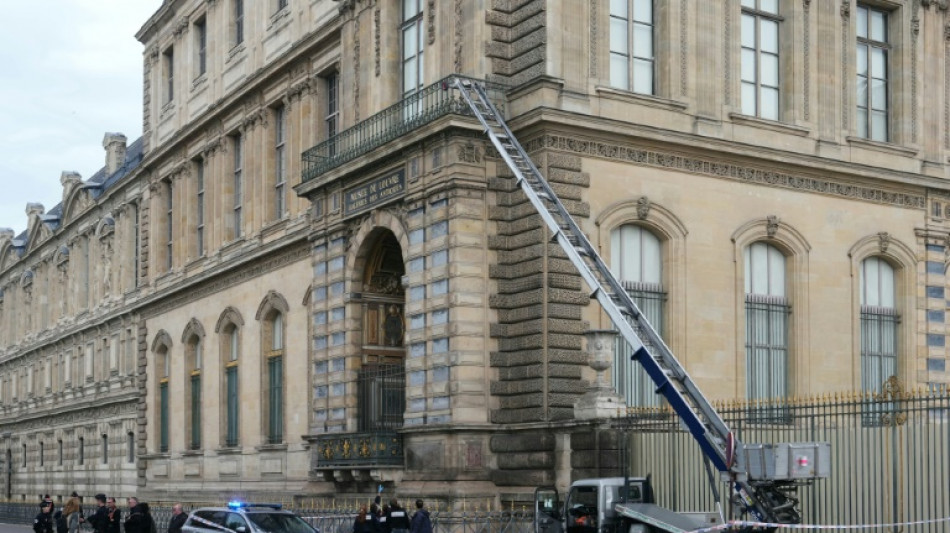
Louvre heist gallery reopens to public, but with nothing to steal / Photo: Dimitar DILKOFF - AFP
The glittering, vaulted gallery targeted by thieves at the Louvre last October reopened to the public on Wednesday, becoming a novel attraction for tourists even though its priceless exhibits have been removed.
The Apollo Gallery, one of the most lavishly decorated rooms of the world's most visited museum, was previously known for displaying the French crown jewels.
But after eight items valued at around $100 million dollars were stolen during a daylight heist last year, it became globally famous as the scene of one of the most daring -- and embarrassing -- burglaries of recent times.
"For me it's an honour to be here on the first day, in the morning," Jenny Lee, a 34-year-old guide for Korean tourists, told AFP.
The robbery is "new history for the Apollo Gallery".
"It's beautiful, as I remember it. I think I prefer it empty, without the jewels," Alison Leslie, a 52-year-old retired police officer from Scotland, told AFP.
Even though the four suspected Louvre robbers have been arrested, the stolen items have have still not been found despite extensive searches by French investigators in the Paris region and exchanges with police in Belgium, Italy and beyond.
The remaining jewels have been removed from the Apollo Gallery and will be displayed in the future in a secure room with no windows.
The thieves used a truck-mounted lift to gain access to a balcony of the gallery before slicing through the windows and glass display cases with powerful disc cutters.
The security vulnerabilities of the gallery, due to its balcony and road-side location, had been flagged in a 2019 audit ordered by the museum, but the findings were never acted on.
- Changes -
The burglary stunned the world, embarrassed France and revealed a series of security lapses, including the museum's old-fashioned CCTV system.
It also triggered an internal crisis, leading to protests from employees and the resignation of the museum's first woman president, Laurence des Cars.
Des Cars was replaced in February by Christophe Leribault, an art historian who previously ran the Versailles Palace outside Paris.
The four men suspected of robbing the Louvre were arrested by police in the weeks afterwards, all of them men from the Paris region with criminal backgrounds ranging from robberies to pimping.
Several of them have admitted taking part, but say they were acting on the orders of a supposed mastermind and denying that they knew they were breaking into the Louvre.
They have refused to give details about the alleged ringleader out of fear of reprisals, but investigators are reportedly unsure if such a figure exists.
One theory is that the gang conceived of the plan themselves, acting for financial gain.
The Louvre, home to the Mona Lisa, welcomed around nine million visitors last year, far above its intended capacity which has led to overcrowding problems.
R.Schmid--NZN