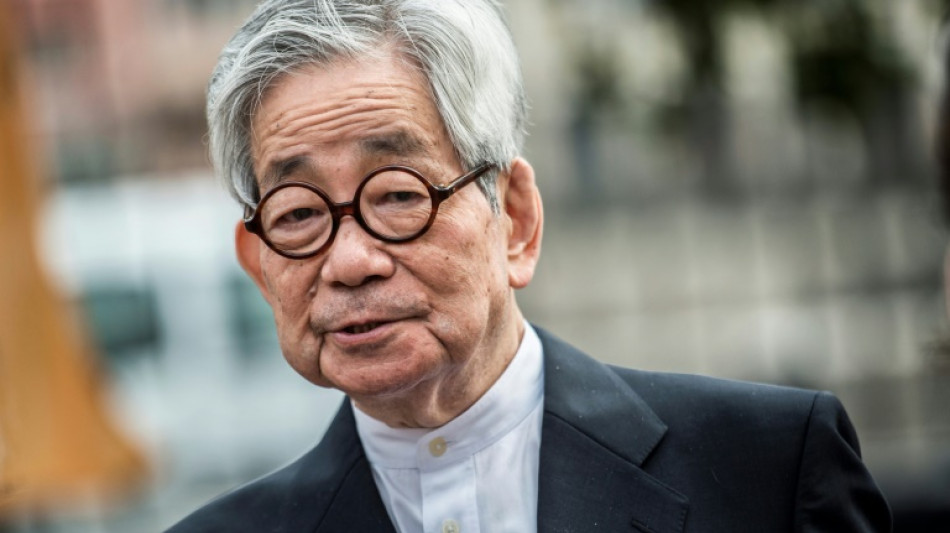
Kenzaburo Oe: novelist who won Nobel with 'poetic force' / Photo: Jeff PACHOUD - AFP/File
Nobel-winning Japanese novelist Kenzaburo Oe, a leading liberal voice who defended the disenfranchised and challenged the conformity of modern society, has died aged 88.
"He died of old age in the early hours of March 3," publisher Kodansha said in a statement on Monday, adding that a family funeral has already been held.
Known for his pacifist and anti-nuclear views, Oe saw himself as part of a generation of writers "deeply wounded" by World War II, "yet full of hope for a rebirth".
His esoteric stories, influenced by French and American literary culture, confronted issues from perceptions of disability to the disconnect between village traditions and big-city life.
"With poetic force (Oe) creates an imagined world, where life and myth condense to form a disconcerting picture of the human predicament today," the Nobel panel said when it awarded him the 1994 literature prize.
Born in 1935, Oe grew up in a forested valley on Japan's western Shikoku island, a remote setting which he frequently evoked in his writing as a microcosm of humanity.
Growing up, his mother and grandmother would recount legends passed down through the community about defiant local uprisings.
But his young life was also marked by the war, with his school days dominated by militarist propaganda.
That all changed after Japan's 1945 surrender, and Oe soon became fascinated by the democratic principles espoused by the occupying US forces.
In his Nobel lecture, the writer described the tensions between the country's indigenous culture and its rapid postwar westernisation.
"Present-day Japan is split between two opposite poles of ambiguity," he said.
"I too am living as a writer with this polarisation imprinted on me like a deep scar."
- Peripheral vision -
Oe left his village to study French literature at the University of Tokyo, immersing himself in existentialist philosophy and Renaissance humanism.
He began writing fiction while still a student, and in 1958 won Japan's prestigious Akutagawa Prize for young authors with "The Catch" -- about a Black American pilot taken captive by Japanese villagers during World War II.
The same year, Oe published his first full-length novel "Nip the Buds, Shoot the Kids", a fable about teenage boys left to fend for themselves after being evacuated during the war.
From the outset, he vowed his work would focus "on the peripheries" of society and promised to never collaborate "with those at the centre of things, who have power", he said in an interview in the mid-2000s.
In 1963, Oe's personal life was upended by the birth of his son Hikari, meaning "light" in Japanese, who has intellectual disabilities.
Writing and living with Hikari are activities which "overlap and enrich each other", Oe said. "It's something that shapes my imagination."
Oe published a series of novels that drew on his family situation, including 1964's "A Personal Matter", in which a troubled young father struggles to come to terms with the birth of his disabled son.
- Anti-nuclear activist -
After Hikari was born, Oe attended an anti-nuclear conference in Hiroshima, where he met survivors of the 1945 attack who, in his words, "never surrendered to any situation".
It strengthened the author's resolve to accept his own family circumstances, and he documented the survivors' accounts in the 1965 essay "Hiroshima Notes".
Oe's anti-conformist stance has at times angered Japanese nationalists, and he was threatened with assault in the 1960s over a novella about a far-right teenage terrorist.
The writer was also sued for defamation over a passage in his "Okinawa Notes" that recounted the forced mass suicide of civilians by the Japanese military. The long trial concluded in his favour in 2011.
In his later years, Oe campaigned ardently against nuclear energy, for the rights of people with disabilities and against the revision of Japan's pacifist constitution.
His staunch ideals also led him to turn down Japan's Order of Culture in 1994, an award ceremonially presented by the emperor.
"I would not recognize any authority, any value, higher than democracy," he explained to The New York Times.
Oe is survived by his three children, including Hikari, who is a successful composer.
F.Schneider--NZN