Zürcher Nachrichten - How a Bronze Age rock became a 'treasure map' for researchers

EUR -
AED 4.333813
AFN 76.694218
ALL 96.458833
AMD 446.314032
ANG 2.112139
AOA 1081.980314
ARS 1707.917161
AUD 1.690045
AWG 2.126794
AZN 2.003739
BAM 1.952934
BBD 2.375244
BDT 144.108487
BGN 1.981511
BHD 0.44482
BIF 3480.691272
BMD 1.179913
BND 1.500298
BOB 8.149074
BRL 6.203154
BSD 1.179284
BTN 106.725812
BWP 15.530272
BYN 3.367657
BYR 23126.298749
BZD 2.371789
CAD 1.613112
CDF 2595.809277
CHF 0.916244
CLF 0.025684
CLP 1014.158893
CNY 8.186472
CNH 8.190893
COP 4281.598231
CRC 584.622111
CUC 1.179913
CUP 31.2677
CVE 110.098739
CZK 24.379723
DJF 209.694622
DKK 7.466733
DOP 73.981728
DZD 153.072875
EGP 55.339571
ERN 17.698698
ETB 182.70601
FJD 2.604184
FKP 0.861238
GBP 0.864664
GEL 3.179902
GGP 0.861238
GHS 12.949049
GIP 0.861238
GMD 86.133714
GNF 10349.371313
GTQ 9.045417
GYD 246.728913
HKD 9.217913
HNL 31.157401
HRK 7.535282
HTG 154.573782
HUF 379.74445
IDR 19816.465232
ILS 3.651601
IMP 0.861238
INR 106.723562
IQD 1544.938988
IRR 49703.843799
ISK 144.787077
JEP 0.861238
JMD 184.928574
JOD 0.836519
JPY 184.848147
KES 152.149521
KGS 103.183534
KHR 4760.033709
KMF 493.203477
KPW 1061.857147
KRW 1722.826151
KWD 0.362599
KYD 0.982762
KZT 585.848344
LAK 25366.875674
LBP 105607.344052
LKR 364.991916
LRD 219.348055
LSL 18.846999
LTL 3.483977
LVL 0.713718
LYD 7.452746
MAD 10.811166
MDL 19.953798
MGA 5224.354177
MKD 61.638824
MMK 2477.742356
MNT 4212.109227
MOP 9.490211
MRU 46.827682
MUR 54.134825
MVR 18.229397
MWK 2044.543931
MXN 20.445413
MYR 4.63944
MZN 75.219714
NAD 18.847716
NGN 1614.781643
NIO 43.396673
NOK 11.422923
NPR 170.792046
NZD 1.968927
OMR 0.453673
PAB 1.179274
PEN 3.964381
PGK 5.052413
PHP 69.585426
PKR 329.840899
PLN 4.218177
PYG 7805.279322
QAR 4.301341
RON 5.094507
RSD 117.37538
RUB 89.968813
RWF 1721.181058
SAR 4.424956
SBD 9.50786
SCR 16.181867
SDG 709.719337
SEK 10.611821
SGD 1.502053
SHP 0.88524
SLE 28.878401
SLL 24742.189014
SOS 672.815337
SRD 44.711638
STD 24421.821036
STN 24.464404
SVC 10.318418
SYP 13049.338421
SZL 18.846418
THB 37.452217
TJS 11.020671
TMT 4.141495
TND 3.410778
TOP 2.840948
TRY 51.355719
TTD 7.988478
TWD 37.335402
TZS 3044.518392
UAH 50.873625
UGX 4198.837225
USD 1.179913
UYU 45.451363
UZS 14456.291932
VES 438.503609
VND 30656.504801
VUV 141.066633
WST 3.216644
XAF 654.998412
XAG 0.013812
XAU 0.00024
XCD 3.188774
XCG 2.12539
XDR 0.813527
XOF 655.01227
XPF 119.331742
YER 281.26177
ZAR 18.991527
ZMK 10620.635681
ZMW 23.085215
ZWL 379.931569
  • SCS

    0.0200

    16.14

    +0.12%

  • RYCEF

    -0.3500

    16.65

    -2.1%

  • CMSC

    -0.1200

    23.54

    -0.51%

  • RBGPF

    0.1000

    82.5

    +0.12%

  • RELX

    -0.4950

    30.015

    -1.65%

  • CMSD

    -0.1200

    23.82

    -0.5%

  • NGG

    2.0900

    88.32

    +2.37%

  • RIO

    -0.4500

    95.92

    -0.47%

  • GSK

    4.0430

    57.383

    +7.05%

  • BCE

    0.2950

    26.395

    +1.12%

  • VOD

    0.4670

    15.717

    +2.97%

  • BCC

    4.9400

    89.87

    +5.5%

  • AZN

    3.7200

    188.04

    +1.98%

  • BTI

    -0.1300

    61.74

    -0.21%

  • JRI

    0.0050

    13.125

    +0.04%

  • BP

    0.5950

    39.415

    +1.51%

How a Bronze Age rock became a 'treasure map' for researchers
How a Bronze Age rock became a 'treasure map' for researchers / Photo: Fred TANNEAU - AFP

How a Bronze Age rock became a 'treasure map' for researchers

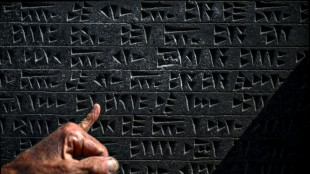
A piece of rock with mysterious markings that lay largely unstudied for 4,000 years is now being hailed as a "treasure map" for archaeologists, who are using it to hunt for ancient sites around north-western France.

Text size:

The so-called Saint-Belec slab was claimed as Europe's oldest map by researchers in 2021 and they have been working ever since to understand its etchings -- both to help them date the slab, and to rediscover lost monuments.

"Using the map to try to find archaeological sites is a great approach. We never work like that," said Yvan Pailler, a professor at the University of Western Brittany (UBO).

Ancient sites are more commonly uncovered by sophisticated radar equipment, aerial photography or by accident in cities when the foundations for new buildings are being dug.

"It's a treasure map," said Pailler.

But the team are only just beginning their treasure hunt.

The ancient map marks an area roughly 30 by 21 kilometres and Pailler's colleague, Clement Nicolas from the CNRS research institute, said they would need to survey the entire territory and cross reference the markings on the slab.

That job could take 15 years, he said.

- Rivers and mountains -

Nicolas and Pailler were part of the team that rediscovered the slab in 2014 -- it was initially uncovered in 1900 by a local historian who did not understand its significance.

The French experts were joined by colleagues from other institutions in France and overseas as they began to decode its mysteries.

"There were a few engraved symbols that made sense right away," said Pailler.

In the coarse bumps and lines of the slab, they could see the rivers and mountains of Roudouallec, part of the Brittany region about 500 kilometres west of Paris.

The researchers scanned the slab and compared it with current maps, finding a roughly 80 percent match.

"We still have to identify all the geometric symbols, the legend that goes with them," said Nicolas.

The slab is pocked with tiny hollows, which researchers believe could point to burial mounds, dwellings or geological deposits.

Discovering their meaning could lead to a whole flood of new finds.

- 'Doomed' slab -

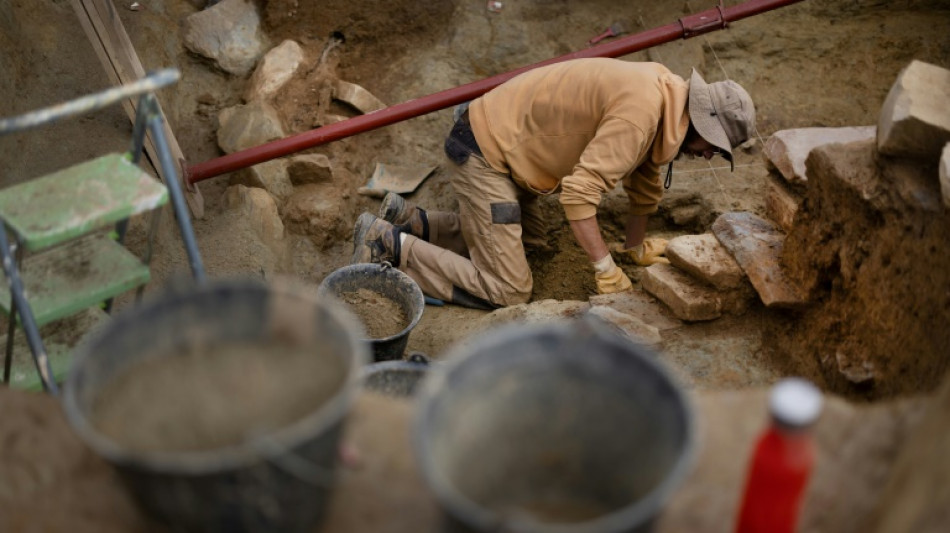
But first, the archaeologists have spent the past few weeks digging at the site where the slab was initially uncovered, which Pailler said was one of the biggest Bronze Age burial sites in Brittany.

"We are trying to better contextualise the discovery, to have a way to date the slab," said Pailler.

Their latest dig has already turned up a handful of previously undiscovered fragments from the slab.

The pieces had apparently been broken off and used as a tomb wall in what Nicolas suggests could signify the shifting power dynamics of Bronze Age settlements.

The area covered by the map probably corresponds to an ancient kingdom, perhaps one that collapsed in revolts and rebellions.

"The engraved slab no longer made sense and was doomed by being broken up and used as building material," said Nicolas.

F.Schneider--NZN