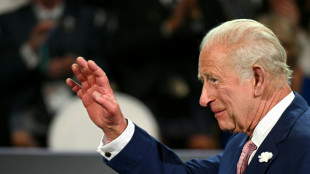
Norman Lear, sitcom king who changed TV -- and America / Photo: VALERIE MACON - AFP/File
Norman Lear was television's prolific genius whose trailblazing sitcoms in the 1970s and 1980s not only revolutionized US entertainment -- they helped change the way a nation saw itself.
With boundary-breaking shows like "All In the Family" and "The Jeffersons," Lear -- who has died aged 101 -- helped millions of viewers confront their deepest fears, frailties and prejudices, as well as their aspirations, with humor and humanity.
Among his milestones was creating the first African American nuclear family regularly appearing on television: the Evans clan on "Good Times," beginning in 1974.
He injected the sensitive subjects of race, sexuality, class, inequality and politics like the anti-war movement into his work, breaking the sitcom mold and beaming modern visions of family life into millions of US households.
Lear abandoned the idealistic representation of American families seen on shows like "Leave It to Beaver" (1957-1963) and instead adopted a more faithful, real-world depiction -- and in so doing, he changed the face of television.
"What was new was that we were engaging in reality," the famed creator said in the 2016 documentary "Norman Lear: Just Another Version of You."
By politicizing the personal and personalizing the political, Lear became an entertainment giant.
Fellow comedy icon Mel Brooks hailed Lear as "the bravest television writer, director and producer of all time."
In the mid-1970s, at the height of his eight-decade career, Lear had five popular sitcoms airing in prime time -- an era before cable or streaming, when Americans collectively consumed shows in real time.
Broadcaster CBS estimated at the time that a staggering 120 million Americans watched Lear programming each week.
The six-time Emmy Award winner wrote, produced, created or developed roughly 100 specials and shows including 1980s mega-hit "The Facts of Life" and the long-running "One Day at a Time."
His revolutionary comedy also earned him a spot on president Richard Nixon's so-called enemies list.
- Lovably irascible -
Lear's most explosive creation was "All In the Family," a blue-collar comedy so audacious that its first episode, in early 1971, came with a disclaimer.
The half-hour show featured abrasive patriarch Archie Bunker, lovably irascible but bigoted, narrow-minded and clashing relentlessly with his liberal relatives including son-in-law "Meathead," played by Rob Reiner.
It marked a TV paradigm shift.
"Television can be broken into two parts, BN and AN: Before Norman and After Norman," writer and producer Phil Rosenthal said in the 2016 documentary.
Lear, donning his trademark porkpie hat, also produced or funded such big-screen classics as "The Princess Bride" and "This is Spinal Tap."
But television was his magic medium.
Never far from the surface in Lear's shows were the issues gnawing at American society: misogyny, racism, homophobia, women's rights and political division.
He dug deep into the exigencies of Black life. And while "Good Times" was intended as a white audience's window into Black America, "The Jeffersons" represented the American Dream for Black people.
Over 253 episodes from 1975 to 1985, "The Jeffersons" portrayed African American success through an unapologetically Black couple "movin' on up" in New York society.
- 'Enemy' of the family? -
Norman Milton Lear was born on July 27, 1922 into a Jewish family in New Haven, Connecticut.
His mother emigrated from Russia as a child, and his father was a self-employed salesman who served time in jail and had a bigoted streak that embarrassed his son -- but also served as source material.
"A piece of him was Archie Bunker, a piece of him was Dad," Lear told the Television Academy Foundation.
He attended Emerson College in Boston but dropped out after a year to enlist in the US Army, flying 37 World War II bombing sorties as a radio operator and gunner.
By 1949, Lear moved to Los Angeles, where he found television success writing for variety shows.
He also produced films including 1963's "Come Blow Your Horn" starring Frank Sinatra, and in 1967 received an Academy Award nomination for best screenplay for "Divorce American Style."
With "All In the Family" and the TV shows that followed, Lear's influence skyrocketed.
So did his concern about the mix of politics and religion.
Criticism from conservative circles poured in. In addition to being on Nixon's enemies list, Lear said televangelist Jerry Falwell "called me the number one enemy of the American family."
Lear pushed back against the burgeoning religious right political movement and in 1981 founded the People For the American Way group to promote pluralism, civic engagement, and freedom of expression and religion.
Lear's work ethic was legendary. Well beyond his 100th birthday, he collaborated with TV host Jimmy Kimmel on several "Live in Front of a Studio Audience!" specials in which star-studded casts performed remakes of classic Lear shows.
A pioneer on multiple fronts, Lear's portrayal of true-to-life traumas sealed his reputation.
In a watershed moment on a 1972 episode of "Maude," the title character agonizes over terminating her pregnancy, a plotline that brought the abortion fight to prime time one year before the Supreme Court's landmark Roe v Wade ruling.
Half a century later, Lear -- who married three times and had six children -- told "E! Insider" the issues his sitcoms addressed carry equal resonance today.
"The culture has shifted and changed... but the way families experience life is pretty much the same," he said.
W.Vogt--NZN