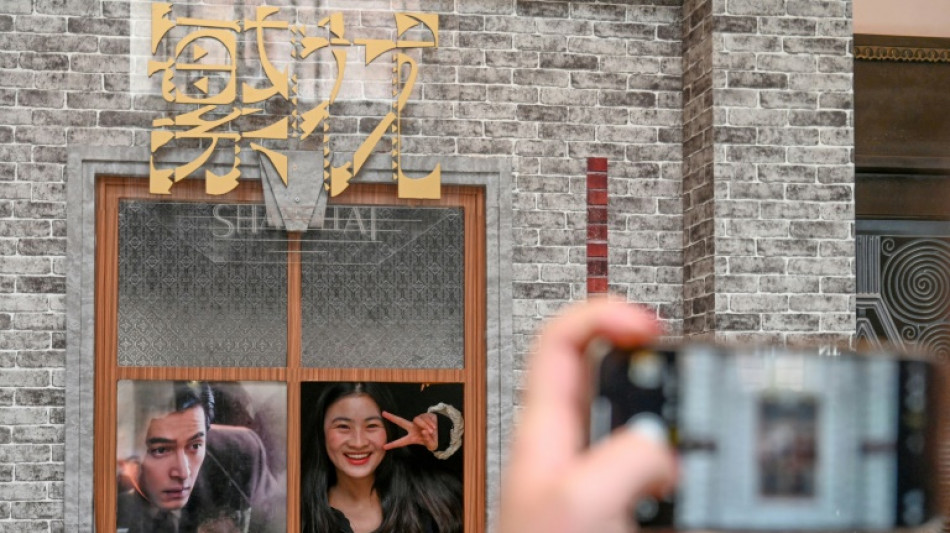
Hit Chinese TV series rekindles sidelined Shanghainese dialect / Photo: STR - AFP
A hit Chinese television series set in gritty but glamorous 1990s Shanghai has sparked a wave of nostalgia for the megacity's boom years, and reignited interest in its declining dialect.
The highly anticipated "Blossoms Shanghai" is famed Hong Kong film auteur Wong Kar-wai's small screen debut, chronicling its protagonist's rise from nobody to business tycoon during China's economic opening up.
Its cast includes Chinese superstars Hu Ge and Ma Yili, but it is the Shanghainese vernacular spoken by their characters that has stolen the spotlight.
It is a rare starring role for the language, once a valued marker distinguishing locals from outsiders in China's financial hub.
Though it is still spoken by around 14 million people, it has faded from everyday and business use after decades of government efforts to limit local dialects and promote Mandarin.
"Watching (the series) gave me such a sense of familiarity, and I felt very happy that us Shanghainese now had another TV show of our own," 22-year-old local Xie Niyun told AFP as she photographed a "Blossoms" display outside Shanghai's Peace Hotel.
Mandarin is the country's official language, but its 1.4 billion citizens also speak dozens of mutually unintelligible regional tongues.
Beijing officially labels them dialects, though linguists argue many can be considered stand-alone languages.
The release of "Blossoms" last month caused a stir because it can be viewed in both Mandarin and Shanghainese formats, a rare thing for a major TV production.
Social media users have posted tutorials on common Shanghainese phrases and discussed the accuracy of the show's vocabulary.
The buzz is reminiscent of that generated by 2021's romantic comedy "B for Busy", which also used mainly Shanghainese dialogue.
The star power of director Wong and his leads, however, has turbocharged the excitement around "Blossoms".
Fans have flocked to its shooting locations in central Shanghai, including the nearly 100-year-old Peace Hotel and the Art-Deco-style Cathay Theatre.
Across the city, themed walks and menus have sought to capitalise on the series' popularity, while orders for classic snacks eaten on-screen have soared, according to delivery services.
"(Watching "Blossoms"), I feel like we are seeing our parents' halcyon days, when they were our age," Duan, a long-time Shanghai resident in her 30s, told AFP.
Originally from Shandong province, Duan needs subtitles to watch in Shanghainese -- but said she preferred it because "the Mandarin version doesn't quite have the same flavour".
- 'Crisis of inheritance' -
It is unlikely that pop culture alone will restore Shanghainese to anywhere near its former status.
The ruling Communist Party sees Mandarin as a unifying tool to promote its political values and ideology, and has repeatedly sought to curb the use of regional tongues.
Beijing's linguistic policy has sparked protests from southern Guangdong province to Inner Mongolia, while human rights groups say Mandarin is steadily replacing the minority Uyghur language in Xinjiang.
While the use of regional dialects is not banned outright, Mandarin has been privileged for use in schools, business, and official communications -- resulting in local languages gradually losing currency, especially among young people.
In Shanghai, a 1992 government decision to ban Shanghainese in schools caused a "crisis of inheritance", according to Qian Nairong, a prominent linguist.
Mandarin is now the main language in the city, despite recent efforts to reintroduce the vernacular in public transport announcements and at after-school clubs.
At a small language school in the bustling former French Concession, Jason Wang is among a handful of tutors in the city offering formal Shanghainese classes -- though his students are mainly foreigners.
The lack of standardised, up-to-date textbooks is a challenge.
"The topics and content in some of these books can be overly old-fashioned," he told AFP, adding that there was no standard way to transcribe the sounds of Shanghainese, causing problems for beginners.
Wang said he hoped for more representation in films and music, pointing out that Hong Kong culture's huge popularity had caused some people to "learn Cantonese because they loved Cantonese music so much".
"Having more and more films and shows like this for Shanghai will definitely have benefits," he said.
On the streets of Shanghai, a local in his late sixties surnamed Yu said he was optimistic that the dialect was slowly being taken up again.
"It is a culture rooted in Shanghai, it must not be lost," he said.
S.Scheidegger--NZN