Have poor and troubled Paris suburbs won Olympic gold? / Photo: JULIEN DE ROSA - AFP
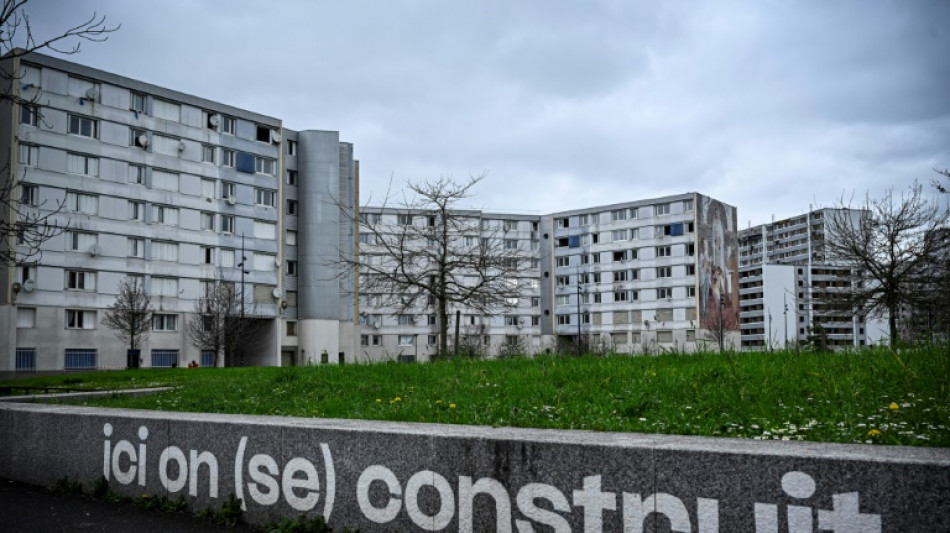
Less than 500 metres separate the Stade de France -- the sparkling centrepiece of the Paris Olympics -- and the crumbling Francs-Moisins estate plagued by poverty and crime.
Samia Achoui, a secretary who lives in one of the grey blocks dogged by drug dealing, doesn't have a ticket to see the Games.
Instead she will listen from her window to the cheers and applause echoing over the canal.
Despite its name, the Paris Olympics will take place mostly in Seine-Saint-Denis on the other side of the "peripherique" ring road that divides the French capital from some of its poorest and most notorious suburbs, known as banlieues.
The densely populated working-class department north of Paris hosts four of the Games' big venues, the athletes' village and other key Olympic sites.
Paris's pitch for the Games -- which run from July 26 to August 11 -- leaned hard on regenerating an area that has absorbed wave after wave of immigration and has the country's youngest population. A third of its 1.6 million people lives below the poverty line.
France not only hopes to use the Olympics to turbo-charge ongoing redevelopment there, but to recast the fevered image of Seine-Saint-Denis as a crime-ridden collection of ghettos forged during suburban riots which started there in 2005.
Its reputation took a further battering in the world's media after the 2022 Champions League Final fiasco, when football fans were attacked and robbed on their way into the Stade de France.
- 'People's Games'? -
Mohamed Gnabaly is relentlessly upbeat about how the Games could help change Seine-Saint-Denis.
The mayor of Ile-Saint-Denis, the narrow island in the River Seine where part of the athletes' village has been built, is "obsessed" about making the Olympics "a people's Games".
So much so that his little municipality has brought 7,000 tickets -- one for pretty much all of its inhabitants.
The island, which has its share of grim apartment blocks, has been turned upsidedown by construction works for the Olympics.
But the mayor is determined it will now extract the maximum benefit from the Games, notwithstanding that his town hall was ransacked when rioting again erupted in poor suburbs across France last June after police shot and killed a teenager at a traffic stop just outside Paris.
"I have been working on this for three years," said Gnabaly, who is proud the island is also home to the Olympics' "Africa Station", a fan zone dedicated to African culture and sport.
"We have suffered (with all the work) but not only will this transform our town, we will be at the heart of the reactor," the mayor insisted. "We are not going to be left out by the Games."
His optimism is not shared by everyone across Seine-Saint-Denis.
"There are two extremes," said Cecile Gintrac of Vigilance JO, a local watchdog group. "One part of Paris is going to be a big party while the other won't be able to go to work or get around" because of all the Olympic road closures and restrictions.
Delivery driver Moussa Syla, 45, who lives in the Francs-Moisins estate -- which is also getting a major facelift -- said the thought of the disruption brings him out in a cold sweat.
"It is going to be a nightmare to get around," he said.
- Renaissance -
It is hard to go anywhere in Seine-Saint-Denis these days without seeing scaffolding or cranes building whole new neighbourhoods.
The Olympics is part of a long-term push to drag up the department that began with the symbolic decision to build the Stade de France there for the 1998 World Cup, which France's "rainbow" multiracial team went on to win.
High property prices in Paris and a massive soon-to-delivered extension of its metro system into Seine-Saint-Denis -- Europe's single biggest infrastructure project -- has made the department attractive for developers.
Companies like Tesla are moving their French headquarters to its former industrial areas where factories have long shut.
"We need to find a second wind for Seine-Saint-Denis so jobs stay here," said Isabelle Vallentin, the number two at Solideo, the state body charged with delivering the Olympic projects.
And Seine-Saint-Denis's "extremely decrepit housing has to be developed," she added.
A large slice of the 4.5-billion-euro ($4.8 billion) building budget for the Games is going into this push, with the department the big winner, taking around 80 percent of 1.7 billion euros in public money. While private investment is harder to quantify, it likely is not far behind.
- Housing legacy -
The Olympic Village, the Games' biggest building project and a whole new eco-neighbourhood in itself, will house 14,250 athletes and their support teams as well as 6,000 Paralympians.
Built on a former industrial zone along the River Seine, it is architecturally varied, with many buildings overlooking the river. All those under eight floors are built of wood and all the village's energy comes from heat pumps and renewables.
Once the Paralympics finish, the village will morph into a mixed neighbourhood of apartments and offices, the first of its 6,000 new residents moving in early next year, followed by a similar number of workers.
But only a third of the 2,800 apartments will be sold on the open market.
Contrary to previous Games like London -- where the organisers were accused of "gentrification on an industrial scale" and not keeping their promises to locals -- Solideo's Vallentin said they insisted developers "respond first to (local) housing needs".
So 25 to 40 percent of the apartments, depending on the three municipalities the village spans, will go to social housing, with the rest let out at "affordable" rents through semi-public housing bodies.
Seine-Saint-Denis's other big headline win is a clutch of new swimming pools, of which it is in dire need.
The most eye-catching is the Olympic Aquatic Centre, a spectacular undulating wood edifice opposite the Stade de France where the diving, water polo and artistic swimming medals will be decided.
It will also get the main Olympic pool, which is to be dismantled and divided in two after the Games, as well as a new training pool. The organisers are also helping pay for two others.
- 'A real plus' -
Olympic-related sites have been popping up like confetti across Seine-Saint-Denis, with the little town of Dugny likely to be transformed by the Games.
Its population is set to grow by a third with housing on a site inherited from the Olympics' "media cluster". Badly served by public transport until now, Dugny is using the Games to diversify its housing stock, 77 percent of which is social housing -- the highest rate in France.
One-third of the 1,400 new homes are being set aside to help get people on the property ladder.
Dugny's young mayor Quentin Gesell said many of his friends "who had grown up like me in Dugny have had to leave because they can neither buy here or rent [their incomes being too high for social housing] when they would have preferred to stay close to their families".
Another more subtle transformation is likely to come through a series of new footbridges linking areas long divided by the major road and rail arteries that slice through the department.
Back near the Francs-Moisins estate, a foot and bike bridge is being built across the Saint-Denis canal to the Stade de France, replacing an old and unreliable rotating road bridge and a steep-stepped pedestrian crossing.
"It's a nightmare to cross now," said Karene, a mother of three. "You have to fold up the pushchair and take the baby in the other arm. So this is really great, a real plus for the area."
The bridge had been talked of for years but the Games got it over the line, putting up two-thirds of the 10.5-million-euro cost.
The Olympics have been the "pivot point that has acceleration the transformation" of the department, Stephane Troussel, the socialist head of Seine-Saint-Denis council, told AFP.
"In record time we have managed to deliver a huge amount of infrastructure, housing, roads and bridges," he said.
- 'Badly paid' jobs -
But there are doubts over the jobs the Games promised to deliver to the department, whose 10.4 percent unemployment rate is nearly a third higher than the national average.
"The Games are recruiting -- get yourself a job!" declared the flyer for an Olympic job fair near Charles de Gaulle airport in December.
"I have been to a lot of these and it's always the same," said Fouad Yousfi as he went between stands looking for cleaners and pastry chefs. "Not exactly the companies you would like to work for, and often badly paid."
Stephane Laurent, 47, who was looking to "get work quickly", left another fair in Saint-Denis with an offer to train as a security guard -- something the Games have a huge need for.
While around 180,000 people will work on the Games, according to official estimates, most will be on short-term contracts, such as the 6,000 people taken on by Sodexo for catering at the Olympic Village.
"We have to be honest, there is probably a mismatch between what was expected of the Games and the level of unemployment and precarity we have," said Bernard Thibault, a former CGT union leader who sits on the Olympics committee.
Local firms have also benefited, picking up contracts worth 330 millions euros, according to Seine-Saint-Denis council.
But others question whether the Games' economic dividend has filtered down.
"We are one of the winners," said Mehdi Ourezifi of Services Persos, a local back-to-work nonprofit that landed part of the laundry contract for the Olympic Village. "But generally local companies and back-to-work schemes are disappointed" given the windfall the Games offered, he added.
- Stubborn old image -
Yet beyond the economic and infrastructural gains, one of the biggest Olympics legacies could be how Seine-Saint-Denis is seen.
Police have already stepped up operations targeting drug dealers, street vendors and others who "monopolise public spaces", and a massive security operation is planned for the Games themselves.
But after a police station was attacked last week after a youth was killed by a police car during a chase, and the head of the Mongolian delegation was robbed of jewels worth nearly 600,000 euros on his way to a security committee meeting in October, the bad old image is proving difficult to shake.
In welcoming visitors from all over the world this summer, Seine-Saint-Denis hopes to write a new chapter its history, one that plays up it diversity and potential rather than crime and sporadic outbursts of rioting.
Back on the Francs-Moisins estate, Karene is praying that "the visibility" will do everyone good.
"I hope it is well organised, because if it is like the football (the chaotic scenes before the 2022 Champions League Final), Saint-Denis's image will plummet again."
R.Schmid--NZN