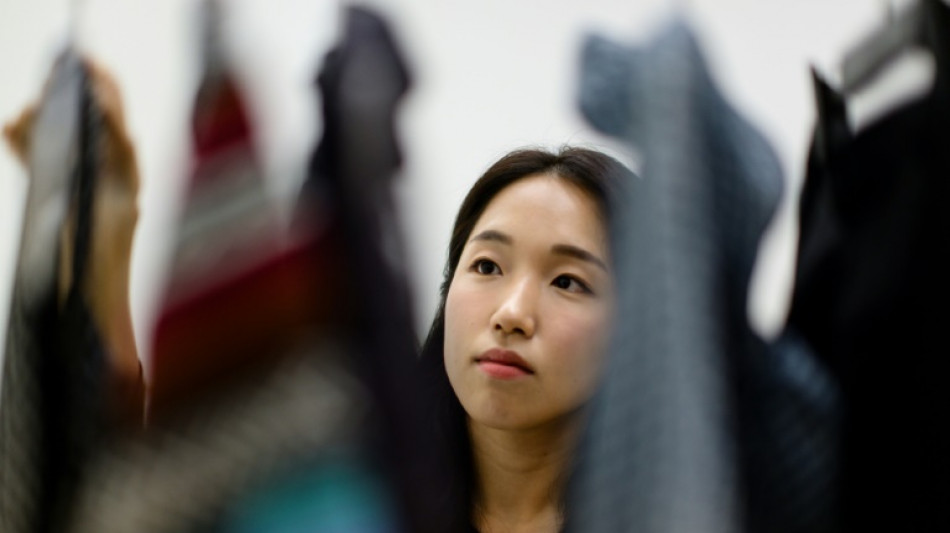
No new clothes: S. Korean climate activist targets hyperconsumption / Photo: ANTHONY WALLACE - AFP
Recovering South Korean shopaholic-turned-climate activist Lee So-yeon used to buy new clothes almost daily -- until a $1.50 winter coat triggered an awakening that stopped her shopping entirely.
While looking at the ultra-cheap padded jacket at an H&M shop in the United States, where she was working at the time, Lee asked herself how any item of clothing could be sold so cheaply.
The 30-year-old embarked on a deep dive into fast fashion production methods and was horrified at the human, social and environmental toll hyperconsumerism is having on the planet -- and on the mental health of women who make and buy cheap clothes.
"I used to buy one new outfit each (working) day of the week," Lee told AFP, adding that each item from major high street retailers would typically cost less than a dollar.
But the reason the clothes are so cheap, Lee learned, is because the women who sew for companies are paid little, while the business model itself is causing significant environmental harm.
Lee stopped buying any new clothes -- and has not purchased a single fast fashion garment since her epiphany around six years ago.
Her much more compact wardrobe consists of used items that she received from friends and family, including a vintage leather jacket that once belonged to her mother.
Unlike fast fashion items, which are often designed to be thrown away after just a few wears, each piece is irreplaceable because it carries a unique story and history, she said.
"Ultimately, the most eco-friendly clothes are the ones already in your wardrobe," said Lee.
- Break the cycle -
Lee now organises clothing swaps with her friends and family, and has written a book to promote the idea of valuing garments for "the story behind it," rather than chasing ephemeral trends.
She is part of a small but growing global movement seeking to promote second-hand clothing and help people -- especially women -- opt out of the cycle of over-consumption.
The app Lucky Sweater provides a platform for users to trade items from their closets with each other, focussing on sustainable brands, founder Tanya Dastyar told AFP.
"We're programmed to believe the only way to express my fashion or show that I'm beautiful or trendy... is new outfits," Dastyar said.
"But you can still be fashionable and feel good and look great and not have to do that," she said, adding that although trading clothes did not have the same quick dopamine hit as making a fast-fashion purchase, it was far more rewarding over time.
The app's growing uptake indicates that people are hungry to shift their relationship with clothing and consumerism, she said.
People realise: "I don't have to follow trends and I can just dress in a way that feels comfortable to me," she said. "Is that like a mass market thing? No. But do I feel like it can be a movement? Yes."
For Lee, breaking the cycle of cheap clothing consumption helped her improve her mental health.
As a teenager, she would worry about what to wear on school trips -- when uniforms were not required -- at least a month in advance and would go shopping to ease her fears.
"I felt a lot of pressure about how others would see me," she told AFP.
But learning about Bangladesh's 2013 Rana Plaza tragedy -- one of the world's worst industrial disasters that killed more than 1,130 garment factory workers, most of them young women -- was a turning point.
The factory workers died making clothes for "women like me", Lee said.
- No second-hand? -
The global fashion industry is one of the most polluting, accounting for up to 10 percent of greenhouse gas emissions, according to World Bank estimates.
Most modern clothes are made of synthetic materials like nylon and polyester, which are essentially plastic and do not biodegrade in landfills, industry data shows.
Keeping clothes out of landfills can help, but in South Korea, many still avoid used garments, said Kim Dong-hyun, who runs a used clothing export factory.
"People often don't look favourably on someone wearing used clothes because they are seen as unwanted items," Kim told AFP, noting he has found dirty diapers and food waste in the collection bins.
South Korea is the fifth largest exporter of used clothing in the world -- and activists say many garments are essentially dumped in developing countries, which lack the capacity to process them.
At Kim's second-hand clothing factory in Paju, outside Seoul, a mechanical claw categorised piles of used clothes to be exported overseas.
"Many people treat the clothing collection bin as just a trash can," Kim said.
A.Senn--NZN