Iran's early recordings revive forgotten sound heritage / Photo: ATTA KENARE - AFP
In a century-old building in Tehran, Saeed Anvarinejad turned the dial of a vintage radio to tune into some of Iran's earliest recorded sounds, some serving as reminders of the seismic changes that shaped the country's history.
Along with a team of fellow enthusiasts, he spent months tracking down the earliest recordings of Iranian music, speeches, interviews, theatrical plays, radio broadcasts and even the hum of daily life from more than a century ago up to the present day.
"Sound is a phenomenon we pay little attention to... although it's very important," said Anvarinejad, one of the organisers of the "SoundScape" exhibition.
And "the era of early sound recording in Iran is a very important time in the socio-political history of the country".
He highlighted the emotional power of early voice recordings, saying they captured "in a very raw and pure way... the feeling that people have at that moment," unlike written records.
According to Anvarinejad, the oldest surviving sound recordings from Iran date back to 1898 and 1899, during the reign of Mozaffar al-Din Shah of the Qajar dynasty, which reigned over the country from the late 18th to the early 20th century.
His rule saw the unfolding of the Constitutional Revolution, a pivotal moment in Iran's political transformation that established a parliament and constitutional monarchy.
"It was a time when... a new order was taking shape in the Iranian mind and very important things were happening politically, socially and culturally," he added.
"We thought it would be good to have a new approach to the sound (from that time) and engage audiences with it."
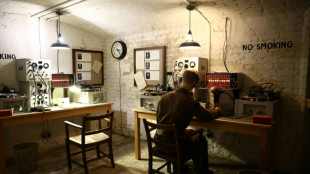
Upon tuning the wooden-framed antique radio, a chilling broadcast announced the overthrow of prime minister Mohammad Mosaddegh in 1953, who had pushed for the nationalisation of Iran's oil industry sparking a coup d'etat orchestrated by the United States and Britain.
"This is Tehran! Good news! Good news! People of the cities of Iran, be awake and alert, the traitor Mosaddegh has fled!" crackled the voice of a radio anchor.
- 'Mysterious void' -
Other audio included Iran's first recorded call to prayer in either 1912 or 1913, and the 1959 report on the death of Qamar, the first woman singer to perform in public in the country.
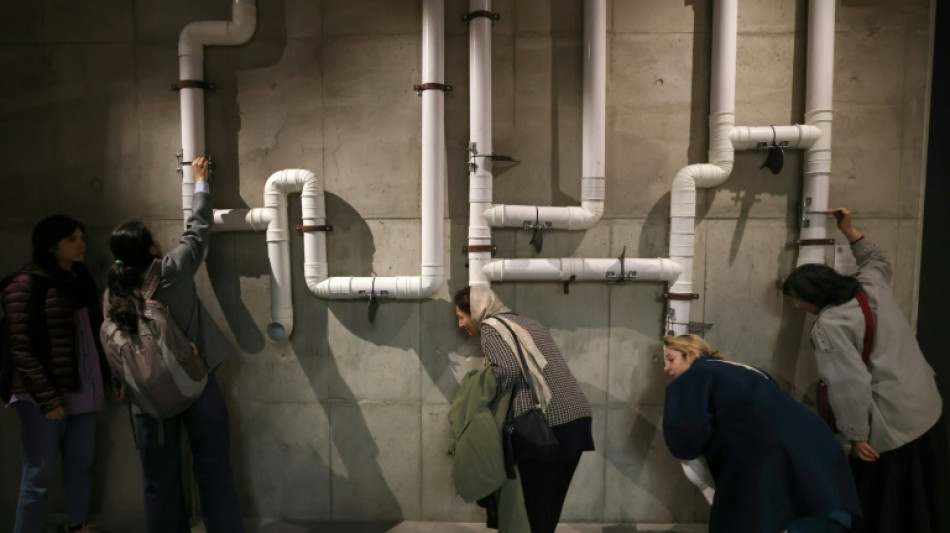
One striking installation at the exhibition involved a mechanical device mounted on a concrete wall with gears, chains, wheels and a lever which played old recordings of the stringed tar instrument through retro telephone handsets.
Another, "Mowj Negar", featured printed sound waves arranged in three rows on one wall, with a metal device which moved along the waves.
When moved, the device activates melodies from the Qajar and early Pahlavi (1925-1979) eras that once echoed through Iran's grand palaces and bustling city streets.
Nearby stood a wooden cabinet named "The Silent Closet", displaying a series of photos from the First World War -— but without a single accompanying sound.
"There are no sound recordings from Iran during this period, not because technology was unavailable, but likely because the country was in such turmoil that recording sound was not a priority," said Atabak Axon, another exhibition organiser.
"There was a 12-year silence that remains a mysterious void in Iran's auditory history."
For centuries, sound has played a central role in Persian culture, connecting belief with poetry and identity.
For 21-year-old Sarvin Faizian, visiting the exhibition with friends was a deeply moving experience "as if I was experiencing my parents' past."
Similarly, Fatemeh Sadeghi described feeling overwhelmed by nostalgia, while 63-year-old Kamran Asadi found the exhibition unexpectedly personal.
"It is a very good and intimate atmosphere for me," he said, lingering on an old song playing in the background.
"It is good for the younger generation to learn where Iran's heritage of music and art came from."
E.Schneyder--NZN