Zürcher Nachrichten - Silent for 800 years, medieval organ sings again in Jerusalem

EUR -
AED 4.2383
AFN 75.595632
ALL 93.422114
AMD 421.437509
AOA 1058.276875
ARS 1727.056315
AUD 1.636692
AWG 2.077316
AZN 1.966371
BAM 1.957368
BBD 2.320839
BDT 142.644237
BHD 0.434544
BIF 3443.55778
BMD 1.154064
BND 1.478584
BOB 13.995208
BRL 5.938237
BSD 1.152313
BTN 109.971071
BWP 15.669413
BYN 3.39619
BYR 22619.659
BZD 2.317536
CAD 1.623232
CDF 2608.185306
CHF 0.93219
CLF 0.02675
CLP 1056.234506
CNY 7.794031
CNH 7.784821
COP 3700.403103
CRC 522.513929
CUC 1.154064
CUP 30.582702
CVE 110.353377
CZK 24.171647
DJF 205.192551
DKK 7.476005
DOP 67.203238
DZD 153.369708
EGP 57.902286
ERN 17.310964
ETB 184.794555
FJD 2.58193
FKP 0.859053
GBP 0.857522
GEL 3.012045
GGP 0.859053
GHS 13.499811
GIP 0.859053
GMD 85.400216
GNF 10120.104707
GTQ 8.789039
GYD 241.2432
HKD 9.051712
HNL 30.986451
HRK 7.536498
HTG 150.660657
HUF 360.667835
IDR 20698.14205
ILS 3.475834
IMP 0.859053
INR 109.519253
IQD 1512.40118
IRR 1586982.580461
ISK 141.833811
JEP 0.859053
JMD 182.194332
JOD 0.818213
JPY 181.631823
KES 149.32436
KGS 100.923231
KHR 4664.675085
KMF 493.939336
KRW 1640.554196
KWD 0.357079
KYD 0.960269
KZT 542.844738
LAK 26062.872505
LBP 103188.544626
LKR 386.889842
LRD 207.996574
LSL 18.67854
LTL 3.407652
LVL 0.698082
LYD 7.345678
MAD 10.736699
MDL 20.171154
MGA 4974.016858
MKD 61.574312
MMK 2423.150055
MNT 4136.511653
MOP 9.309677
MRU 46.266137
MUR 53.029348
MVR 17.841675
MWK 1998.082855
MXN 19.898121
MYR 4.720928
MZN 73.751906
NAD 18.996413
NGN 1572.966021
NIO 42.403959
NOK 11.004493
NPR 175.952387
NZD 1.962607
OMR 0.443735
PAB 1.152323
PEN 3.905933
PGK 5.103846
PHP 70.210919
PKR 320.656616
PLN 4.294296
PYG 6870.442676
QAR 4.200564
RON 5.250761
RSD 117.374106
RUB 93.045188
RWF 1693.012232
SAR 4.330659
SBD 9.315088
SCR 15.474001
SDG 693.024943
SEK 10.97261
SGD 1.478172
SLE 28.217204
SOS 658.521672
SRD 43.728636
STD 23886.799612
STN 24.519424
SVC 10.083075
SZL 18.978562
THB 38.303967
TJS 10.635818
TMT 4.050765
TND 3.385111
TRY 54.900339
TTD 7.823265
TWD 37.189147
TZS 3064.038244
UAH 51.525118
UGX 4315.456042
USD 1.154064
UYU 46.427383
UZS 13785.296924
VES 870.408229
VND 30314.382285
VUV 137.499608
WST 3.153152
XAF 656.477053
XAG 0.018979
XAU 0.000279
XCD 3.118916
XCG 2.07679
XDR 0.816447
XOF 656.477053
XPF 119.331742
YER 275.070767
ZAR 18.867623
ZMK 10387.962599
ZMW 21.807275
ZWL 371.608213
  • CMSC

    0.0300

    21.79

    +0.14%

  • CMSD

    0.0000

    22.02

    0%

  • RIO

    3.1100

    99.01

    +3.14%

  • GSK

    0.0200

    51.53

    +0.04%

  • NGG

    0.5600

    80.42

    +0.7%

  • BTI

    -0.4400

    59.12

    -0.74%

  • BCE

    0.2100

    22

    +0.95%

  • RELX

    0.6400

    36.8

    +1.74%

  • RBGPF

    -1.2500

    69.74

    -1.79%

  • AZN

    -2.3500

    155.62

    -1.51%

  • VOD

    0.0800

    15.69

    +0.51%

  • RYCEF

    0.2000

    20.4

    +0.98%

  • JRI

    -0.1000

    12.72

    -0.79%

  • BCC

    3.4600

    86.49

    +4%

  • BP

    -1.8200

    42.44

    -4.29%

Silent for 800 years, medieval organ sings again in Jerusalem
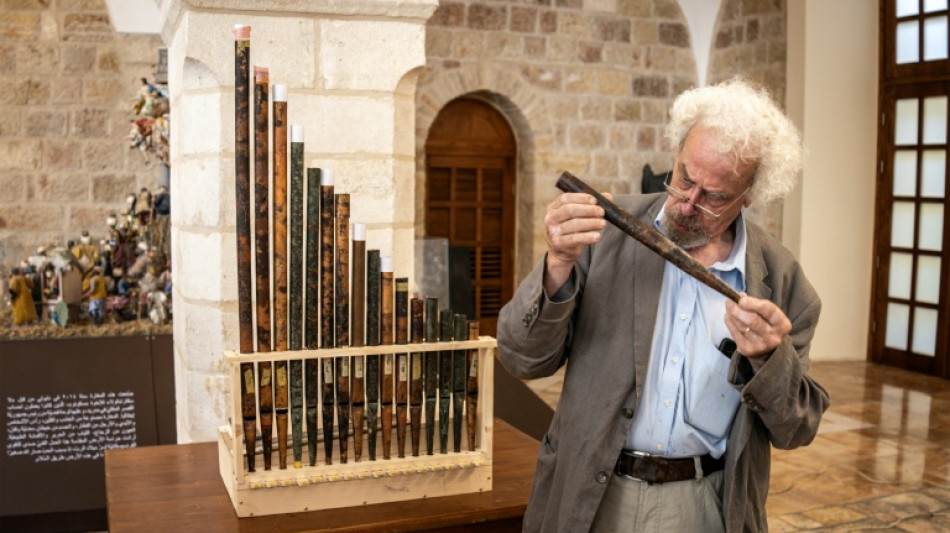
Silent for 800 years, medieval organ sings again in Jerusalem / Photo: JOHN WESSELS - AFP

Silent for 800 years, medieval organ sings again in Jerusalem

The pipes of a medieval organ, buried for centuries and discovered near the Church of the Nativity in Bethlehem in the occupied West Bank, are once more filling a Jerusalem monastery with ancient melodies.

Text size:

"This is a window into the past... we have the opportunity for the first time in modern history of listening to a medieval sound which is a thousand years old," said David Catalunya, a Spanish researcher who has worked for more than five years to bring the 11th-century instrument back to life.

"And it's not through a recreation or a hypothetical reconstruction, but it's really the original sound: the same vibration that the Crusaders heard at the Nativity Church," he told AFP.

Dating nearly as far back as the invention of the instrument itself, it was discovered in 1906 at the Biblical birthplace of Jesus Christ.

Catalunya pulls on small tabs to play the organ -- which he fondly refers to as a "miracle" -- expelling a formidable ringing from the otherwise modest wooden instrument.

Currently housed in the Monastery of Saint Saviour in Jerusalem's Old City, the instrument is set to be displayed in a museum of the Franciscan Custody of the Holy Land.

"It's like finding a living dinosaur, because it's something we knew existed but we only know from fossils, so there's very limited evidence," said Alvaro Torrente, a musicologist who participated in the restoration project.

"This is not a fossil, this is the real object and the real sound," he told AFP.

- Chance discovery -

It was discovered "almost by chance", according to Father Eugenio Alliata, a Franciscan archaeologist attached to the mission in charge of several holy sites, including the Church of the Nativity in Bethlehem.

During construction of a pilgrim hostel, a set of 222 copper pipes and a bell carillon were unearthed near the site.

It was seemingly buried with "utmost care", according to Catalunya, meaning researchers were able to reconstruct the instrument with painstaking care.

Koos van de Linde, one of the world's leading organ specialists who also consulted on the project, said that "the hope the Crusaders who buried these pieces had, that one day they would resound again, was not in vain.

"It was an immense honour to witness and participate in their resurrection," he continued.

To the experts, the instrument is unique not just for its complexity -- 18 pipes producing a single note -- or what Catalunya says is an "incredible state of preservation", but also its antiquity.

While the oldest organs studied by historians are from the 15th century, this one was built in the 11th century in France before being transported to Bethlehem by Crusaders in the 12th century, Catalunya said.

"The Christians of Europe brought to the Church of the Nativity in Bethlehem the most avant-garde musical instrument used at the time in liturgy: the organ, an instrument designed to become the emblem of sacred music," Torrente told AFP.

He hopes the discovery will spark more interest in what the research team simply calls the "Bethlehem organ", which Torrente says has not yet sung all its tunes.

D.Graf--NZN