Zürcher Nachrichten - World's oldest cave art discovered in Indonesia

EUR -
AED 4.256694
AFN 73.006558
ALL 96.183185
AMD 437.462357
ANG 2.074413
AOA 1062.652651
ARS 1616.583177
AUD 1.634887
AWG 2.088802
AZN 1.968976
BAM 1.975086
BBD 2.334991
BDT 142.252756
BGN 1.980809
BHD 0.437517
BIF 3441.742426
BMD 1.158836
BND 1.487395
BOB 8.011612
BRL 6.048742
BSD 1.159341
BTN 108.010902
BWP 15.820233
BYN 3.584907
BYR 22713.182337
BZD 2.331679
CAD 1.591719
CDF 2636.351736
CHF 0.91339
CLF 0.026784
CLP 1057.587983
CNY 7.996489
CNH 7.972918
COP 4277.55277
CRC 542.427133
CUC 1.158836
CUP 30.70915
CVE 112.464864
CZK 24.472182
DJF 205.948898
DKK 7.471133
DOP 68.168493
DZD 153.256108
EGP 60.532024
ERN 17.382538
ETB 182.173906
FJD 2.558248
FKP 0.869907
GBP 0.862579
GEL 3.146225
GGP 0.869907
GHS 12.629381
GIP 0.869907
GMD 85.754443
GNF 10171.680078
GTQ 8.868484
GYD 242.551028
HKD 9.078147
HNL 30.790613
HRK 7.5344
HTG 152.071514
HUF 390.82922
IDR 19560.279743
ILS 3.624074
IMP 0.869907
INR 108.151817
IQD 1518.074942
IRR 1524013.975298
ISK 143.799646
JEP 0.869907
JMD 182.132997
JOD 0.821554
JPY 182.779731
KES 150.179997
KGS 101.337763
KHR 4646.931796
KMF 495.9811
KPW 1042.938319
KRW 1723.368534
KWD 0.354812
KYD 0.96618
KZT 557.540752
LAK 24885.999794
LBP 103773.749324
LKR 361.379075
LRD 212.536652
LSL 19.502855
LTL 3.421741
LVL 0.700968
LYD 7.393341
MAD 10.845255
MDL 20.31736
MGA 4826.550671
MKD 61.840893
MMK 2433.253315
MNT 4155.40254
MOP 9.354227
MRU 46.481248
MUR 53.891672
MVR 17.903794
MWK 2012.897608
MXN 20.545118
MYR 4.564685
MZN 74.050655
NAD 19.503121
NGN 1573.11839
NIO 42.552008
NOK 10.987384
NPR 172.811971
NZD 1.971968
OMR 0.445583
PAB 1.159381
PEN 4.0032
PGK 4.985268
PHP 68.413043
PKR 323.488759
PLN 4.267587
PYG 7533.334191
QAR 4.223496
RON 5.094213
RSD 117.478165
RUB 99.83641
RWF 1690.741481
SAR 4.350755
SBD 9.326986
SCR 17.598041
SDG 696.460551
SEK 10.757867
SGD 1.480649
SHP 0.869427
SLE 28.565483
SLL 24300.220556
SOS 662.27146
SRD 43.458668
STD 23985.562074
STN 24.91497
SVC 10.144364
SYP 128.084693
SZL 19.503003
THB 37.627637
TJS 11.10097
TMT 4.055925
TND 3.373661
TOP 2.790198
TRY 51.308384
TTD 7.858106
TWD 36.841128
TZS 3010.068531
UAH 50.982556
UGX 4381.978336
USD 1.158836
UYU 46.959974
UZS 14132.002921
VES 526.906001
VND 30465.794063
VUV 138.374754
WST 3.166195
XAF 662.460109
XAG 0.015907
XAU 0.000249
XCD 3.131812
XCG 2.08942
XDR 0.823884
XOF 662.273593
XPF 119.331742
YER 276.440433
ZAR 19.405896
ZMK 10430.917809
ZMW 22.694786
ZWL 373.144666
  • RYCEF

    -0.5900

    16.01

    -3.69%

  • CMSC

    0.0200

    22.85

    +0.09%

  • RBGPF

    -13.5000

    69

    -19.57%

  • BCC

    -1.9800

    69.86

    -2.83%

  • NGG

    -1.8700

    85.53

    -2.19%

  • RELX

    -0.0400

    33.82

    -0.12%

  • CMSD

    0.0100

    22.9

    +0.04%

  • GSK

    0.3100

    52.37

    +0.59%

  • RIO

    -2.0700

    85.65

    -2.42%

  • BCE

    -0.0200

    25.73

    -0.08%

  • VOD

    0.0500

    14.42

    +0.35%

  • JRI

    -0.1630

    12.16

    -1.34%

  • BTI

    0.6300

    58.72

    +1.07%

  • AZN

    0.5100

    188.93

    +0.27%

  • BP

    1.2500

    45.86

    +2.73%

World's oldest cave art discovered in Indonesia
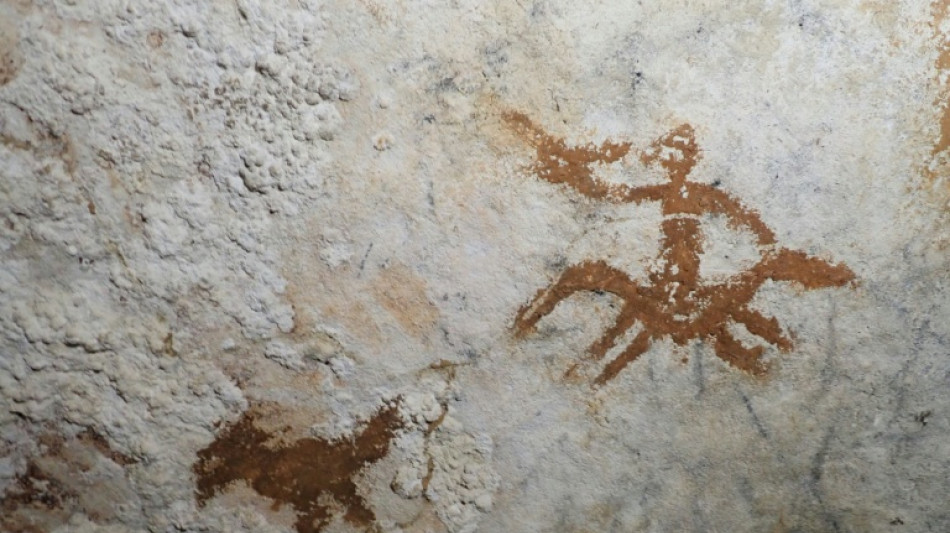
World's oldest cave art discovered in Indonesia / Photo: Maxime AUBERT - GRIFFITH UNIVERSITY/AFP

World's oldest cave art discovered in Indonesia

A red stencil of a hand pressed against the wall of an Indonesian cave is the oldest rock art ever discovered, scientists said Wednesday, and sheds light on how humans first migrated to Australia.

Text size:

The cave art dates back at least 67,800 years, according to research published in the journal Nature by a team of Indonesian and Australian archaeologists.

"We have been working in Indonesia for a long time," study co-author Maxime Aubert of Australia's Griffith University told AFP.

This time they ventured to caves on the island of Muna in the Sulawesi province on the advice of Indonesian archaeologist Adhi Agus Oktaviana, the study's lead author.

There they found "handprints in negative, stencilled, probably using red ochre," Aubert said.

The fingers of one of the hands were "retouched to become pointed like claws -- a style of painting only seen in Sulawesi," the Canadian archaeologist added.

To determine the art's age, the team took five-millimetre samples from "cave popcorn", which are small clusters of calcite that form on the walls of limestone caves.

Then they zapped the layers of rock with a laser to measure how the uranium decayed over time, compared to a more stable radioactive element called thorium.

This "very precise" technique gave the scientists a clear minimum age for the painting, Aubert explained.

At 67,800 years old, the Indonesian stencil is more than a thousand years older than other hand stencils found in a Spanish cave which has been attributed to Neanderthals. However the dating of that cave art "has been controversial," the study cautioned.

The new discovery is also more than 15,000 years older than previous art found in the Sulawesi region by the same team.

The scientists also established that the Muna caves had been used for rock art many times over a long period.

Some of the ancient art was even painted over up to 35,000 later, Aubert said.

- A fork in the road -

Beyond setting a new record, the art also offers clues for a long-running historical mystery.

Scientists have been divided about how Homo sapiens first journeyed from Asia to Australia.

They could have taken the northern route, travelling by boat through Indonesia islands including Sulawesi to Papua New Guinea.

These ancient humans could then have walked the rest of the way -- at the time, Papua New Guinea and Australia were both part of a supercontinent called Sahul.

Or the migrants could have taken the southern route, travelling through the islands of Sumatra, Java and Bali before heading for Timor. Then a boat ride was required to finally make it to Australia.

"These paintings provide the first evidence that modern humans were on these Indonesian islands at that time," Aubert said.

The discovery also "reinforces the idea that people arrived in Australia via Papua, perhaps around 65,000 years ago", he said.

But it could not be ruled that other people were also making their way to Australia via the southern route at the same time, he added.

The researchers also said that the paintings were very likely created by people closely linked to the ancestors of Indigenous Australians.

A.P.Huber--NZN