Plenty of fish but no catch as Sri Lanka economic crisis bites
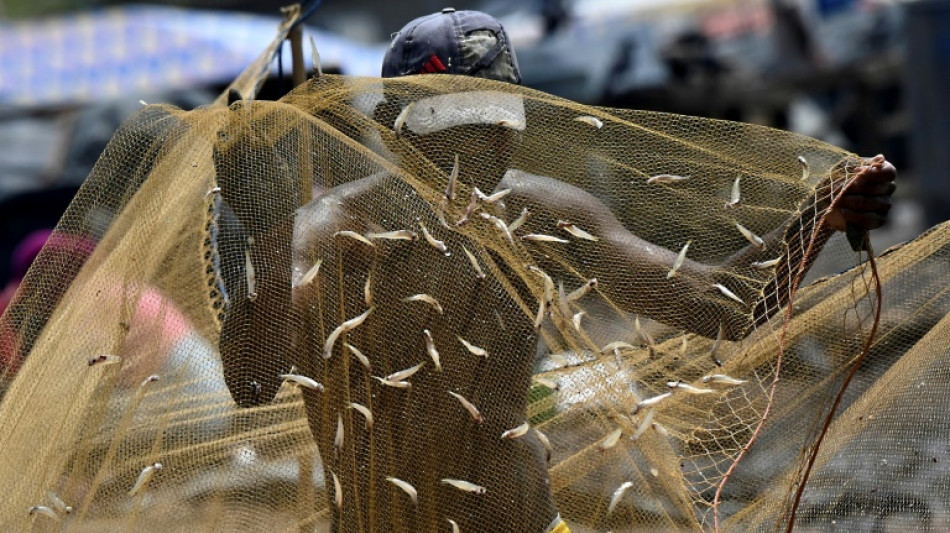
The sky and seas off Sri Lanka's coast are crystal blue but a worsening economic crisis has kept fishermen moored at Negombo harbour, out of gas and unable to reel in the day's catch.
The waters nearby are a tropical bounty of fist-sized prawns and mackerel that normally find their way into the island nation's staple seafood curries.
But the crisis has left coastal communities short of fuel to send their vessels out to the ocean, and the repercussions are rippling down to dinner tables around the country.
"If we queue up by five in the morning, then we will get fuel by three in the afternoon, on good days," Arulanandan, a seasoned member of Negombo's close-knit fishing community, tells AFP.
"But for some, even that is not possible, because by the time they get to the end of the queue, the kerosene is gone."
Around the local estuary, idle crew members sun themselves on deck or lean against the rails of trawlers bobbing in the water, puffing on cigarettes as they listlessly wait for news of a fresh diesel shipment.
Their ships are equipped to go deep into international waters for weeks at a time but the shortages have prevented most from setting sail.
Other fishermen work closer to land, on smaller kerosene-powered motorboats like Arulanandan's, but locals say three in every four of these vessels are not working on any given day.
The adversity has knock-on effects -- if a crew specialising in catching bait has no fuel, then other boats fortunate enough to source kerosene are also forced to stay on land.
"When I can't bring money home, my children ask me, 'Why are you not feeding me?'" Arulanandan says.
"But they don't understand the problems we are going through."
- 'What will everyone else do?' -
An hour's drive south, on the outskirts of the capital Colombo, stands the country's biggest fish market -- a bustling open-air warehouse that usually serves as a hub for wholesale buyers from across the country.
The consequences of Sri Lanka's shrinking catch are being keenly felt here, with far less seafood making its way to stallholders and far fewer customers passing through.
"The buyers come from far away, and because of diesel and petrol shortages, they haven't shown up," says Mohammed Asneer, a young shrimp vendor.
"Our sales have gone down and our expenses have gone up."
Asneer grows exasperated while bemoaning his straitened circumstances and says he would seize any opportunity to leave for abroad.
"I don't want to be in this country anymore," he tells AFP.
"We work in the fish market and we can't even afford to buy a kilo of fish. So what will everyone else do?"
- 'Everything is expensive' -
Sri Lanka's government admits that the current economic crisis is the nation's worst since independence from Britain in 1948.
Inflation is running rampant. The cost of diesel -- when the fuel is available -- has almost doubled in a matter of months, and official figures show the average price of food shot up by 25 percent in January.
"Now everything is expensive -- for us it's very difficult to do business," says K.W. Shiromi, the owner of Mama's Place seafood restaurant in the bucolic southern coastal town of Weligama.
By the roadside, a smattering of foreign tourists select a fish for Shiromi's brother to scale and gut before it is dispatched to the kitchen to be sauteed in chilli and spices.
As a few satisfied customers watch the waves roll in at their tables, Shiromi tells AFP that the rising cost of her catch has forced her to jack up prices.
"If the government does something to make things better, then everyone will be happy," she says.
"Otherwise everyone in Sri Lanka will suffer."
F.E.Ackermann--NZN