Zürcher Nachrichten - Three, two, one: astronomers predict SpaceX space junk will hit the Moon

EUR -
AED 4.26807
AFN 76.126374
ALL 92.206872
AMD 421.806782
ANG 2.08003
AOA 1066.870586
ARS 1753.415385
AUD 1.609841
AWG 2.091904
AZN 1.970654
BAM 1.956404
BBD 2.341272
BDT 142.864093
BGN 1.971463
BHD 0.438233
BIF 3476.238288
BMD 1.162169
BND 1.472998
BOB 14.381231
BRL 5.955953
BSD 1.162454
BTN 109.745765
BWP 15.564536
BYN 3.58099
BYR 22778.506256
BZD 2.337971
CAD 1.606751
CDF 2649.744425
CHF 0.940398
CLF 0.027404
CLP 1082.049236
CNY 7.799665
CNH 7.7972
COP 3638.866374
CRC 527.260463
CUC 1.162169
CUP 30.79747
CVE 110.266773
CZK 24.202179
DJF 207.002998
DKK 7.474633
DOP 68.810941
DZD 154.819155
EGP 59.217024
ERN 17.43253
ETB 188.729389
FJD 2.575832
FKP 0.859697
GBP 0.858697
GEL 3.027427
GGP 0.859697
GHS 13.213212
GIP 0.859697
GMD 86.000106
GNF 10217.845869
GTQ 8.872143
GYD 243.133909
HKD 9.111926
HNL 31.20596
HRK 7.533761
HTG 152.021033
HUF 362.121881
IDR 20497.169125
ILS 3.495397
IMP 0.859697
INR 109.814191
IQD 1522.856904
IRR 1597517.076516
ISK 140.808644
JEP 0.859697
JMD 184.263699
JOD 0.823945
JPY 179.466158
KES 150.396107
KGS 101.630602
KHR 4704.269752
KMF 492.759271
KPW 1045.952159
KRW 1561.82646
KWD 0.358995
KYD 0.96882
KZT 529.454798
LAK 26067.1574
LBP 104099.580962
LKR 381.459373
LRD 203.37327
LSL 18.572512
LTL 3.431582
LVL 0.702985
LYD 7.376245
MAD 10.894875
MDL 20.024094
MGA 4987.453475
MKD 61.588789
MMK 2440.252121
MNT 4180.357205
MOP 9.387417
MRU 46.766233
MUR 54.494406
MVR 17.96749
MWK 2015.687424
MXN 19.655922
MYR 4.702153
MZN 74.301895
NAD 18.572832
NGN 1536.305885
NIO 42.781916
NOK 10.778644
NPR 175.643454
NZD 1.975414
OMR 0.446859
PAB 1.162119
PEN 3.898753
PGK 5.240505
PHP 72.752962
PKR 322.366446
PLN 4.308903
PYG 6955.116673
QAR 4.247668
RON 5.251023
RSD 117.3384
RUB 100.35455
RWF 1711.098659
SAR 4.364928
SBD 9.297945
SCR 15.933325
SDG 699.043175
SEK 11.159521
SGD 1.471009
SHP 0.861011
SLE 28.64689
SLL 24370.095374
SOS 664.393622
SRD 43.849205
STD 24054.545402
STN 24.507037
SVC 10.172358
SYP 15110.517153
SZL 18.575413
THB 38.192309
TJS 10.714872
TMT 4.06759
TND 3.391855
TOP 2.798223
TRY 56.287202
TTD 7.869463
TWD 36.646431
TZS 3073.974524
UAH 51.78069
UGX 4387.07054
USD 1.162169
UYU 46.780752
UZS 13711.054751
VES 937.146216
VND 30236.142718
VUV 137.097747
WST 3.158909
XAF 656.148219
XAG 0.017634
XAU 0.000263
XCD 3.14082
XCG 2.095092
XDR 0.821714
XOF 656.15669
XPF 119.331742
YER 275.433763
ZAR 18.564274
ZMK 10460.940695
ZMW 22.232383
ZWL 374.217843
  • CMSD

    -0.0700

    20.69

    -0.34%

  • CMSC

    -0.1100

    20.81

    -0.53%

  • JRI

    -0.0700

    12.14

    -0.58%

  • BCC

    2.0900

    79.21

    +2.64%

  • RIO

    0.4300

    103.27

    +0.42%

  • BCE

    -0.1400

    23.67

    -0.59%

  • NGG

    -0.0500

    78.12

    -0.06%

  • RBGPF

    0.0000

    70

    0%

  • GSK

    -0.9800

    49.89

    -1.96%

  • RYCEF

    0.1400

    19.92

    +0.7%

  • BTI

    -0.6200

    55.35

    -1.12%

  • BP

    0.2300

    43.81

    +0.52%

  • RELX

    -1.1400

    35.51

    -3.21%

  • VOD

    0.3200

    16.9

    +1.89%

  • AZN

    -2.0700

    162.7

    -1.27%

Three, two, one: astronomers predict SpaceX space junk will hit the Moon

Three, two, one: astronomers predict SpaceX space junk will hit the Moon

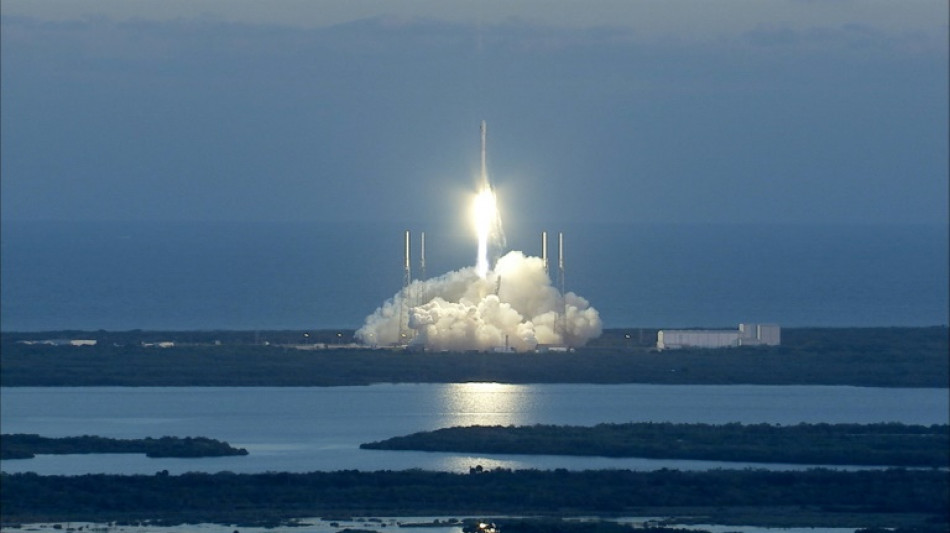
A chunk of a SpaceX rocket that blasted off seven years ago and was abandoned in space after completing its mission will crash into the Moon in March, experts say.

Text size:

The rocket was employed in 2015 to put in orbit a NASA satellite called the Deep Space Climate Observatory.

Since then the second stage of the rocket, or booster, has been floating in what mathematicians call a chaotic orbit, astronomer Bill Gray told AFP Wednesday.

It was Gray who calculated the space junk's new collision course with the Moon.

The booster passed by pretty close to the Moon in January in a rendezvous that altered its orbit, said Gray.

He is behind Project Pluto, software that allows for calculating the trajectory of asteroids and other things in space and is used in NASA-financed space observation programs.

A week after the rocket stage whizzed close to the Moon, Gray detected it again and concluded it will actually crash into the satellite's dark side on March 4.

Gray appealed to the amateur astronomer community to join him in observing the booster -- it is bright and easy to detect -- and his conclusion was confirmed.

The exact time and spot of impact may change a bit from his forecast but there is widespread agreement that there will be a collision on the Moon that day.

"I've been tracking junk of this sort for about 15 years. And this is the first unintentional lunar impact that we've had," Gray told AFP.

The impact of this object weighing four tons on the Moon will not be visible from Earth in real time.

But it will leave a crater that scientists can observe, such as with NASA's Lunar Reconnaissance Orbiter or India's Chandrayaan-2 satellite, and thus learn more about the geology of the Moon.

Spacecraft have been intentionally crashed into the Moon before, for scientific purposes.

In 2009, for instance, NASA sent a rocket stage hurling into the Moon near its south pole to look for water.

But most rockets do not go so far from Earth. SpaceX brings its rocket boosters back through the Earth's atmosphere so they disintegrate over the ocean.

Gray said there could be more unintentional crashes into the Moon in the future as the US and Chinese space programs leave more junk in orbit.

O.Pereira--NZN