Zürcher Nachrichten - 'Kind of complicated': Growing grapes in the world's driest desert

EUR -
AED 4.268807
AFN 76.128995
ALL 96.365789
AMD 443.574615
ANG 2.080444
AOA 1065.758721
ARS 1673.674315
AUD 1.751247
AWG 2.093455
AZN 1.972883
BAM 1.953571
BBD 2.342397
BDT 142.125365
BGN 1.953867
BHD 0.438096
BIF 3447.155519
BMD 1.162224
BND 1.50804
BOB 8.053809
BRL 6.329004
BSD 1.163058
BTN 104.580656
BWP 15.500911
BYN 3.362276
BYR 22779.584681
BZD 2.339131
CAD 1.610773
CDF 2591.758996
CHF 0.937275
CLF 0.027439
CLP 1076.428062
CNY 8.209485
CNH 8.207827
COP 4490.832409
CRC 568.651074
CUC 1.162224
CUP 30.798928
CVE 110.701528
CZK 24.266773
DJF 206.550565
DKK 7.468563
DOP 74.672518
DZD 151.21888
EGP 55.26234
ERN 17.433356
ETB 180.115634
FJD 2.65686
FKP 0.872594
GBP 0.87405
GEL 3.132216
GGP 0.872594
GHS 13.307695
GIP 0.872594
GMD 85.426305
GNF 10097.973317
GTQ 8.90868
GYD 243.282374
HKD 9.044628
HNL 30.532036
HRK 7.533302
HTG 152.312255
HUF 383.891793
IDR 19381.242558
ILS 3.747114
IMP 0.872594
INR 104.480831
IQD 1522.513058
IRR 48958.674107
ISK 148.799483
JEP 0.872594
JMD 186.095232
JOD 0.824019
JPY 182.33256
KES 150.217799
KGS 101.63645
KHR 4655.867651
KMF 492.782924
KPW 1045.997356
KRW 1708.805587
KWD 0.357
KYD 0.969169
KZT 599.785544
LAK 25202.821168
LBP 104077.132901
LKR 358.964185
LRD 205.568257
LSL 19.79245
LTL 3.431744
LVL 0.703018
LYD 6.322329
MAD 10.765097
MDL 19.747955
MGA 5218.384373
MKD 61.544932
MMK 2440.722983
MNT 4122.735213
MOP 9.321682
MRU 46.256927
MUR 53.602018
MVR 17.910378
MWK 2018.202256
MXN 21.148561
MYR 4.782539
MZN 74.265849
NAD 19.793027
NGN 1686.689157
NIO 42.734634
NOK 11.81537
NPR 167.324735
NZD 2.011652
OMR 0.446874
PAB 1.163073
PEN 3.90859
PGK 4.937013
PHP 68.946578
PKR 326.11503
PLN 4.230285
PYG 8132.509524
QAR 4.231668
RON 5.089956
RSD 117.44257
RUB 89.720551
RWF 1687.548824
SAR 4.361312
SBD 9.557922
SCR 16.780765
SDG 699.067862
SEK 10.88745
SGD 1.507979
SHP 0.871969
SLE 27.783516
SLL 24371.247887
SOS 664.205188
SRD 44.885661
STD 24055.68424
STN 24.871587
SVC 10.176212
SYP 12850.659963
SZL 20.001629
THB 37.027262
TJS 10.71737
TMT 4.067783
TND 3.405898
TOP 2.798356
TRY 49.492944
TTD 7.877011
TWD 36.198045
TZS 2847.448133
UAH 49.096939
UGX 4120.244934
USD 1.162224
UYU 45.447355
UZS 13953.658028
VES 299.396029
VND 30650.744745
VUV 141.377858
WST 3.237383
XAF 655.209297
XAG 0.019275
XAU 0.000277
XCD 3.140968
XCG 2.096108
XDR 0.814073
XOF 653.169487
XPF 119.331742
YER 277.248134
ZAR 19.821491
ZMK 10461.401466
ZMW 26.895308
ZWL 374.23556
  • CMSC

    0.0000

    23.22

    0%

  • RBGPF

    0.7600

    79.11

    +0.96%

  • RELX

    0.0250

    39.505

    +0.06%

  • BTI

    -0.1650

    57.245

    -0.29%

  • NGG

    -0.4400

    74.89

    -0.59%

  • GSK

    -1.0650

    47.405

    -2.25%

  • BP

    -0.2300

    35.55

    -0.65%

  • SCS

    0.0200

    16.14

    +0.12%

  • RIO

    1.3350

    74.355

    +1.8%

  • RYCEF

    -0.0500

    14.75

    -0.34%

  • AZN

    -1.2150

    90.065

    -1.35%

  • CMSD

    0.1000

    23.27

    +0.43%

  • BCC

    0.0600

    71.87

    +0.08%

  • VOD

    -0.0150

    12.485

    -0.12%

  • BCE

    -0.1350

    23.205

    -0.58%

  • JRI

    -0.0200

    13.7

    -0.15%

'Kind of complicated': Growing grapes in the world's driest desert
'Kind of complicated': Growing grapes in the world's driest desert / Photo: MARTIN BERNETTI - AFP/File

'Kind of complicated': Growing grapes in the world's driest desert

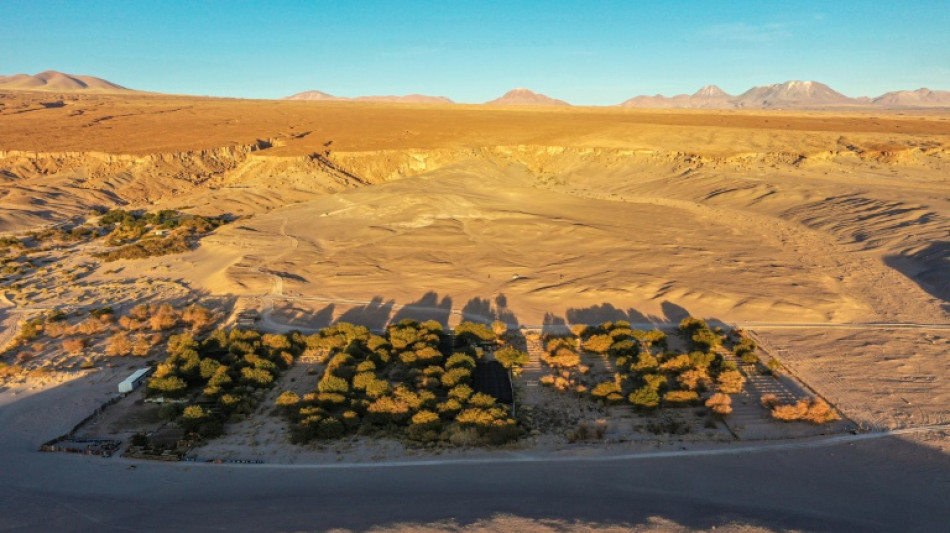
In the middle of Chile's Atacama desert, the driest in the world, Hector Espindola has an unexpected job: he runs a vineyard.

Text size:

Nearly 2,500 meters (8,000 feet) above sea level, his small Bosque Viejo farm produces muscat grapes -- and another of a unique "criollo," or local, variety -- in the shadow of quince, pear and fig trees irrigated by a stream fed by melting Andean snow.

Espindola, 71, farms in an oasis in the Toconao region in Chile's extreme north -- some 1,500 kilometers (932 miles) from the vineyards at the center of the world's longest country that have made it one of the world's top 10 wine exporters.

But growing grapes in the desert is no easy task.

Espindola contends with extreme day-night temperature fluctuations and extreme solar radiation on top of wind and frost.

"You have to be dedicated. I water here at night... at three in the morning, eleven at night," he told AFP while caressing his vines, dry and brown two months after the harvest.

"You have to be careful because here the heat, the climate is no joke," he said.

"Sometimes it is windy and production is lost, sometimes the frost comes early. It is kind of complicated."

- For her sons -

Espindola sends his crop to the Ayllu cooperative which since 2017 has received grapes from 18 small vineyards around Toconao.

In 2021, the cooperative received 16 tons of grapes for a yield of 12,000 bottles.

The harvest was better in 2022 with more than 20 tons of grapes -- enough for 15,000 bottles but still just a drop, at about one percent, of Chile's annual production.

Most contributors to the cooperative are members of indigenous communities who were previously individual, small-scale producers.

One of them, 67-year-old Cecilia Cruz, grows syrah and pinot noir grapes at an altitude of about 3,600 meters outside the village of Socaire -- Chile's highest vineyard.

"I feel special... to have this vineyard here and to produce wine at this altitude," she said amid the vines that still sport a few bunches of wrinkled, dried grapes.

But she has a bigger goal: "a future" for her three sons.

- 'Taste the Atacama' -

For Ayllu oenologist Fabian Munoz, 24, the mission is to create a unique wine that captures the characteristics of the volcanic rock in which the grapes grow.

"When the consumer tastes an Ayllu wine (they should) think: 'Wow! I'm tasting the Atacama desert'," he said.

Carolina Vicencio, an expert in wine chemistry, said the altitude, low atmospheric pressure and extreme temperature fluctuations make for a thicker-skinned grape.

"This generates more tannin molecules in the skin of the grape which gives a certain bitterness in the wine," she said.

"There is also higher salinity of the soil... which makes for a touch of mineralization in the mouth" that makes the Atacama desert wine one of a kind.

D.Smith--NZN