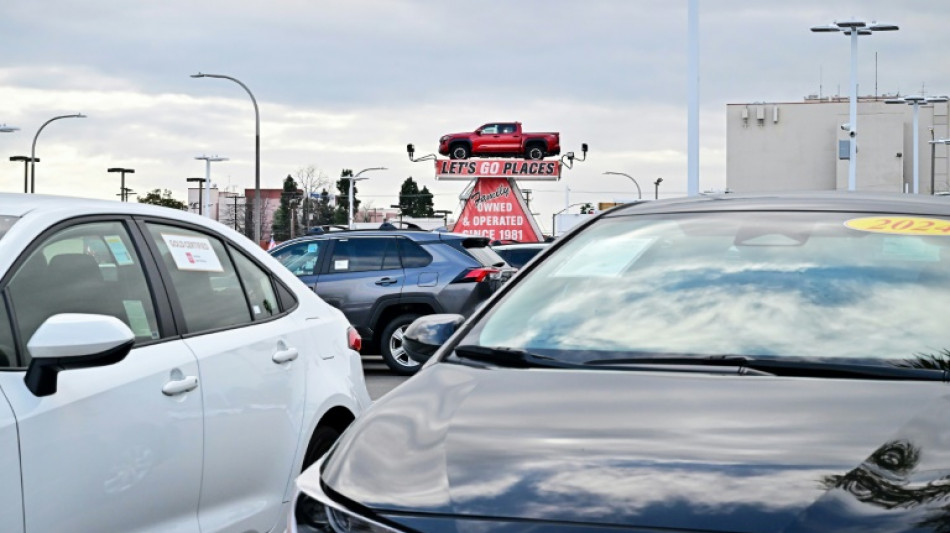
Carmakers face doubts and jolts over US tariffs / Photo: Frederic J. BROWN - AFP/File
Raise prices or cut into their margins, open or close factories: carmakers must soon make major decisions as the United States imposes stiff tariffs on imported vehicles.
The 25-percent tariffs that the administration of President Donald Trump is imposing as of April 3 will apply to cars and car parts not manufactured in the United States.
But all carmakers will be impacted, as even US automakers import foreign parts and manufacture vehicles for the US market in neighbouring Canada and Mexico.
The Bank of America estimates that the tariffs will apply to 7.3 million vehicles, or eight percent of global sales, and will expose carmakers to added costs and chaos.
- Taking stock -
One, albeit temporary, strategy to cope with the new tariffs is to avoid them by shipping as many vehicles as possible to the United States before they come into force.
"Shipments have expanded quite a bit to absorb the first shock" of the tariffs, said Fitch Ratings Director Cigdem Cerit.
"Everyone did build a little buffer," she added.
South Korea's Hyundai was among the automakers that most built up its stock of cars, according to Cox Automotive, an automotive services firm. Meanwhile, Stellantis ate into its ample stocks that had weighed on results in previous quarters.
But the stocks will likely last no more than a few weeks, especially if Americans rush to dealers to snap up any remaining deals.
"After an initial, short surge in buying, we expect vehicle sales to fall, new and used prices to increase, and some models to be eliminated if tariffs persist," said Jonathan Smoke, chief economist at Cox Automotive.
- Sticker shock -
It is an open question about how much car prices will rise and to what extent sales will fall.
The Bank of America estimates that US vehicle prices would rise by approximately $10,000 if manufacturers fully pass on the cost of tariffs and maintain their profit margins.
"However, we don't expect consumers would absorb the price increase in full," said analysts at the bank.
Carmakers "are more likely to sell vehicles at breakeven until they rebalance the production footprint," it said, estimating that US consumers would see price hikes of around $4,500.
Mid-range imported vehicles are likely to feel the pinch, such as the Chevrolet Silverado pick-up and the Toyota Rav4 SUV.
But even manufacturers like Porsche could have trouble passing on the cost of tariffs on low-end models like its Macan SUV, said Fitch's Cerit.
Ferrari was the first carmaker to announce a hike in prices -- as much as 10 percent -- on vehicles sold in the United States, its top market.
A major question is whether consumers continue to buy the same vehicles at a higher price, said Deloitte auto analyst Guillaume Crunelle.
He believes that is unlikely as "people buy in the price bracket that corresponds with their means".
- Made in the USA -
Donald Trump has stated that the goal of the tariffs is to encourage manufacturing jobs to return to the United States, but it is unclear whether that will be achieved.
Crunelle said companies will ask themselves: "Is it more competitive to manufacture in the United States, with a weaker market, or to pay customs duties?"
US manufacturers are still hoping that tariffs will be reduced on vehicles imported from Canada and Mexico, where they have numerous factories.
"Manufacturers have need for certainty," said automotive sector analyst Sebastien Amichi at the consulting firm Kearney.
Hyundai and Stellantis have announced the opening or reopening of factories since Trump's November re-election.
But such moves take time: up to several years to bring a factory online. And suppliers, which are also in a weak position due to the switch to electric vehicles, must also follow manufacturers.
European and Japanese carmakers that play Trump's game face a double cost according to Deloitte's Crunelle: in addition to building new factories they have to pay the costs of laying off workforces at home.
Some may refuse to have their arms twisted into manufacturing in the United States.
"I'll bet that certain manufacturers will prefer to reduce their production costs" at home rather than set up in the United States, Crunelle said.
O.Pereira--NZN