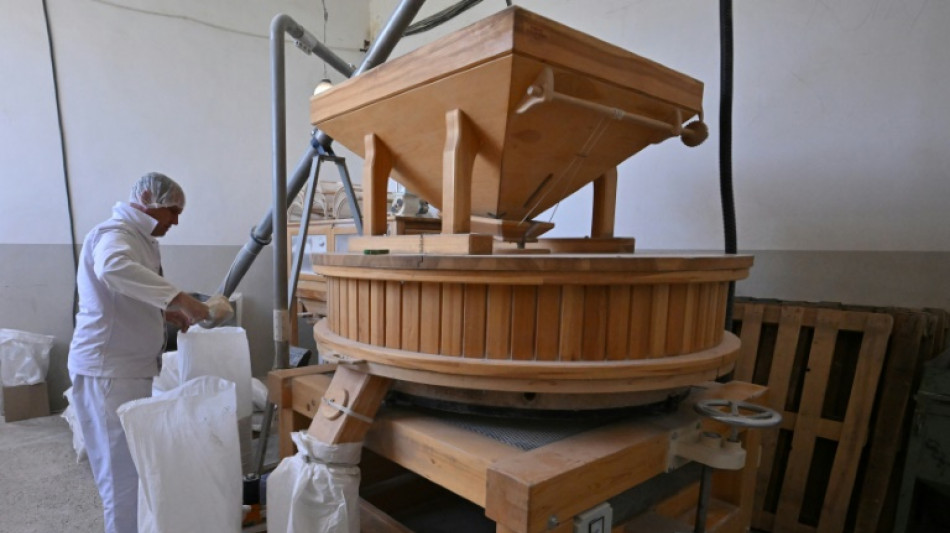
Russian farmers seek to ride out Western sanctions / Photo: Yuri KADOBNOV - AFP
Yevgeny Shifanov, co-owner of an organic farm, says his business has felt the sting of Western sanctions and he is no longer able to sell his grain to Europe.
But the 42-year-old puts on a brave face, saying he is pivoting to ex-Soviet countries such as Belarus as well as domestic clients.
"We are more interested in our internal market, our economy," the co-owner of Chyorny Khleb ("Black Bread") told AFP.
Shifanov's business -- located in the village of Khatmanovo, some 150 kilometres (90 miles) south of Moscow on the banks of the Oka River -- is one of numerous small farms that have mushroomed in Russia over the past decade.
Moscow's military intervention in Ukraine has devastated crops and farming in the pro-Western nation and disrupted crucial deliveries from Ukraine fuelling concern about hunger and food prices worldwide.
The military campaign also put a major focus on Russia's own agriculture sector.
The country is the largest wheat exporter in the world and has been accused by the West of using grain as a geopolitical tool.
While Russia appears to be calling the shots in the current grain standoff with the West, experts say that its own agricultural sector is also bracing for tough times.
At Chyorny Khleb, which cultivates cereals on just over 1,000 hectares of land, green wheat stalks are knee-high. The farmers are enjoying a relative lull before harvesting starts in late July.
"In March or April, we begin to prepare the land, then we plant. Soon we will reap the results of our work," said Alexei Yershov, a 28-year-old tractor driver before climbing into his red-and-black tractor and setting off into a buckwheat field.
- New reality -
The outlook for the season is good, with the agriculture ministry forecasting a harvest of 130 million tonnes including a record 87 million tonnes of wheat.
But the farmers admit they have struggled since the onset of unprecedented Western sanctions.
"We have faced logistical problems," said Shifanov, adding that he has partners in Europe and Israel but the trucks carrying his farm's produce abroad were blocked at the border.
"We have buyers abroad, but we can't do anything, we can't deliver there, now we can only make do with our domestic market," he said.
He added that he was also searching for partners in Belarus, Armenia and Kazakhstan.
The farm is gradually adjusting to the new reality.
Like many other Russian businesses, the farm went on a "panic buying" spree in the first few weeks of the crisis, purchasing a year's worth of packaging supplies that are now gathering dust.
One of Shifanov's partners is now running out of glue needed to make labels.
"It was imported from Europe," said Shifanov, standing in a shed between mounds of wheat.
"They are trying to solve the problem via China but the logistics remain complicated," he added.
In a nearby building, Roman Tikhonov, 40, works on an Austrian-made wooden milling machine.
The miller said that the farm is learning to operate without foreign-made spare parts.
"Recently, something broke, we found the material and fixed it," he said.
"Before the spare parts arrived from Austria, we waited a long time, now we make them ourselves, it's faster."
The Ukrainian-made milling machine next-door has been receiving its spare parts via Belarus since the outbreak of hostilities between Ukrainian forces and Moscow-backed separatists in 2014.
Shifanov nevertheless says he is relieved that his tractors were mainly made in Russia or Belarus.
- Trading at a discount -
The grain market is also adjusting to the new conditions.
Before Russia's military campaign, the price of wheat was already high at around $300 per tonne but now it is more than $400.
Andrey Sizov, the head of Sovecon, a Russian agriculture consultancy, said that Russia is now selling its grain -- just like its oil -- at a discount.
"The war discount for Russian grain is $20 per tonne," he told AFP.
"Russian grain has become cheaper than, for example French grain, because you have to reflect and price in those additional costs like freight, insurance, problems with payments."
Sizov also pointed out that not only do farmers face higher production costs due to inflation, authorities in 2021 introduced strict export taxes that take about "30 percent of farmers revenue".
"The irony is current record high wheat prices were driven mainly by the Russian war but at the same time Russian farmers are not benefiting from them."
M.Hug--NZN