Ancient bread rises again as Turkey recreates 5,000-year-old loaf / Photo: Yasin AKGUL - AFP
In the early Bronze Age, a piece of bread was buried beneath the threshold of a newly built house in what is today central Turkey.
Now, more than 5,000 years later, archaeologists have unearthed it, and helped a local bakery to recreate the recipe -- with customers lining up to buy it.
Round and flat like a pancake, 12 centimetres (five inches) in diameter, the bread was discovered during excavations at Kulluoba, a site near the central Anatolian city of Eskisehir.
"This is the oldest baked bread to have come to light during an excavation, and it has largely been able to preserve its shape," said Murat Turkteki, archaeologist and director of the excavation.
"Bread is a rare find during an excavation. Usually, you only find crumbs," he told AFP.
"But here, it was preserved because it had been burnt and buried," he said.
The bread was charred and buried under the entrance of a dwelling built around 3,300 BC.
A piece had been torn off, before the bread was burnt, then buried when the house was built.
"It makes us think of a ritual of abundance," Turkteki said.
- 'Moved by this discovery' -
Unearthed in September 2024, the charred bread has been on display at the Eskisehir Archaeological Museum since Wednesday.
"We were very moved by this discovery. Talking to our excavation director, I wondered if we could reproduce this bread," said the city's mayor, Ayse Unluce.
Analyses showed that the bread was made with coarsely ground emmer flour, an ancient variety of wheat, and lentil seeds, with the leaf of an as yet undetermined plant used as yeast.
Ancient emmer seeds no longer exist in Turkey.
To get as close as possible to the original recipe, the municipality, after analysing the ancient bread, decided to use Kavilca wheat, a variety that is close to ancient emmer, as well as bulgur and lentils.
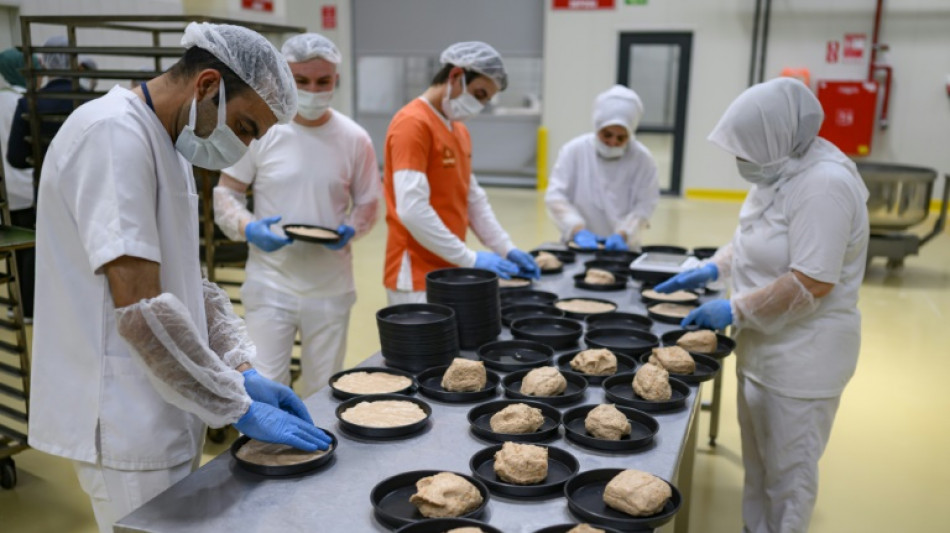
At the Halk Ekmek bakery (meaning "People's Bread" in Turkish), promoted by the municipality to offer low-cost bread, employees have been shaping 300 loaves of Kulluoba by hand every day.
"The combination of ancestral wheat flour, lentils and bulgur results in a rich, satiating, low-gluten, preservative-free bread," said Serap Guler, the bakery's manager.
The first Kulluoba loaves, marketed as 300-gramme (11-ounce) cakes that cost 50 Turkish lira (around $1.28), sold out within hours.
"I rushed because I was afraid there wouldn't be any left. I'm curious about the taste of this ancient bread," said customer Suzan Kuru.
- Drought resistant -
In the absence of written traces, the civilisation of Kulluoba remains largely mysterious.
In the Bronze Age, the Hattians, an Anatolian people who preceded the Hittites, lived in the Eskisehir region.
"Kulluoba was a medium-sized urban agglomeration engaged in commercial activities, crafts, agriculture and mining. There was clearly a certain family and social order," said archaeologist Deniz Sari.
The rediscovery of the bread has sparked interest in the cultivation of ancient wheats better adapted to drought.
Once rich in water sources, the province of Eskisehir is today suffering from drought.
"We're facing a climate crisis, but we're still growing corn and sunflowers, which require a lot of water," said Unluce, the local mayor.
"Our ancestors are teaching us a lesson. Like them, we should be moving towards less thirsty crops," she added.
The mayor wants to revive the cultivation of Kavilca wheat in the region, which is resistant to drought and disease.
"We need strong policies on this subject. Cultivating ancient wheat will be a symbolic step in this direction," she said.
"These lands have preserved this bread for 5,000 years and given us this gift. We have a duty to protect this heritage and pass it on."
T.Furrer--NZN