Russia and China eye NATO's 'Arctic Achilles heel' / Photo: Jonathan NACKSTRAND - AFP/File
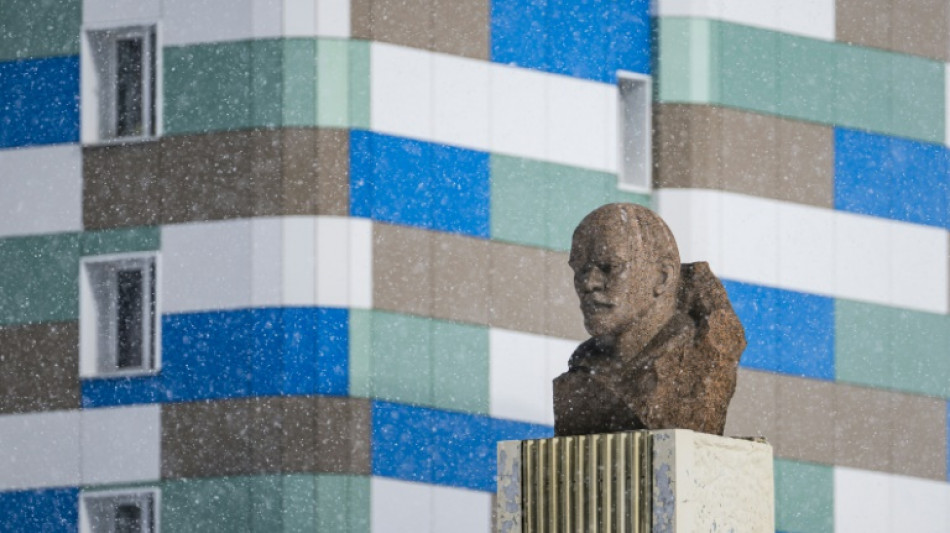
Russian flags flap in the stiff polar breeze, a bust of Lenin looms out of the snow and a vast slogan declares, "Communism is our goal!"
No, this is not some time warp Soviet settlement lost in the Arctic wastes, but a corner of Norway where Moscow can -- theoretically at least -- mine, build, drill and fish what it likes.
Welcome to Spitsbergen, the largest island of the Svalbard archipelago and "NATO's Achilles heel in the Arctic".
These spectacular islands of glaciers and mountain peaks halfway between Norway and the North Pole are a strategic and economic bridgehead not just for Moscow but also for Beijing.
All because of one of the most bizarre and little-understood international treaties ever concluded, which gives Norway sovereignty but allows the citizens of 46 countries to exploit the islands' potentially vast resources on an equal footing.
Which is why 370 Russians and Ukrainian miners from the Donbass work in Barentsburg, a cut-off corner of Spitsbergen where the Soviets dug coal for decades and where it is pitch dark for nearly three months of the year.
"Spitsbergen has been covered with Russian sweat and blood for centuries," Moscow's consul Sergey Gushchin said.
"I'm not arguing that it's not Norwegian territory but it's part of Russian history," he added.
He makes no attempt to hide that some Ukrainians have left since the Russian invasion in February.
Moscow has long wanted a bigger say in the archipelago which has been a haunt of its hunters, whalers, fishermen since the 16th century.
It also insists on calling the islands by the original Spitsbergen rather than the Norwegian Svalbard, the official name since shortly after the treaty handing them to Norway was signed in 1920 while Russia was otherwise engaged with the civil war between Reds and Whites.
- Nuclear submarines -
Nuclear submarines from Russia's powerful Northern Fleet also have to pass close to Svalbard's southernmost Bear Island to get into the North Atlantic.
Russia's "main interest is to avoid a situation (where) others use (the islands) offensively," said political scientist Arild Moe of Norway's Fridtjof Nansen Institute.
To make sure that happens they "maintain a reasonable presence and are very attentive to what is going on," he added.
After failing to get joint authority of the islands at the end of World War II, Russia is now pushing -- without much success -- for "bilateral consultations" to lift the brakes on its activities.
But with no road to the capital Longyearbyen, visitors have to come to Barentsburg by boat or snowmobile -- depending on the season -- to admire what was for decades a Soviet showpiece on the Western side of the Iron Curtain.
Barentsburg holds onto its Soviet relics "not because we still have hope for communism but because we value our heritage -- and tourists also like taking pictures" of themselves with them, said Russian historian and tourist guide Natalia Maksimishina.
- Ringfencing the Russians -
Moscow accuses Norway of using environmental protection to hamstring its ambitions, with Russian helicopter flights for instance strictly controlled.
"We started to put nature reserves around Russian sites," admitted former diplomat Sverre Jervell, the architect of Norwegian policy in the Barents Sea which separates the islands from Norway and Russia.
"Particularly after the end of the Cold War and the collapse of the USSR when Barentsburg struggled to stay afloat."
This "wasn't officially" done to curtail the Russians, Jervell said, but in reality that is what happened. "Of course we had good arguments, the environment is very fragile," he said.
And Norway was treaty-bound to protect the islands' nature. "But we particularly protected the areas around Russian sites."
With another Soviet mining operation at Pyramiden, there was actually more Russians than Norwegians on the islands at the end of the Cold War.
Moscow regularly accuses Oslo of violating one of the most important articles of the 1920 treaty which effectively makes Svalbard a demilitarised zone.
It protests every time a Norwegian frigate docks or NATO lawmakers visit, and is particularly wary of the gigantic Svalsat satellite station near Longyearbyen.
On a windy plateau near the Global Seed Vault -- a "Noah's Ark" where 1,145,693 seed varieties are frozen in case of catastrophe -- some 130 antennae covered by giant golf-ball domes communicate with space.
They also download data from military satellites, Moscow suspects.
In January, one of two fibre optic cables linking Svalsat with the mainland was mysteriously damaged.
Russia too has been accused of taking liberties with the treaty, like when its then deputy prime minister Dmitry Rogozin -- who had been sanctioned by Europe over the annexation of Crimea -- turned up unannounced in Svalbard in 2015.
Or when Chechen special forces made a stopover there the following year on their way to a military exercise close to the North Pole.
"Svalbard is sensitive to the general international climate," said Norwegian analyst Moe. "It is somewhere where Russia can easily express its dissatisfaction by putting Norway under pressure."
- 'Neutralising NATO' -
Svalbard is "the Achilles heel of NATO in the Arctic", said James Wither, a professor at the George C. Marshall European Center for Security Studies in Germany, because its distance from mainland Norway and "peculiar legal status provides a range of possible pretexts for Russian intervention.
"Although the danger of a direct military confrontation remains low, Svalbard is particularly vulnerable to a Russian gamble that offers the strategic payoff of advancing Russia's long-term objectives of dividing the West and neutralising NATO," the former British Army officer wrote in 2018.
Norway tries to play down Russian grievances, saying that they are far from new and insists that its sovereignty over the islands is no different to any other part of its territory.
Praised for his rapport with his Russian opposite number Sergei Lavrov when he was foreign minister between 2005 and 2012, Norwegian Prime Minister Jonas Gahr Store is an apostle of Oslo's "High North, low tensions" doctrine.
"I would not say that we are being tested," he said, "but there is growing interest in the Arctic from countries from there and from afar."
"We wish to see the communities in Svalbard developed when it comes to new activities, research, (and) tourism... and that will be done in a transparent fashion," he added.
Even so, Norway spent 300 million kroner (33.5 million euros) in 2016 buying a huge estate near Longyearbyen, the only one in private hands in the archipelago.
Russia has been quick to play on fears of the arrival of new powers like China.
"If we leave Spitsbergen, then who might come in our place?" said the Russian consul Gushchin from his impressive residence on a hill overlooking Barentsburg. "It might be China for example, or the United States or any member state of the Spitsbergen Treaty."
- China planting flag -
Like its high-latitude neighbours Greenland, Iceland and the Faroe Islands, Svalbard seems to be in China's sights. Indeed it now defines itself as a "near-Arctic" state and wants to establish a "Polar Silk Road".
With the region heating up three times faster than the planet, shrinking ice floes are opening up economic opportunities and maritime routes, although some are more theoretical than real.
With new fishing grounds and easier access to potential resources like oil and gas fields, everyone is trying to get a foot in the door.
It is hard to miss China's Institute of Polar Research in Spitsbergen's third biggest settlement Ny-Alesund, a former mining community now given over to international science.
Two marble lions -- symbols of imperial China -- guard the entrance of the Norwegian-owned building known as the Yellow River Station by its occupants.
It is a flagrant example of "flag showing", according to Torbjorn Pedersen, a political science from Norway's Nord University in Bodo.
"Some foreign capitals... cast their presence there as national stations and strategic footholds, potentially entitling them to political power and influence on the islands and in the wider Arctic region," he wrote in the Polar Journal last year.
"Some of the research presence in Svalbard may seem geopolitically motivated," Pedersen added.
"If consolidated, the strategic presence could potentially embolden some... including great powers, with regional aspirations and become a real security challenge for host nation Norway."
Oslo takes a dim view of "scientific diplomacy" more suited to Antarctica than a sovereign nation.
In 2019 it began trying to discourage the idea of national research stations from which countries could fly their flag in favour of sharing research facilities.
The Franco-German station appears to be the first to feel the change. Since 2014 Paris and Berlin have been trying to centralise researchers scattered over several sites in one new building, but they have gotten nowhere.
Privately the Norwegians say they do not want to create a precedent.
"We cannot allow the French to do one thing and refuse the Chinese," said Jervell. "The principle of the Svalbard Treaty is not to discriminate."
P.Gashi--NZN