Zürcher Nachrichten - South Korea sees record birth rate growth for Jan-May

EUR -
AED 4.2804
AFN 77.00368
ALL 96.580114
AMD 443.844105
ANG 2.086359
AOA 1068.789777
ARS 1667.072313
AUD 1.75332
AWG 2.097951
AZN 1.972067
BAM 1.95641
BBD 2.346432
BDT 142.534443
BGN 1.956969
BHD 0.439237
BIF 3442.173288
BMD 1.165528
BND 1.509171
BOB 8.05051
BRL 6.337098
BSD 1.164963
BTN 104.746008
BWP 15.477826
BYN 3.34933
BYR 22844.356995
BZD 2.343021
CAD 1.610702
CDF 2601.459778
CHF 0.936391
CLF 0.027497
CLP 1078.694141
CNY 8.240402
CNH 8.237693
COP 4469.789828
CRC 569.077441
CUC 1.165528
CUP 30.886503
CVE 110.300339
CZK 24.202217
DJF 207.454686
DKK 7.468822
DOP 74.563249
DZD 151.128474
EGP 55.300711
ERN 17.482926
ETB 180.702444
FJD 2.634618
FKP 0.87379
GBP 0.873581
GEL 3.141131
GGP 0.87379
GHS 13.252075
GIP 0.87379
GMD 85.083348
GNF 10123.113015
GTQ 8.923897
GYD 243.734952
HKD 9.068103
HNL 30.683567
HRK 7.536076
HTG 152.507553
HUF 382.108583
IDR 19440.198145
ILS 3.771312
IMP 0.87379
INR 104.826468
IQD 1526.169321
IRR 49083.310339
ISK 149.000846
JEP 0.87379
JMD 186.468142
JOD 0.826379
JPY 180.641781
KES 150.704975
KGS 101.925779
KHR 4664.454402
KMF 491.852653
KPW 1048.974993
KRW 1710.424855
KWD 0.357782
KYD 0.970899
KZT 589.161176
LAK 25262.768695
LBP 104325.381679
LKR 359.340503
LRD 205.046574
LSL 19.744372
LTL 3.441503
LVL 0.705017
LYD 6.332975
MAD 10.760055
MDL 19.822096
MGA 5196.620335
MKD 61.65949
MMK 2447.140495
MNT 4134.564794
MOP 9.342073
MRU 46.457486
MUR 53.695494
MVR 17.951093
MWK 2020.129888
MXN 21.173224
MYR 4.786804
MZN 74.489031
NAD 19.744372
NGN 1688.908807
NIO 42.873184
NOK 11.769391
NPR 167.591256
NZD 2.01278
OMR 0.447119
PAB 1.165063
PEN 3.916021
PGK 4.94352
PHP 68.665964
PKR 326.607938
PLN 4.229528
PYG 8012.498341
QAR 4.246479
RON 5.092157
RSD 117.437121
RUB 89.449495
RWF 1695.028519
SAR 4.374346
SBD 9.592989
SCR 15.753845
SDG 701.063515
SEK 10.942261
SGD 1.509937
SHP 0.874448
SLE 27.624965
SLL 24440.545996
SOS 664.607228
SRD 45.023208
STD 24124.085063
STN 24.507536
SVC 10.194135
SYP 12887.05829
SZL 19.729152
THB 37.116255
TJS 10.68907
TMT 4.091005
TND 3.41751
TOP 2.806313
TRY 49.62585
TTD 7.898242
TWD 36.289912
TZS 2873.610463
UAH 48.90845
UGX 4121.267354
USD 1.165528
UYU 45.564794
UZS 13937.405549
VES 296.687514
VND 30729.156744
VUV 141.449819
WST 3.250206
XAF 656.161595
XAG 0.020144
XAU 0.000277
XCD 3.149899
XCG 2.099646
XDR 0.816054
XOF 656.161595
XPF 119.331742
YER 278.037051
ZAR 19.730882
ZMK 10491.15474
ZMW 26.934398
ZWL 375.299675
  • NGG

    -0.5000

    75.41

    -0.66%

  • GSK

    -0.1600

    48.41

    -0.33%

  • CMSC

    -0.0500

    23.43

    -0.21%

  • RIO

    -0.6700

    73.06

    -0.92%

  • AZN

    0.1500

    90.18

    +0.17%

  • SCS

    -0.0900

    16.14

    -0.56%

  • RBGPF

    0.0000

    78.35

    0%

  • JRI

    0.0400

    13.79

    +0.29%

  • RYCEF

    -0.0500

    14.62

    -0.34%

  • BCC

    -1.2100

    73.05

    -1.66%

  • CMSD

    -0.0700

    23.25

    -0.3%

  • BCE

    0.3300

    23.55

    +1.4%

  • BTI

    -1.0300

    57.01

    -1.81%

  • BP

    -1.4000

    35.83

    -3.91%

  • VOD

    -0.1630

    12.47

    -1.31%

  • RELX

    -0.2200

    40.32

    -0.55%

South Korea sees record birth rate growth for Jan-May
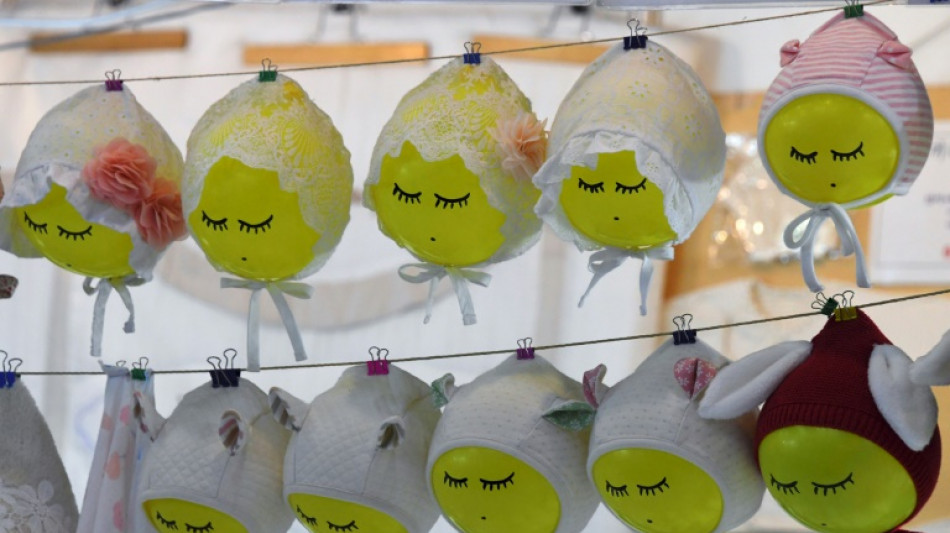
South Korea sees record birth rate growth for Jan-May / Photo: JUNG Yeon-Je - AFP/File

South Korea sees record birth rate growth for Jan-May

South Korea registered record birth rate growth during the first five months of the year, a statistics agency official told AFP on Wednesday.

Text size:

The country has one of the world's longest life expectancies and lowest birth rates -- a combination that presents a looming demographic challenge.

Seoul has poured billions of dollars into efforts to encourage women to have more children and maintain population stability.

"The number of newborns for the January–May period stood at 106,048, a 6.9 percent increase, the highest growth rate since such data collection began in 1981," said Kang hyun-young from Statistics Korea.

The surge follows South Korea's first annual increase in the number of births in more than a decade, driven by a rise in marriages. In 2024, the number of newborns rose by 8,300, or 3.6 percent, to 238,300 from the previous year.

April in particular saw a spike, with year-on-year growth reaching 8.7 percent and the number of births totalling 20,717 that month.

The latest figure marks a sharp turnaround from early 2024, when the number of births for the January–May period dropped by 2.7 percent from the previous year.

The fertility rate, or the average number of babies a woman is expected to have in her lifetime, for May stood at 0.75.

The country needs a fertility rate of 2.1 children in order to maintain the country's population of 51 million.

At current rates, the population will nearly halve to 26.8 million by 2100, according to the Institute for Health Metrics and Evaluation at the University of Washington in Seattle.

- Marriage correlation -

The increase is attributable "to a rise in the number of women in their early 30s, leading to an overall increase in marriages", Kang told AFP.

"In South Korea, there is a strong correlation between marriage and childbirth, which has driven the increase in births during the first five months," she added.

In 2024, the country saw a 14.8 percent on-year increase in the number of marriages, with more than 220,000 couples tying the knot.

Many government benefits designed to support child-rearing do not cover parents who are not legally married.

Analysts say there are multiple reasons for the low birth rate, from high child-rearing costs and property prices to a notoriously competitive society that makes well-paid jobs difficult to secure.

The double burden for working mothers of managing the brunt of household chores and childcare while also maintaining their careers is another key factor, they say.

In a bid to reverse the trend, the South Korean government offers cash subsidies, babysitting services, and support for infertility treatment.

Neighbouring Japan is grappling with the same issue -- it has the world's second-oldest population after Monaco, and the country's relatively strict immigration rules mean it faces growing labour shortages.

O.Hofer--NZN