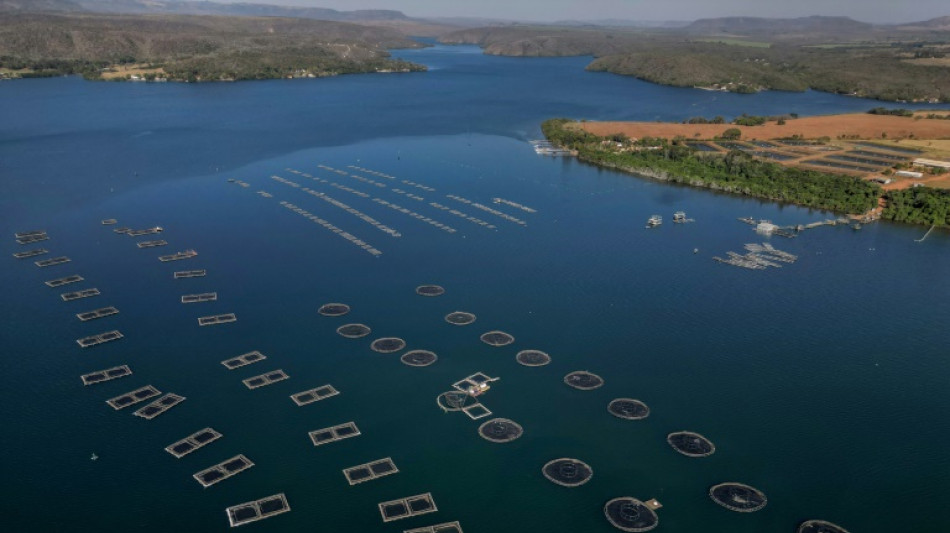
Trump's tariffs drown Brazil's fish industry / Photo: Nelson ALMEIDA - AFP
When the water pump is switched on, hundreds of tilapia come to the surface of a pond at a Brazilian fish farm. Their final destination is now uncertain because of US President Donald Trump's stiff tariffs.
Fish are one of the Brazilian products subject to a whopping 50 percent levy imposed by Washington a week ago -- a stunning blow to the industry, which now fears layoffs, given that 60 percent of its exports go to the United States.
Fider Pescados, Brazil's second biggest exporter of tilapia, manages 400 fish ponds along the Rio Grande in the southeastern state of Sao Paulo, the country's most populous and richest.
Tilapia raised there are processed at a company factory in Rifaina, a small town of 4,000 residents.
Before the new wave of tariffs, 40 percent of the 9,600 tonnes of fish produced annually by Fider Pescados was shipped to the United States. Now, exports have already plummeted by a third.
"We're expecting sales to the US to bottom out, as the 50 percent tariff is untenable," company director Juliano Kubitza told AFP.
Once hatched, it takes eight months for farm-raised tilapia -- a mild white fish -- to reach supermarket shelves.
"This isn't like the production cycle for chicken -- that only takes 40 days and so you can recalibrate" the production schedule, explained Kubitza, whose company employs 500 people.
"In the fish industry, it's like a moving train -- you can't hit the brakes too suddenly."
Kubitza is now in a race against time to find new markets for his product, and he is under no illusions that it will be easy.
"No other country consumes as much (tilapia) as the United States," he said.
- 'Hammer blow' -
Sergio Secco, a 43-year-old team leader in Fider Pescados' fish ponds, knows that he is at serious risk of losing his job.
"I told the younger staff that tariffs would be a hammer blow. Whether we want it or not, it will have consequences on production and jobs, as we export a huge amount" to the US market, he said.
Some 20,000 employees in Brazil's fish industry "could be laid off or made redundant by staff cuts," warned the Brazilian Fish Industry Association.
While Fider Pescados has not talked about cutting any jobs so far, Rafaela Ferreira do Nascimento, a 26-year-old who prepares tilapia filets for export in the Rifaina factory, admitted she is "a bit afraid" to find herself without work.
In the short term, the company cannot let anyone go. Staff cuts would prevent it from handling all of the fish ready for harvesting.
- Search for new markets -
Once a fish reaches a certain weight, it must be taken to the factory for processing before being shipped -- fresh or frozen.
US buyers mainly purchase fresh tilapia, which is sold at a higher profit margin.
"If the tariffs cut into exports, we will have to freeze some products" that were intended to be sold fresh, said production supervisor Samuel Araujo Carvalho.
"Few other countries could buy fresh fish from us," said Kubitza, who hopes to boost sales at home, which already account for 50 percent of total production.
But those domestic sales would fetch a far lower price than the company intended to charge before the tariffs kicked in.
"Since the tariff hike, they are offering us sale prices, but before they were too expensive, and now I don't plan to buy from them," said one restaurant owner in Rifaina, on condition of anonymity.
As it looks for new markets, Fider Pescados has been forced to put on hold a planned expansion, which would have allowed it to increase production by 35 percent.
W.Vogt--NZN