Bondi shooting shocks, angers Australia Jewish community / Photo: DAVID GRAY - AFP
Near the iconic, sun-soaked Sydney beach where father-and-son gunmen killed 15 people as they fired into crowds at a Hanukkah festival, Jewish Australians say they feel unsafe and angry.
Among those killed were two survivors of the Holocaust who found a home in Australia, a 10-year-old girl, a couple shot after tackling one of the assailants, and others who died trying to protect loved ones.
The attack at Bondi Beach on Sunday was one of the deadliest in Australian history.
As the first of the 15 people killed were laid to rest Wednesday, Jewish Australians said they felt unsafe, angry and frustrated at perceived government foot-dragging in confronting antisemitism.
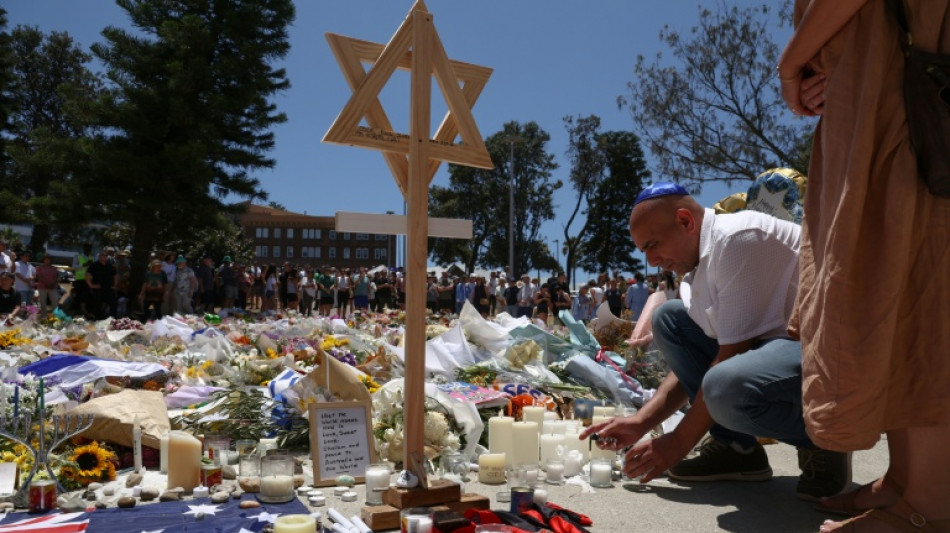
"Do we feel safe? You know, the answer is 'not really', to be honest," rabbi Yossi Friedman told AFP at a floral memorial for the victims.
"We thought we were safe. Our grandparents and great grandparents -- Holocaust survivors -- many of them came to here to escape hate and to escape bloodshed, pogrom, persecution," he said.
"We're finding it here again."
Like others who spoke to AFP, he said an October 9, 2023 pro-Palestinian rally at the Sydney Opera House where some participants hurled antisemitic insults was a turning point for many Jews.
"We saw the police stand by and do nothing and, sadly, we've seen that from that moment on hate was allowed to fester."
- 'Like a prison' -
The government's special envoy to combat antisemitism, Jillian Segal, said this week that anti-Jewish prejudice has been "seeping into society for many years and we have not come out strongly enough against it".
Segal was appointed Australia's first antisemitism envoy last year after a string of attacks in Sydney and Melbourne following the October 7, 2023 Hamas attack on Israel and the ensuing war in Gaza.
In the 12 months after the Hamas assault, she said antisemitic incidents in Australia had surged 316 percent to more than 2,000 -- including threats, assaults, vandalism and intimidation.
"We should be able to be who we are and not be afraid," said 37-year-old data analyst Brett Ackerman.
"I went to a Jewish school. My children went to the same Jewish school I did. You know, every parent there does security -- you stand outside the school with a walkie-talkie," he told AFP.
"There's armed people there and it's getting more and more like a prison," he added.
"We work with the police and unfortunately, it's necessary."
Prime Minister Anthony Albanese has decried the Bondi attack as an antisemitic, terrorist act of "pure evil" perpetrated by men inspired by Islamic State jihadist ideology.
- 'Society's problem' -
And Albanese has rejected criticism that his government failed to react swiftly or forcefully to Segal's call for a suite of measures to combat antisemitism including tougher laws and improved education.
The prime minister has pointed to his government's criminalising of hate speech, banning the Nazi salute and hate symbols, and the creation of a student ombudsman with investigative powers.
Since the shooting, Albanese is leading a state-federal push for stricter gun control, after the older assailant was found to have six licensed guns.
"Gun reform is a complete diversion from the real issue, which is hate -- identifying hate where it begins," said retired writer Danny Gingef, 66.
He told AFP he was sad and angry, pointing to "hate marches" at which he had seen some protesters carrying flags of Lebanese militant group Hezbollah.
"I feel the last few years, the Jews have been on high alert," he said.
"We're going to a restaurant, we know where the exits are," he said.
In some areas, people would be wary of visible displays of their faith, like wearing the Star of David or a kippah.
"There's no other religion that requires armed security guards" outside schools or places of worship, Gingef said.
To him, there is not "much more that we can do" without support from the authorities and other groups.
"Antisemitism isn't a Jewish problem to solve, it's society's problem," he said.
P.Gashi--NZN