Zürcher Nachrichten - CERN chief upbeat on funding for new particle collider

EUR -
AED 4.135358
AFN 74.30766
ALL 92.174985
AMD 408.089217
ANG 2.015714
AOA 1033.546642
ARS 1716.797186
AUD 1.619592
AWG 2.029376
AZN 1.918444
BAM 1.95959
BBD 2.267215
BDT 138.392725
BGN 1.895331
BHD 0.424498
BIF 3374.787384
BMD 1.125867
BND 1.440686
BOB 13.524675
BRL 5.876469
BSD 1.125692
BTN 109.052025
BWP 15.561542
BYN 3.390557
BYR 22067.000075
BZD 2.263878
CAD 1.604846
CDF 2600.753988
CHF 0.932922
CLF 0.028273
CLP 1116.41447
CNY 7.548434
CNH 7.550574
COP 3685.008874
CRC 515.797517
CUC 1.125867
CUP 27.015606
CVE 110.729497
CZK 24.452605
DJF 200.089588
DKK 7.475427
DOP 67.210877
DZD 150.457842
EGP 58.890973
ERN 16.88801
ETB 183.858169
FJD 2.530106
FKP 0.853334
GBP 0.850312
GEL 2.921671
GGP 0.853334
GHS 13.220097
GIP 0.853334
GMD 82.755586
GNF 9901.797609
GTQ 8.602331
GYD 235.465374
HKD 8.834968
HNL 30.22185
HRK 7.537124
HTG 147.405071
HUF 368.853851
IDR 20182.29813
ILS 3.436519
IMP 0.853334
INR 108.275395
IQD 1474.671561
IRR 1966371.237333
ISK 137.232406
JEP 0.853334
JMD 178.204636
JOD 0.798284
JPY 177.641044
KES 146.081722
KGS 98.457532
KHR 4565.830004
KMF 493.130294
KPW 1013.280974
KRW 1515.158936
KWD 0.347702
KYD 0.938014
KZT 505.758102
LAK 25284.899273
LBP 100798.556354
LKR 372.246674
LRD 192.482248
LSL 18.820629
LTL 3.324394
LVL 0.681026
LYD 7.208942
MAD 11.183927
MDL 20.115903
MGA 4973.61864
MKD 61.700146
MMK 2364.184695
MNT 4051.28469
MOP 9.098496
MRU 44.980391
MUR 54.210939
MVR 17.395076
MWK 1951.874793
MXN 20.487452
MYR 4.599398
MZN 71.954607
NAD 18.82155
NGN 1495.895338
NIO 41.418629
NOK 10.829363
NPR 174.48324
NZD 2.006161
OMR 0.432897
PAB 1.125677
PEN 3.900705
PGK 5.097995
PHP 70.532779
PKR 311.766358
PLN 4.38518
PYG 6585.824279
QAR 4.10319
RON 5.343821
RSD 117.455029
RUB 94.346891
RWF 1667.124104
SAR 4.229236
SBD 9.079953
SCR 15.495772
SDG 677.21335
SEK 11.294143
SGD 1.440334
SHP 0.852801
SLE 27.700465
SLL 23608.866271
SOS 643.321284
SRD 42.570738
STD 23303.181044
STN 24.547801
SVC 9.849179
SYP 14638.527581
SZL 18.816722
THB 37.811172
TJS 10.361639
TMT 3.951794
TND 3.354332
TOP 2.710818
TRY 55.325013
TTD 7.632761
TWD 35.848785
TZS 2966.663889
UAH 50.651406
UGX 4491.746576
USD 1.125867
UYU 45.368949
UZS 13277.030654
VES 974.413465
VND 29256.226043
VUV 135.199002
WST 3.130892
XAF 655.957
XAG 0.01869
XAU 0.000272045889
XCD 3.042713
XCG 2.028723
XDR 0.796047
XOF 655.957
XPF 119.331742
YER 266.126937
ZAR 18.759556
ZMK 10134.161233
ZMW 22.118776
ZWL 362.528828
SSP 6431.620713
MXV 2.318114
  • RIO

    1.3500

    94.22

    +1.43%

  • CMSD

    0.1200

    20.46

    +0.59%

  • RBGPF

    0.0000

    65

    0%

  • GSK

    -0.1450

    47.035

    -0.31%

  • NGG

    0.7970

    76.127

    +1.05%

  • BCE

    -0.1900

    19.73

    -0.96%

  • CMSC

    0.0800

    20.24

    +0.4%

  • RYCEF

    0.3000

    19.7

    +1.52%

  • BTI

    0.2799

    52.635

    +0.53%

  • AZN

    -0.7900

    156.91

    -0.5%

  • BCC

    0.3600

    75.06

    +0.48%

  • BP

    0.2900

    44.79

    +0.65%

  • RELX

    -0.0700

    33.42

    -0.21%

  • VOD

    0.4400

    16.82

    +2.62%

  • JRI

    0.0900

    10.86

    +0.83%

CERN chief upbeat on funding for new particle collider
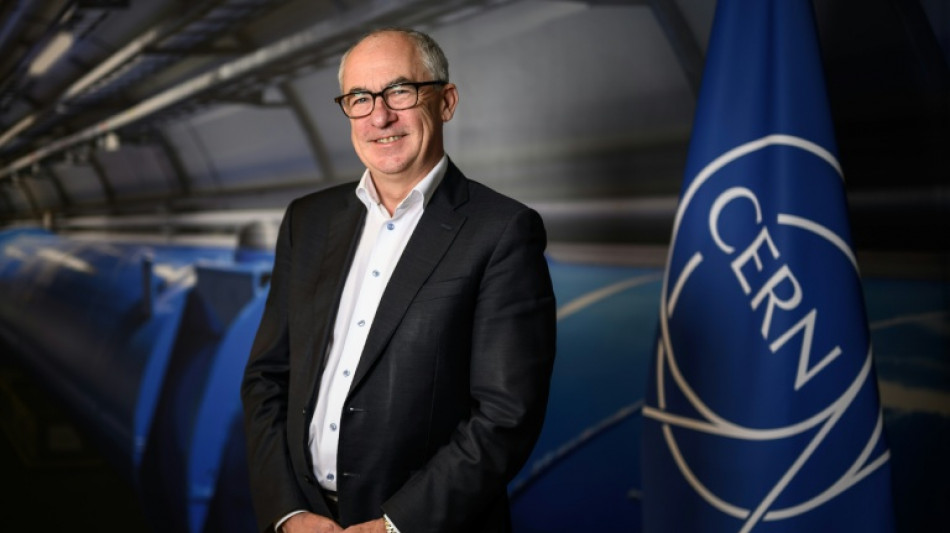
CERN chief upbeat on funding for new particle collider / Photo: Fabrice COFFRINI - AFP

CERN chief upbeat on funding for new particle collider

Mark Thomson, the new head of Europe's physics laboratory CERN, voiced confidence Tuesday about raising the billions of dollars needed to build by far the world's biggest particle accelerator.

Text size:

CERN, the European Organization for Nuclear Research, seeks to unravel what the universe is made of and how it works.

The planned Future Circular Collider (FCC) would be a proton-smashing ring with a circumference of 91 kilometres and an average depth of 200 metres.

Scientists believe that ordinary matter -- such as stars, gases, dust, planets and everything on them -- accounts for just five percent of the universe.

The FCC will try to reveal what makes up the other 95 percent, the so-called dark matter and dark energy that scientists have yet to observe directly.

"That project would start operation in the second half of the 2040s," Thomson told reporters.

The British particle physicist took over as CERN's director-general on January 1.

He said the gigantic collider would cost around $19.5 billion.

"About half of that comes out of the existing ongoing budget, and we have to find the resources for the other half," he said.

"I'm very optimistic personally, but it's not going to be straightforward."

In December, in a first for the laboratory, private donors pledged $1 billion towards the construction of the FCC.

"They're not expecting anything in return. This is really for the good of science," said Thomson.

- 'Giant leap forward' -

Based on the outskirts of Geneva, CERN has 25 member states and its council is set to take a decision in 2028 on whether to go ahead with the FCC.

For now, CERN's Large Hadron Collider (LHC) is currently the world's biggest particle accelerator, whizzing particles into each other at phenomenal speeds.

The 27-kilometre proton-smashing ring, running about 100 metres below France and Switzerland, has, among other things, been used to prove the existence of the Higgs boson.

Dubbed "the God particle", its discovery in 2012 broadened science's understanding of how particles acquire mass and earned physicists Peter Higgs and Francois Englert the 2013 Nobel Prize for Physics.

The LHC is expected to have fully run its course by around 2040.

It is set to resume operations in February after a winter break, before shutting down again in June.

It will then undergo upgrades, including more powerful focusing magnets and new optics, becoming the High Luminosity LHC (HL-LHC), aimed at conducting more detailed studies thanks to an increased number of collisions.

"This is technology we just didn't have when we designed the LHC," said Thomson.

"We're going to have a brighter machine, so we get much, much more data, and every bit of data we get, we have a clearer image of what's going on.

"This is really an opportunity for discovery. And I'm not sure what we will discover.

"Sometimes you make small steps in science. This is not a small step. This is a giant, giant leap forward."

I.Widmer--NZN