Japan's Takaichi may struggle to soothe voters and markets / Photo: Kazuhiro NOGI - AFP
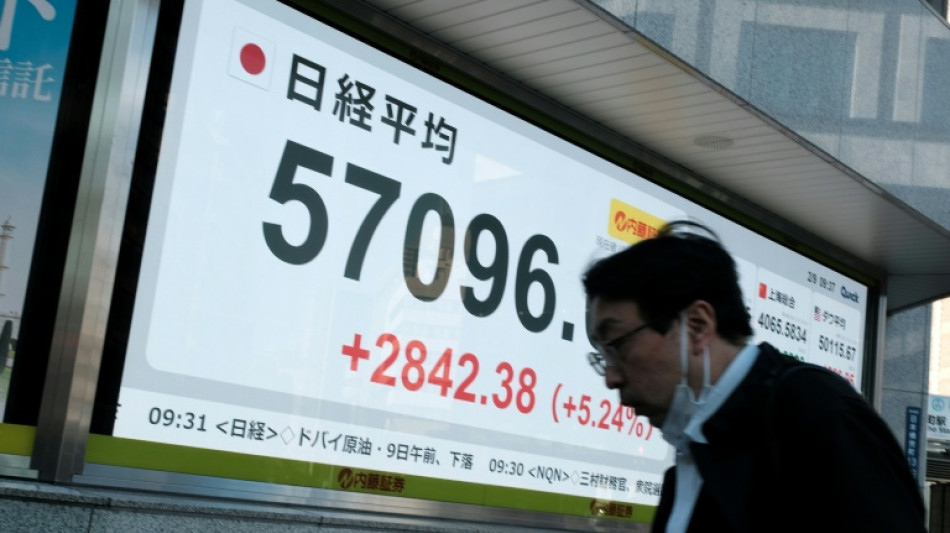
Japanese stocks soared to record highs Monday after Prime Minister Sanae Takaichi's election triumph, but experts warned that the country's first woman leader could struggle to keep both voters and markets happy.
In its best result since its founding in 1955, Takaichi's conservative Liberal Democratic Party won a two-thirds majority in Sunday's snap lower house election, according to Japanese media.
With the result, Takaichi, 64, managed to capitalise on her strong popularity since taking the helm of a moribund LDP in October and becoming Japan's fifth premier in five years.
On Monday the Nikkei 225 briefly jumped more than five percent to pass 57,000 points for the first time, while the yen strengthened against the dollar.
Analyst Kyle Rodda of Capital.com said the victory handed Takaichi "the mandate she was looking for for her big-spending agenda".
Equities are "poised to benefit from higher fiscal spending but interest rates that remain accommodative and negative in real terms", he said.
And SPI Asset Management's Stephen Innes said: "Politically, the win hands... Takaichi freedom of movement and removes the need to bargain every decision down to the lowest common denominator."
But a major reason for voters deserting the party in past elections was inflation, an unwelcome phenomenon for households after several decades of stable or falling prices.
The cost of rice, for example, doubled in 2025.
- Food tax -
After a $135-billion stimulus last year, economists said Takaichi's room for manoeuvre was limited because of market concerns about Japan's debt, which at more than twice the size of gross domestic product is a bigger ratio than any other major economy.
The yen has also weakened, prompting speculation that Japanese authorities -- potentially in partnership with US officials -- might intervene to provide support.
Off-the-cuff remarks by Takaichi earlier this month talking up the benefits for Japanese exporters of a weaker yen added to pressure on the currency.
In the election campaign Takaichi floated the idea of suspending a consumption tax on food items, but this sent yields on long-term Japanese bonds to record levels.
On Sunday she told local media further discussions were needed on such a move, which Bloomberg News reported would cost 5 trillion yen ($32 billion) in lost annual revenue.
"Most parties are in favour of reducing the consumption tax... I strongly want to call for the establishment of a supra-party forum to speed up discussion on this, as it is a big issue," Takaichi said.
She also reiterated her mantra of having a "responsive and proactive" fiscal policy.
But she added: "We will ensure necessary investments. Public and private sectors must invest. We will build a strong and resilient economy."
- 'Betrayed' -
Tetsuo Kotani at the Japan Institute of International Affairs said Takaichi could struggle to keep voters happy and that they could end up feeling "betrayed".
"In reality, the policies of a Takaichi administration are unlikely to curb the inflation that voters expect her to address," he warned.
"An income tax hike linked to increased defence spending will also be unavoidable. If these policies lead to a triple decline in stocks, the yen, and government bonds, people's lives will become even more difficult."
Takaichi has also pledged to increase defence spending as part of commitments to US President Donald Trump that Japan will be less reliant on Washington.
Kotani said that because of a personnel shortage -- linked to Japan's low birth rate -- this will "not amount to a fundamental strengthening of Japan's defence capabilities".
Marcel Thieliant at Capital Economics added that he did not expect Takaichi to embark on any new major spending splurges or tax cuts.
"(We) view the recent fiscal expansion as an attempt to bolster public support ahead of the election rather than as a sign of things to come," he said in a note.
"With Upper House elections not due until 2028, we don't expect any further major fiscal loosening."
Hiroshi Shiratori, politics professor of Hosei University, said Takaichi wanted to emulate the "Abenomics" of former premier Shinzo Abe -- her mentor -- of big spending and lower interest rates.
"But Abemonics was done at the time of deflation in Japan and a higher yen," Shiratori told AFP.
"Now is the time of inflation, and the cheaper yen exacerbating inflation, with the market reacting on worries over potential worsening of fiscal conditions," he said.
"But not all voters understand this logic."
jug-mac-kh-stu/dan
R.Bernasconi--NZN