Junk to high-tech: India bets on e-waste for critical minerals / Photo: Arun SANKAR - AFP
Hundreds of discarded batteries rattle along a conveyor belt into a crusher in a remote plant in northern India, fuelling a multi-billion-dollar industry that is bolstering the country's geopolitical ambitions.
India is cashing in on the growing "e-waste" sector -- pulling critical minerals like lithium and cobalt, which are needed to make everything from smartphones to fighter jets and electric cars, from everyday electronics.
Global jitters about China's dominance as a critical minerals producer has kicked New Delhi into action, ramping up extraction of the materials that are essential for its drive to become an artificial intelligence hub.
With demand expected to soar and domestic mining unlikely to deliver meaningful output for at least a decade, the country is turning to an often‑overlooked source -- the swelling mountains of electronic waste.
Dead batteries yield lithium, cobalt and nickel; LED screens contain germanium; circuit boards hold platinum and palladium; hard disks store rare earths -- e‑waste has long been described as a "gold mine" for critical minerals.
India generated nearly 1.5 million tonnes of e‑waste last year, according to official data -- enough to fill 200,000 garbage trucks -- though experts believe the real figure is likely to be twice as much.
At Exigo Recycling's sprawling plant in Haryana state, a machine churns the batteries from e-scooters into a jet-black powder.
The material is then leached into a wine‑red liquid, filtered, evaporated and finally transformed into a fine white powder -- lithium.
"White gold," said the facility's lead scientist, watching the final product collect in trays.
- Backyard workshops -
Industry estimates suggest "urban mining" -- the recovery of minerals from e‑waste -- could be worth up to $6 billion annually.
While insufficient to meet India's projected demand, analysts say it could help absorb import shocks and strengthen supply chains.
Most e‑waste, however, is still dismantled in informal backyard workshops that extract easily saleable metals such as copper and aluminium, leaving critical minerals untapped.
India's formal recycling capacity remains limited compared to China and the European Union, both of which have invested heavily in advanced recovery technologies and traceability systems.
India has a "100 percent import dependency" for key critical minerals including lithium, cobalt and nickel, according to the Institute for Energy Economics and Financial Analysis.
Seeking to close the gap, Prime Minister Narendra Modi's government approved a $170‑million programme last year to boost formal recycling of critical minerals.
The programme builds on Extended Producer Responsibility (EPR) rules, which require manufacturers to collect and channel e‑waste to government-registered recyclers.
"EPR has acted as a primary catalyst in terms of bringing scale to the recycling industry," said Raman Singh, managing director at Exigo Recycling, one of the few Indian facilities able to extract lithium.
Other analysts agree the rules have redirected more waste into the formal sector.
"Before EPR was fully implemented, 99 percent of e-waste was being recycled in the informal sector," said Nitin Gupta of Attero Recycling, which says it can recover at least 22 critical minerals.
"About 60 percent has now moved to formal."
Government data suggests an even higher shift, though critics say the figures are inflated due to poor tracking of total e‑waste generation.
More than 80 percent of India's e-waste is still processed informally, according to a United Nations Development Programme note in October.
- Rife with hazards -
Indian government-backed think‑tank NITI Aayog warned that organised recycling lagged behind both policy targets and the rapid growth in waste volumes.
Informal recycling is rife with hazards -- open burning, acid baths and unprotected dismantling expose workers to toxic fumes and contaminate soil and water.
A bulk of India's e‑waste still flowed through informal channels, leading to "loss of critical minerals", said Sandip Chatterjee, senior adviser at Sustainable Electronics Recycling International.
"India's informal sector remains the backbone of waste collection and sorting," he told AFP.
In Seelampuri, a low‑income Delhi neighbourhood home to one of India's largest informal e‑waste hubs, narrow alleys spill over with tangled cables and broken devices.
"The new companies just keep enough for certification, but the rest still comes to us," said Shabbir Khan, a local trader. "Business has increased... not gone down."
Even the junk that eventually reaches formal recyclers often passes through informal hands first, Chatterjee said.
"Integrating informal actors into traceable supply chains could substantially reduce" loss of valuable critical minerals at the sorting and dismantling stages, he said.
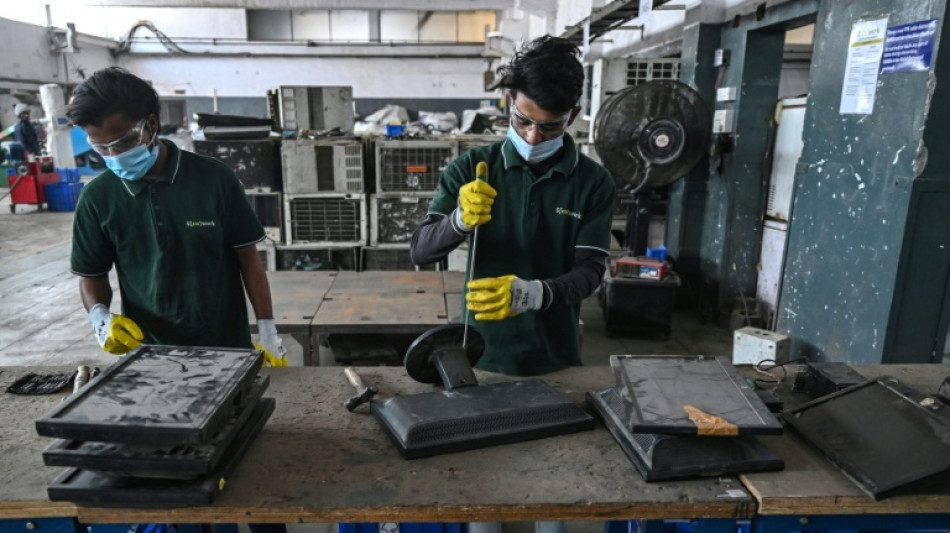
Ecowork, India's only authorised non‑profit e‑waste recycler, is attempting that through training and safe workspaces.
"Our training covers dismantling and the (full) process for informal workers," said operations manager Devesh Tiwari.
"We tell them about the hazards, the valuable critical minerals, and how they can do it the right way so the material's value doesn't drop."
At its facility on the outskirts of Delhi, Rizwan Saifi expertly dismantled a discarded hard drive, slicing out a permanent magnet destined for an advanced recycler, where it will be shredded to recover dysprosium -- a rare‑earth metal essential to modern electronics.
"Earlier all we would care about was copper and aluminium because that is what was high-value in the scrap market," Saifi, 20, said.
"But now we know how valuable this magnet is."
F.Schneider--NZN