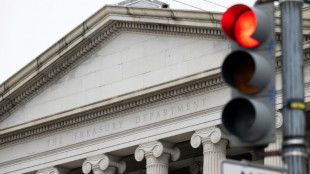
Data canary shows economy already suffering from Middle East war / Photo: Tiziana FABI - AFP/File
Soaring fuel prices due to the Middle East war and snarled supply chains are already hurting businesses, business survey data published Tuesday showed.
Now in its fourth week, the war sparked by US and Israeli strikes on Iran has seen global oil prices soar by more than 40 percent as Tehran has effectively shut the Strait of Hormuz through which a fifth of oil and liquefied natural gas supplied flowed before the conflict began.
Economists have warned that if they persist higher energy prices could trigger a fresh surge in inflation and slow economic growth.
The Purchasing Managers' Indices compiled monthly by S&P Global are the data equivalent of the canary in the coal mine.
They survey managers who have their thumbs on the pulse of businesses across many industries, and often reveal changes in business conditions months before official government data.
The latest batch of PMI surveys, which included the period since the war broke out on February 28, showed that businesses activity is already slowing and prices rising.
The initial reading for the composite US PMI dipped to an 11-month low of 51.4 points in March from 51.9 points in February, with services taking a hit while manufacturing edged higher.
A reading above 50 points indicates economic growth.
"The flash PMI survey data for March signal an unwelcome combination of slower growth and rising inflation following the outbreak of war in the Middle East," said Chris Williamson, chief business economist at S&P Global Market Intelligence.
"Companies are reporting a hit to demand from the additional uncertainty and cost of living impact generated by the conflict," he added.
- Stagflation threat -
Williamson said that the price component of the surveys indicated inflation rising back to around four percent "hinting at a growing risk of the US moving into an environment of stagflation."
Stagflation is a period of little or no economic growth and high inflation, which poses a quandary for central bankers as raising interest rates to reduce inflation is a sure recipe to trigger a recession.
Meanwhile the eurozone PMI dropped to 10-month low of 50.5 in March, down from 51.9 in February, signalling a near stop in growth and weakening demand.
"The flash Eurozone PMI is ringing stagflation alarm bells," said Williamson.
Analysts said the data is a warning signal.
"The risk is that the PMI data, which is a lead indicator, is the start of a wave of weaker economic data to come down the line," said Kathleen Brooks, research director at XTB.
- Growth at near stop -
Christophe Boucher at ABN AMRO Investment Solutions said the impact of the war in Iran is visible in the PMI data in three ways: a slowdown in the growth in services, an increase in manufacturing prices and a degradation in the global outlook.
Services is by far the main largest economic sector, and in the United States the services PMI dipped to an 11-month low of 51.1.
In Europe it fell to 50.1, a 10-month low.
Germany however saw manufacturing output jump to a four-year high thanks in part a major public investment programme to boost the economy.
But "the problem with German industry is that it is extremely dependent upon access to fossil fuels" which raises concern that it will also face headwinds, said Christopher Dembik, investment strategist at Pictet Asset Management.
In France, the private sector registered its strongest contraction since October at 48.3 points.
The same slowdown trend was observed in PMIs in Britain and Australia.
- Inflationary spiral -
The survey found war-related shipping issues were a key cause of longer supply delivery times.
In the eurozone, input prices increased at the fastest pace since February 2023, with both manufacturing and services facing steeper inflation, due to higher energy prices.
In the United States, input prices rose at the fastest rate in 10 months, and companies passed the higher costs to clients, with selling prices jumping at the fastest rate in over three-and-a-half years.
ABN AMRO's Boucher said it is important to watch for companies passing on higher costs to clients.
"What seems to be the most important to monitor, particularly in case of an extended conflict, is the risk of the transmission of inflation in the services sector which would signal the second-round effects," he said.
While Iran and Israel traded strikes on Tuesday, there was still cautious optimism that talks US President Donald Trump evoked on Monday to justify postponing threatened attacks on Iranian energy infrastructure might lead to a deescalation.
"With the Ukraine conflict in 2022 it took five weeks to realize that it wasn't temporary and was becoming structural," Pictet AM's Dembik told AFP, referring to the rise in energy prices triggered by Russia's invasion of its neighbour.
"Today, with some twenty days of fighting, we're still in the middle of the zone of uncertainty," he added.
Jack Allen-Reynolds, deputy chief eurozone economist at Capital Economics, said "if energy prices remain high, worse could be to come."
T.L.Marti--NZN