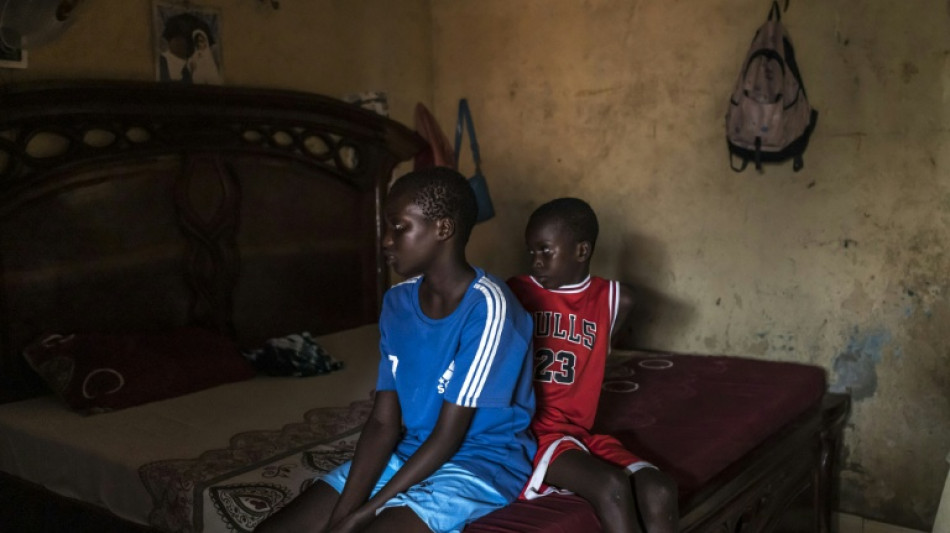
Senegal's children mourn in silence when migrant parents disappear / Photo: PATRICK MEINHARDT - AFP
Fallou softly whispers that since his mother's death he has chosen to remain quiet, while young Sokhna recounts the many nightmares she has had following her father's disappearance: for the children of Senegalese migrants lost at sea, the torment of grief is long-lasting.
Known as "those who remain", the young bereaved are forced to live with the unbearable suspense or impossible pain of knowing a parent has either died or gone missing after their boat disappeared.
The number of such dead, missing and their children is at least in the thousands in Senegal as of recent years, said Saliou Diouf, founder of the Boza Fii association which fights to maintain the migrants' memory.
In Senegal's western port city of Mbour, the shattered lives and heartfelt dramas of such children are often kept in the shadows or swept under the rug due to the taboo nature of their parents' decisions to leave.
Crowded onto colourful wooden boats known as pirogues, which frequently hold more than 100 people, the migrants risk life and limb to make it abroad, generally to Spain's Canary Islands.
Families are also afraid to share the children's stories due to the authorities' often repressive approach, which includes arresting smugglers and "rescuing" boats whether or not they want to come back.
"I cried a lot, and then I told myself it was God's will," Fallou whispered to AFP in halting speech, his figure contorted by spasms as he spoke of his mother's death.
In Tefees, an Mbour fishing district with sandy alleyways and precarious houses, Fallou and his nine-year-old brother are happy to be together, leaning against each other in the small bedroom where their grandmother Ndeye Ndiaye lives.
Their lives changed forever when their mother, Awa, in her 30s, died in Morocco in 2024 after her pirogue capsized.
Since the tragedy, "I've become silent," Fallou said, explaining that he did not talk about it with his grandmother or his friends but only with his father, who has since left but still visits.
"He tells me that my mother was a good person," Fallou explained.
As is often the case when a migrant mother disappears, Fallou's family fell apart: His father returned to live with his family while the children stayed with their maternal grandmother.
Driven into poverty, however, she had to separate the brothers, entrusting the youngest to his godfather.
Awa had not spoken of her plan to migrate to her mother, who had often noticed the young woman "wearing herself out" and wanted to help her more.
- 'Pray for me' -
"She simply told me she had to go to Dakar," Ndiaye recounted. But then one evening Awa called her: "Mum, I took a pirogue to reach Europe and I would like you to pray for me".
Two anguishing weeks later, the family received a call that she had died in a hospital in Morocco.
"They never brought me her body," Ndiaye whispered, unable to hold back tears.
"Seeing children, innocent people like them, having to live without a mother, it affects you to the core," she said.
In 2024, at least 10,457 migrants died or disappeared while trying to reach Spain via the perilous Atlantic route, according to Caminando Fronteras, the highest number recorded since the organisation began counting in 2007.
Those fleeing Senegal are driven by despair and the lack of opportunity, with unemployment, a depleted fishing stock and other factors creating a dire situation.
In addition, Europe's restrictive visa policies and increased border patrols have caused migrants to resort to clandestine and rickety boats.
"Families often don't receive enough information to grieve," said Boza Fii's founder Diouf. "Accepting the loss is extremely difficult."
Children sometimes learn the news abruptly in the street or at a neighbours', subsequently struggling with the unbearable waiting, denial or anger.
Eleven-year-old Sokhna's angelic face is darkened by a pained gaze: Her father, Assane, has been missing since his pirogue caught fire off the coast in 2022.
Her mother Fatou Ngom was only told that he was "among the victims".
Now she and her three children eke by in Mbour living in a single room with a shared courtyard.
- Greater poverty -
Ngom explained that Sokhna is often distant, particularly in class, and has fallen behind in her schooling.
"Sometimes at night she has dreams, she cries 'papa' several times," her mother said.
Sokhna explained frankly that her mother, who is still overwhelmed by grief and finds it very difficult to talk about her husband, does not "understand" her when she wants to bring up her father.
"When I dream about him and I'm scared because I really feel like he's talking to me, the next day I go see my grandmother," Sokhna said.
"She tells me about when my father courted my mother and stories about him".
"I always think about my father when I see the sea," she whispered. Her grandmother, seeing that grief, told Sokhna to avoid walking along the beach and its pirogues.
Unlike Sokhna, who appears to bury her sorrow, her 14-year-old brother Boubacar struggles to hold back his emotions while recounting the day in 2022 when he found out.
"My family came to find my mother, she was preparing coffee," he said. "They said 'Assane died in the pirogue'. She was in shock, she started crying, and so did we."
"My father wanted to build us a house and before he could, God took his soul," he added.
"I often think about him, especially when my mother doesn't have the money for daily expenses because he was the one who helped us live," he sobbed.
The teenager already works after school in a metalworking shop to help his mother.
Navigating the burden of grief, the children must rebuild their lives in broken families, often with fewer meals, increasing debt and sometimes dropping out of school.
Many of the children grow up too fast, burdened by responsibilities.
Sokhna and Boubacar's five-year-old sister, Coumba, barefoot and wearing threadbare clothes, drew on a chalkboard on the courtyard wall. She has grown up hardly knowing her father.
"She's the one who makes me cry because she's always asking about her father," Ngom said. "I tell her he's on a trip."
"She could go crazy if we explain it to her now," Boubacar whispered.
- Breaking the silence -
Amy Drame also did not tell her children, aged 10, six and three, the truth.
Her husband, who had seen his fellow fishermen friends attempt the crossing out of desperation, called her from a boat in August 2024.
"He asked me for news of the children and to pray for him. That was the last time I heard from him," she said, shaken.
A month later the authorities informed them that the pirogue had run aground in Cape Verde with no survivors.
Drame continues to tell her children that their father is away fishing.
"They're just children," she said. "They're always taking my phone to watch videos of their father. They won't forget him".
Breaking this silence is the goal of a pioneering program in Senegal providing psychosocial support to these children, launched in 2024.
Around 50 orphans are being supported by the Senegalese chapter of the Diocesan Delegation of Migration (DDM), an international NGO which began the project after noticing the suffering of wives of missing persons.
This, it observed, was particularly due to the uncertainty surrounding the type of death.
"We noticed that many of their children were also suffering, in a different way, more silently, with a great deal of anger," said Jordi Balsells, DDM director.
Apart from the work carried out at its Mbour base, the NGO conducts three other tours a year in other regions of Senegal and provides in-home support.
In its light-filled Mbour centre, children whose migrant fathers have disappeared receive therapy while their mothers work in a sewing workshop to supplement their income.
The children's horsing around often masks a fragile state of mind.
Babacar Ndiaye, 12, overwhelmed by emotion, was unable to confide in anyone about the disappearance of his father, a fishmonger, in 2024 when his pirogue capsized.
"Know that if you want to talk, we're here," Tesa Reimat Corbella, a doctor specialised in bereavement, gently told him.
- Stigma -
In contrast, Babacar's nine-year-old brother, Pape Balla, is surprisingly confident. He opened up while clutching two figurines, a crocodile and a llama.
"My father didn't want to leave, but the person who organised the trip forced him!" he exclaimed, his way of coping with an abandonment he cannot understand. "It hurts me that he's gone, I wanted him to stay with us."
He has neighbourhood friends whose parents also died but do not want talk about it, he said, recalling how his father "often bought me balloons, I miss that."
Like Babacar, 10-year-old Bambi Diop could at first only manage to articulate a few words: "I don't want to talk about my father," she said.
Psychotherapist Katy Faye gently placed her hands on Bambi's shoulders and tried to soothe her as the child began weeping.
"When I go to class, I think about him," Bambi finally said, explaining that it was often her father who would drop her off at school.
The young girl remains partly in denial, telling AFP that her father lives in another city in Senegal and is doing "fine".
These words came as a surprise to her mother, who insists that her daughter knows her father died in a shipwreck in 2024.
For Corbella, the main challenge "is breaking the silence" around the disappearance.
"We need to start putting words to what happened, to be able to talk with the children about the memories of who their father was, and to work with the parent who remains", the doctor said.
She is heartened that the NGO has succeeded in creating a safe space where the children "can share their feelings with other children".
"The fact that they accept what happened and that they can speak about it without fear or shame is what matters most," she said.
However, she acknowledges that there is still a great deal of work to do: "When these children step outside this space, whether at school or in the street, they still face stigmatisation."
Mamadou Diop Thioune, a civil society advocate who has specialised in migration issues for 20 years, said he regrets that economic and psychosocial support for these families is "not taken into account in [our] public policies".
The authorities lack information, resources and trained personnel, he said, pointing out that the "social consequences" for Senegal resulting from the disappearances "are dire".
At the DDM centre, the late afternoon light cast a soothing glow as three children lined up on a mattress on the floor, captivated by an animated film.
Senegalese society must be made more "aware of the plight of the missing and their families", Corbella said, adding that "it is important to restore dignity to the missing -- people who left in search of a better life".
"We must be able to speak about this subject without hiding these children and families."
L.Zimmermann--NZN