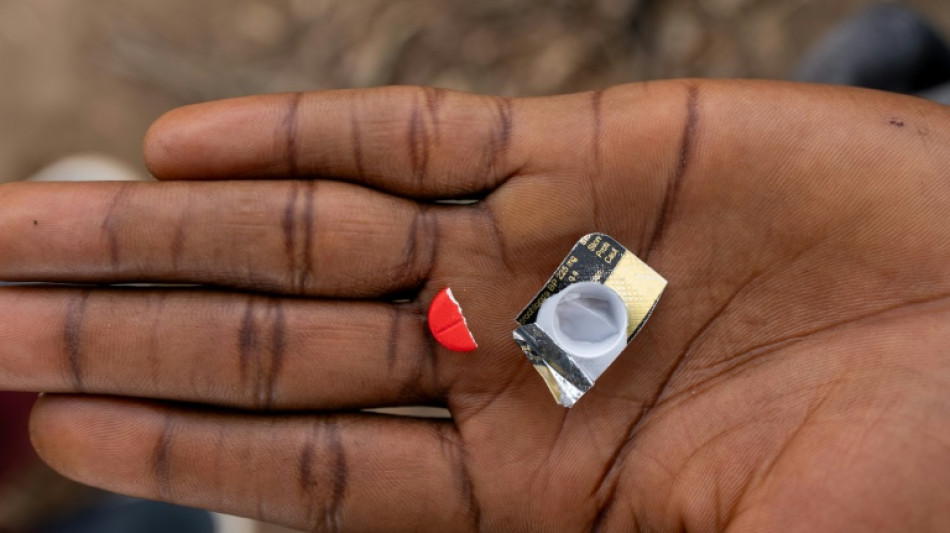
Indian pharma fuels Africa's 'zombie drug' and opioid crisis / Photo: Light Oriye Tamunotonye - AFP
They come in blister packs of 10 like any normal painkiller and you can buy them easily in roadside kiosks and street pharmacies across west Africa.
Millions of tapentadol tablets from India are helping drive a deadly opioid epidemic ravaging the region, with officials and researchers telling AFP that they are also being added to the "zombie drug" kush.
The cheap pills are so strong that no regulatory authority in the world has approved them.
Yet an AFP investigation found Indian pharmaceutical firms were flooding west Africa with the pills despite New Delhi vowing to crack down on the trade. Some shipments were even labelled "Harmless Medicines for Human Consumption".
Customs records show millions of dollars' worth of the high-strength synthetic opioid being shipped from India every month to Nigeria, Sierra Leone and Ghana, where even low doses of the drug are not permitted.
With opioids now heavily regulated in wealthier nations after being linked to one million deaths in the United States alone, some manufacturers in India -- the world's biggest producer of generic drugs -- are pushing hard into Africa.
And in a frightening development, tapentadol is now being added to the "zombie drug" kush, health chiefs and researchers told AFP.
Kush, infamous for the speed with which it hollows out its victims, has already been declared a national emergency in Liberia and Sierra Leone.
- Bodies on the streets -
The tapentadol twist on the ferociously addictive synthetic cocktail is "very alarming", Ansu Konneh, director of mental health at Sierra Leone's social welfare ministry told AFP.
Bodies are being picked up from "the streets, markets and slums on a daily basis", he said -- with more than 400 corpses collected over three months in the capital Freetown alone.
"They grind and mix it with kush," Freetown-based public health researcher Ronald Abu Bangura told AFP, with tapentadol now "being misused all over the place".
The impoverished nation is struggling to tackle the death and misery. AFP visited addicts in informal detox houses who are sometimes chained up for months to go cold turkey.
Konneh said 90 percent of those admitted to the country's few official rehab centres had smoked kush mixed with tapentadol or other powerful opioids such as nitazenes.
New Delhi declared a "zero-tolerance" crackdown on illegal drug trading in February 2025, banning export of tablets that mixed tapentadol with the muscle relaxant carisoprodol after a BBC investigation exposed the damage they were doing in Ghana.
India's drug regulator, the Central Drugs Standard Control Organisation (CDSCO), later said it was withdrawing all export clearances for "combinations of tapentadol... which are not approved by an importing country".
But the main trade was always in pure tapentadol tablets, say researchers.
Shipment records reviewed by AFP show that millions of dollars worth of the high-strength pills are still being exported from India to west Africa every month.
The vast bulk are so strong India officially does not even allow their production without special permission.
Yet AFP matched high-strength tapentadol tablets seized in at least four west African countries with Indian export records through their makers' licence numbers.
This was established using commercial shipment data, government seizure records, interviews and documents obtained under India's Right to Information transparency law.
- Labelled 'harmless medicines' -
Tapentadol tablets seized in Sierra Leone in December marked "Made in India" had a manufacturing licence number that corresponds to Gujarat Pharmaceuticals, a company based in Godhra, Gujarat, according to images of the boxes photographed by AFP.
The firm was listed in the export monitoring database Volza as an exporter of tapentadol to west Africa. Its manufacturing licence number appeared on tablets seized last June in Guinea.
A second licence number on tablets seized in the same Guinean operation corresponds to Merit Organics, another Gujarat-based company in the database.
Senegalese authorities seized high-strength 250mg tapentadol tablets in November with a licence number registered to McW Healthcare, a Madhya Pradesh-based company.
A fourth company, PRG Pharma, also made several shipments after New Delhi's ban last February, labelling them as "harmless medicines".
Its director Manish Goyal is a shareholder in Maiden Pharmaceuticals -- a company controlled by his father -- whose cough syrup Gambian authorities blamed for the death of 69 children in 2023.
The Volza database shows McW Healthcare shipped dozens of consignments of 250mg tablets worth more than $1 million to Sierra Leone and Nigeria after the February crackdown.
AFP found a camera repair shop at the Nigerian importer's address in Lagos. Health authorities there said it had no pharmaceutical permit and called the imports "illegal".
Kuwait Customs intercepted tapentadol tablets in January carried by a Beninese traveller. Their packaging bore the licence number of Syncom Formulations. AFP's analysis identified the company as the largest tapentadol exporter to west Africa by value, having shipped consignments worth nearly $15 million after February, many declared as "Harmless Medicines for Human Consumption".
Benin is among the declared destinations for Syncom's shipments.
The Indian Drug Manufacturers' Association -- the largest industry body -- defended the trade, saying "a legitimate manufacturer who has followed the procedures cannot be held responsible for what happens later in the supply chain."
But government officials in Nigeria and Sierra Leone told AFP tapentadol was illegal, while Ghana said it has never been permitted there.
- 'Get people hooked' -
Most people in Africa take tapentadol not to get high but to do brutal back-breaking work, experts say.
It "energises my body to ride day and night", said motorbike taxi rider Abubakar Sesay, who earns a pittance bumping over the bone-rattling backroads of Freetown. "Without it, I can't survive."
Market porters and gold miners from Lagos to Mali use tapentadol pills to push through the pain, according to NGOs.
"It's used as a performance enhancer to enable people to do long hours of hard work," said medical anthropologist Axel Klein of the Global Initiative Against Transnational Organized Crime.
Opioids are now the second most used drug in Nigeria after cannabis. Femi Babafemi of the country's NDLEA anti-drug agency said it had seized two billion high-strength pills in 2023 and 2024 alone.
"Kidnappers, terrorists and bandits use these drugs so they can carry out their nefarious activities," he added, with police saying jihadist fighters like Boko Haram also take it "for courage".
The pills are also used as a form of currency in ransoms for kidnappings, Babafemi said.
A tablet is cheaper than a meal in the poor and dusty suburb of the capital Abuja where Boluwatife Owoyemi of YouthRISE Nigeria works with drug users.
As well as "giving them lots of strength... they are those who use it as an appetite suppressant... until they have the money to get food," she said.
With brands like TramaKing, Super Royal 200 and Tamol-X, the pills are "made to look like a medicine", said Klein.
"Consumers (in west Africa) are much more naive than in other parts of the world," he said, and there is little government regulation or enforcement on the ground to protect them.
"This creates opportunities for unscrupulous Indian companies to sell products that are problematic, dangerous, harmful or outright illegal to African countries," Vanda Felbab-Brown, a senior fellow at the Brookings Institution, who has long studied opioid flows, told AFP.
"Africa is a market that provides opportunities at a low end," she said.
"It's a prime situation for trafficking networks from India to try to get people hooked."
- A 'sense of impunity' -
Ninety percent of the world's seizures of tramadol over the last decade have been in west and central Africa, according to a new report by the Global Initiative Against Transnational Organized Crime.
India declared the opioid a controlled narcotic in 2018.
But the report said tapentadol has now "replaced or supplemented" tramadol in many west African countries. Lab tests showing pills sold as tramadol in Sierra Leone were all tapentadol.
While tapentadol is often sold on the streets as tramadol, it is actually two to three times stronger and even more dangerous, experts say.
"Indian pharmaceutical companies began exporting vast quantities of tramadol to west Africa, often at potency levels far beyond what was considered safe for human consumption" about 15 years ago, said Felbab-Brown.
"Domestically they could not sell such potent tramadol but they were indifferent to what was well known to stimulate substance-use disorders in their export markets."
Now the pattern is being repeated with even stronger tapentadol, she added, driven by "poor law enforcement and regulatory controls" and a "sense of impunity".
Tapentadol's tongue-twister name and the confusion with tramadol has further helped it slip under the radar.
- 'Bypassing restrictions' -
Nearly three-quarters of tapentadol exports to west Africa since India's crackdown have been high-strength 225mg and 250mg pills, according to AFP's analysis.
Andrew Somogyi, professor of pharmacology at the University of Adelaide, told AFP he did not know of any country that had approved 225mg tapentadol tablets. He questioned "why a country would want that strength except to bypass regulatory and commercial restrictions".
Dr Viranchi Shah of the Indian Drug Manufacturers' Association said there was a "shared responsibility of all key stakeholders" to stop misuse of the drug.
India's drug regulator, the CDSCO -- which is responsible for issuing export clearances -- told AFP it had "no record" of issuing them for consignments of 225 and 250mg tapentadol. It did not respond to follow-up queries.
Jaydip Patel, of Gujarat Pharmaceuticals, whose tapentadol tablets were seized in Sierra Leone, said their exports were conducted legally.
"The importer gave us an authorisation letter," he said. "After that we got the permission here."
He said Indian manufacturers had switched from exporting tramadol to tapentadol because "tapentadol is easier to export because it is not classified as a narcotic".
When AFP visited Gujarat Pharmaceuticals' premises in Godhra in January, the building appeared deserted and charred tablets lay scattered on the ground alongside piles of ash from a fire.
The other Indian firms did not reply to AFP's questions.
- Children now taking it -
Ghana's Food and Drugs Authority told AFP it had "never issued any permit for the manufacture or importation of tapentadol of any strength".
Nigeria's National Agency for Food and Drug Administration and Control (NAFDAC) said tapentadol was neither registered nor approved in the country. "Any tapentadol product found within Nigeria is unauthorised and illegal," it added.
Sierra Leone's Health Minister Austin Demby told AFP that only 50mg tramadol administered in recognised health facilities was legal.
"Anything outside of that is illegal," he added.
Yet police there said there had been an "unprecedented increase" in tapentadol use by young people, including schoolchildren and university students.
"The suffering is too much," said Hassan Kamara, a traditional healer who runs an informal detox house an hour from Freetown where kush addicts -- who are sometimes psychotic -- lie chained to the floor for months.
Manso Koroma, 31, started taking the "zombie drug" for the pain when he lost his leg after a traffic accident, his body haggard and scarred.
"When I came here I was really violent," he told AFP last year.
"I am OK with the treatment," he said, chained to the bed, the windows and doors barred. "I've recovered. I'm just waiting for my sister to come and I can leave here."
In a country where the scars of a long civil war marked by terrible atrocities are still to heal, even the very young are now taking tapentadol, said mental health chief Ansu Konneh.
"What is worrying is that young children in primary schools are now taking the pills," splitting them into two or four pieces to "mix with energy drinks to increase potency".
The fact that tapentadol looks like a medicine and is sold as one, masks its danger.
The tragedy, said Konneh, is that even addicts seeking help "tell us, 'I've stopped taking kush, I'm just taking tapentadol tablets.' They don't see that to be a problem to their health."
sai-fvl-ks-sb/pa/fg/jj
N.Zaugg--NZN