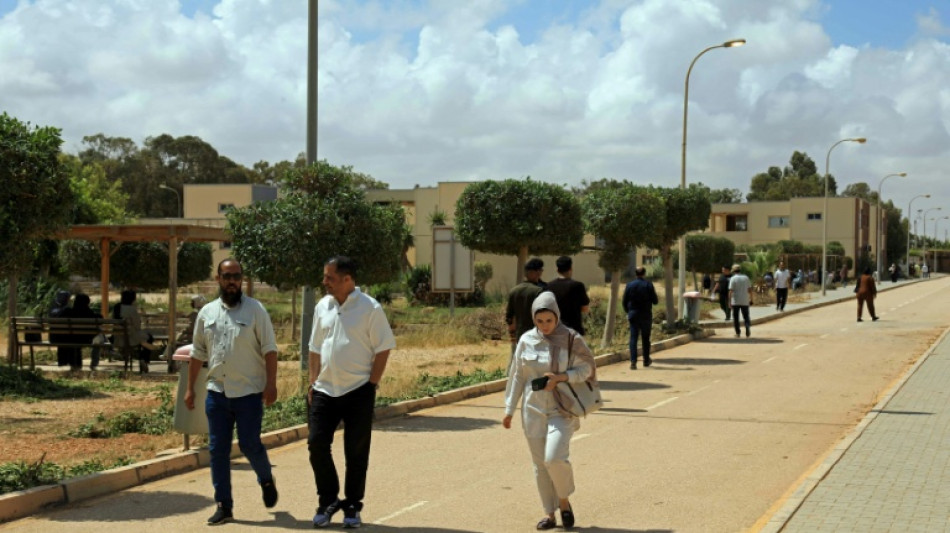
At a Libyan university once ravaged by war, students dream again / Photo: Abdullah DOMA - AFP
A decade after fierce battles reduced much of the University of Benghazi to rubble, students at Libya's oldest and largest university are once again looking to the future with optimism.
After the 2011 uprisings that toppled and killed longtime ruler Muammar Gaddafi, the university, founded in 1955, became the stage for intense fighting between jihadist groups and forces led by military strongman Khalifa Haftar.
Today, its nearly 70,000 students still attend classes in temporary facilities while a brand-new vast campus is set to open in the autumn.
On a recent afternoon, students gathered in the cafeteria and on shaded benches, poring over textbooks and chattering, far from the violence that engulfed the university between 2014 and 2016.
"Jihadists who controlled the city planted home-made landmines and booby traps almost everywhere" on campus, university president Ezzedin Younis Eddressi said in an AFP interview in a newly completed administration building.
According to Eddressi, manuscripts dating back 700 years were looted -- which the university later recovered -- as about 90 percent of the complex was destroyed by the jihadists.
But the university still held classes for those two years, using elementary and secondary schools across the city, with schoolchildren attending in the morning and university students in the afternoon, Eddressi added.
Shutting down the university was never considered, the president said. "The university is life itself" for the city of one million inhabitants. "In every household there's a student, a professor or a university employee," he added.
After the jihadists were defeated by Haftar's forces, students gradually returned to campus but were studying in makeshift facilities.
- 'Suffered a lot' -
Libya has struggled to recover from the chaos that followed the 2011 unrest and is divided between a UN-recognised government in the west and a rival eastern administration backed by Haftar.
Maryam Alrefadi, a 26-year-old who graduated from the university last year and who now teaches French online, recalled the difficult years.
"What we went through was not easy," she told AFP. "We had no idea how we would make it through."
But today, she added, "we have security" and "the possibility to do anything: to travel, start projects, create our own businesses".
Alrefadi said Benghazi's revival was owed to its resilience and the "sacrifices of young people".
"It has always remained vibrant and alive despite everything it endured."
Ayesha al-Mogassbi, a 19-year-old student of English at the university, also recalled hard times.
"At some point, we had nothing," she said. "Libya was at its lowest. We suffered a lot. We suffered bad education, no financial stability.
"So instead of just dreaming of having electricity or drinking water or food, (which) are all normal things... we're looking for more, for better," she said. "We know that we can give more."
Reconstruction of the university began three years ago and has been overseen by Libya's Reconstruction Fund, headed by Belgacem Haftar, one of the sons of Khalifa Haftar -- whose portraits are displayed prominently across the campus.
The fund recently received an additional three billion dollars from Libya's central budget, financed by the country's oil revenues. The Haftars control areas encompassing the majority of Libya's oil fields.
- 'Under better conditions' -
Spread over 600 hectares, the new complex which AFP journalists visited includes a main building topped by a golden dome modelled after the original structure built in the 1970s.
The campus also includes dorms which Eddressi likened to a "five-star hotel", a massive library replacing the old one, and a state-of-the-art conference centre.
Abdulhamid Al-Gweil, 28, a primary school French teacher, said he noticed the students were already in a better mood: They "know they will study under better conditions and in well-equipped buildings".
His friend, Ayman al-Qarqouri, 29, who runs a recruitment company, said opportunities for the youth were now "more promising than ever", especially in engineering, construction and architecture.
For Eddressi, it is important that the university remains free and accessible for Libyans, even as the institution holds exchange programmes with prestigious international schools such as the Polytechnic University of Milan.
When the University of Benghazi "regains its standing as the mother of Libyan universities", he said, there will be "a positive impact on all levels", including on "national reconciliation".
Several reports have said the United States, through President Donald Trump's senior adviser on Arab and African affairs Massad Boulos, has been pushing for a rapprochement between Libya's eastern and western authorities.
But for al-Gweil, al-Qarqouri and Alrefadi, Libya is already unified.
"I feel that we are all united," said al-Gweil. "There are students from Tripoli studying here. And when we go west, we feel we're still in Libya."
T.L.Marti--NZN