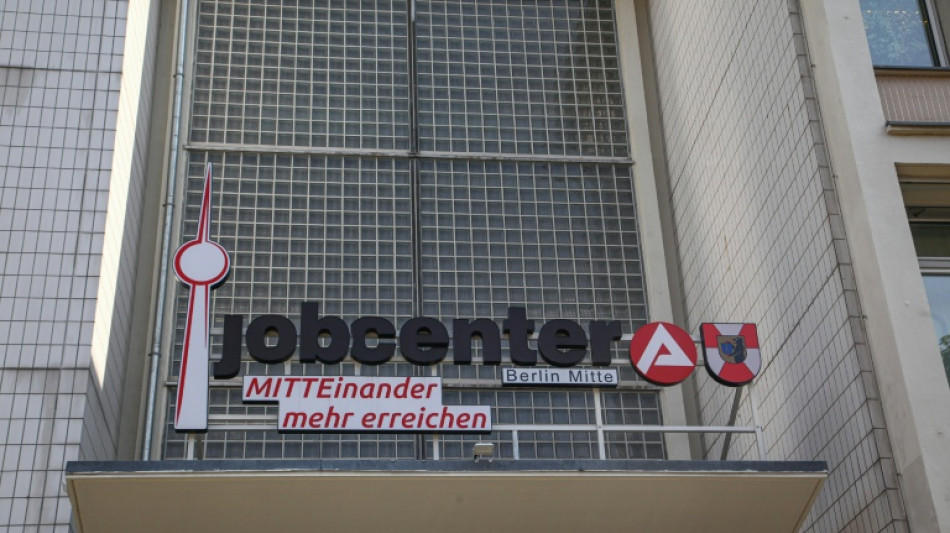
Germany's labour market dilemma: rising unemployment despite vacancies / Photo: Lilas TANTUSSI DEVOS - AFP/File
Graduating with a degree in biology in Germany, Julia Unkelbauer thought she had done everything right. But applying for job after job since 2024 has so far resulted only in rejections.
"I would very much like to continue working in research," the 38-year-old, who lives in the central city of Fulda, told AFP.
"Unfortunately, that's a bit difficult because the number of positions is very limited," she said.
Unkelbauer, who studied palynology -- the study of microscopic biological material found in sediment such as pollen and spores -- illustrates a growing labour market mismatch in Germany.
The number of unemployed in Germany climbed to over three million in January for the first time 2015.
It has since fallen a bit, to 2.94 million in June, but remains relatively high, according to official data released Tuesday.
At the same time, 643,000 vacancies are registered with the Federal Employment Agency (FEA), and companies in sectors ranging from healthcare to machine-making complain about skills shortages.
- Many occupations face shortages -
The mismatch bodes ill for an economy already in crisis and struggling to innovate.
Nationwide, employers are struggling to fill around 160 types of jobs, ranging from careworkers to plumbers, according to the FEA.
These are mostly "jobs that require vocational training, whether through work-and-study programs or practical training at school", FEA head Andrea Nahles said earlier this year.
The healthcare and transport sectors are among those under the greatest strain.
"There is an urgent need for nursing staff, physiotherapy professionals, and bus and truck drivers," she said.
But Unkelbauer does not want to leave the profession she chose.
If she cannot find a position in research, she wants to work "wherever there are opportunities in my field", she said.
Leaving her region remains a last resort, as she lives with her husband, a private-sector executive, and their two children in a village.
- Demographic deficit -
In Fulda, a city of around 65,000 people around 100 kilometres (60 miles) northeast of Frankfurt, Katharina Henkel, head of the local employment agency, sees this mismatch every day.
"We have many people looking for work, while employers are looking for staff. But the requirements and qualifications do not always match," she said.
"It can take up to 300 days to fill certain positions, particularly in healthcare or transport," she added.
And the recruitment difficulties are expected to worsen in Europe's largest economy as the population ages: over the next 10 years, around 13 million Germans will reach retirement age.
At the same time, only 7.8 million people are expected to enter the labour market, widening a gap that immigration alone is currently struggling to offset, the FEA says.
In Frankfurt, Samson, a maker of industrial valves, expects around 450 of its approximately 2,000 German employees to retire within the next seven to eight years.
"We already have to think about how... we will replace them," its human resources director Frank Oppenlaender told AFP.
Samson is struggling to recruit for a new 500 million euro ($570 million) factory it has built in neighbouring Offenbach, he added, while urging authorities to speed up integration of migrants.
"How quickly can I get immigrants and refugees to the stage where they can obtain a work permit and a residence permit? In Germany, that still takes far too long," he said.
"We need people now, not in two years' time."
F.Carpenteri--NZN