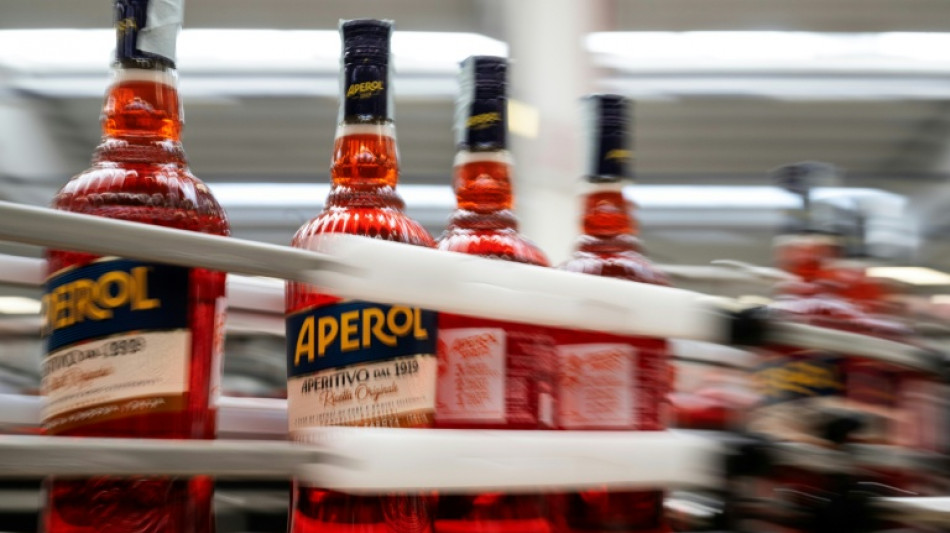
Campari - king of the spritz - hopes to conquer American heartland / Photo: Marco Bertorello - AFP
Whether made with Aperol, Campari or Sarti, the spritz has rapidly established itself on terraces across Europe -- with Italy's Campari Group now hoping to conquer the heart of America.
After 20 years spent winning over Europeans to Italy's northern tradition -- first in Germany and Austria, then in France and Spain --- the Campari Group has set its sights on areas still unaware of the orange, red or pink phenomenon.
Top among them are the United States, where Americans on both coasts enjoy the cocktail hour staple -- but whose interior has yet to be seduced by the spritz.
Back in Italy at Novi Ligure, between Milan and Genoa, Campari's flagship plant is running at full capacity, producing several tens of thousands of bottles of the red alcoholic liquer per hour, in three eight-hour shifts.
Inside huge stainless steel vats --- each holding enough to make a million spritzes -- blends of herbs, spices and roots are ready to infuse in alcohol.
The recipe -- enhanced by artificial colours -- is jealously guarded.
"Even I don't know it," insisted Campari’s head of aperitifs, Andrea Neri, during a factory visit by AFP.
- Aperitivo -
The spritz tradition dates back to Austria's occupation of northeast Italy in the 19th century. When the wine was of poor quality or the weather hot, soldiers would dilute -- or "spritzen" or spray in German -- their drink with sparkling water.
Eventually, Aperol, a light (11–12% ABV) and sweet spirit made from bitter oranges, gentian and rhubarb came to replace the wine -- the forerunner of the spritz was born.
When the Campari Group bought Aperol in 2003, the brand was confined to its historic northern Italian triangle between Venice, Padua, and Treviso.
But the Milanese company gradually made inroads beyond its home territory, until Aperol -— usually consumed combined with prosecco, sparkling water, ice cubes and a slice of orange -- accounted for nearly a third of its sales in the first half of 2026, out of annual revenue of three billion euros($3.4 billion) in revenue.
For Michele Costabile, a marketing professor at Luiss University in Rome, Campari managed to turn the spritz into an Italian product that was instantly recognisable and easy to export.
In his view, the group understood before many others that the "aperitivo" to be enjoyed before dinner had to become a fun ritual at once simple, elegant and accessible.
Aperol offered a recognisable glass, an easy-to-reproduce recipe, and a market position midway between beer or wine and more elaborate cocktails.
Campari has also used Aperol as a springboard to introduce their other spritz-friendly brands to Europeans, Neri said -- such as Cynar, made from artichokes, the bitter, bright red Campari, and the pink and fruity Sarti.
– Coachella –
But with growth slowing after several exceptional years, the company -- which also produces vodka, the bitter Picon aperitif and the orange and cognac-based Grand Marnier -- is looking further afield.
In California, Aperol has been a sponsor of the Coachella music festival for the past four years. But more of the country is to be conquered, with company executives saying they would focus a campaign on weekend brunch.
Sarti was launched in the country earlier this summer.
Neri said Campari has no intention, however, of moving its Aperol production to the United States.
Another challenge is defending Aperol's distinctive character for a spritz -- which is not a registered trademark -- particularly in Italy, where some establishments serve lower-cost alternatives without clearly identifying them.
The group also faces increased competition from copycats in supermarkets, as well as from rival Select, which claims to have invented the spritz in Venice in 1920.
Last year, Bacardi's CEO, Mahesh Madhavan -- whose Martini line of vermouths is yet another cocktail-hour rival -- said the aperitivo phenomenon was "booming", with only the tequila segment growing faster.
The aperitivo category represents $11 billion per year, with 6 percent growth expected annually through 2028, Bacardi estimates.
J.Hasler--NZN