East German refinery adjusts to life without Russian oil / Photo: Tobias SCHWARZ - AFP
Russia's Druzhba ("Friendship") pipeline long supplied the eastern German oil refinery that provides most of Berlin's fuel -- but all that changed after Russia's 2022 full-scale invasion of Ukraine, which plunged the crucial site into an era of turbulence.
As Europe moved to sanction Moscow, Germany placed under state trusteeship the local unit of Russian state-owned firm Rosneft, which holds a majority stake in the PCK Schwedt refinery.
Three years after weaning itself off Russian oil -- and amid surging tensions between Moscow and NATO -- the refinery is still going, but struggling with new geopolitical headwinds that have sparked growing insecurity among its 1,200 employees.
In the past, "everything was perfectly continuous, it was easy," said Ralf Schairer, managing director of the refinery, who took up his post just one month before Russia's Ukraine invasion in February 2022.
These days, "you have to constantly deal with surprises, tackle problems and not go crazy," he told AFP during a media visit to the sprawling site 100 kilometres (60 miles) north of Berlin.
The operators have since also weathered the impacts of sanctions on Rosneft, turmoil sparked by the Middle East war, and political developments in Brussels.
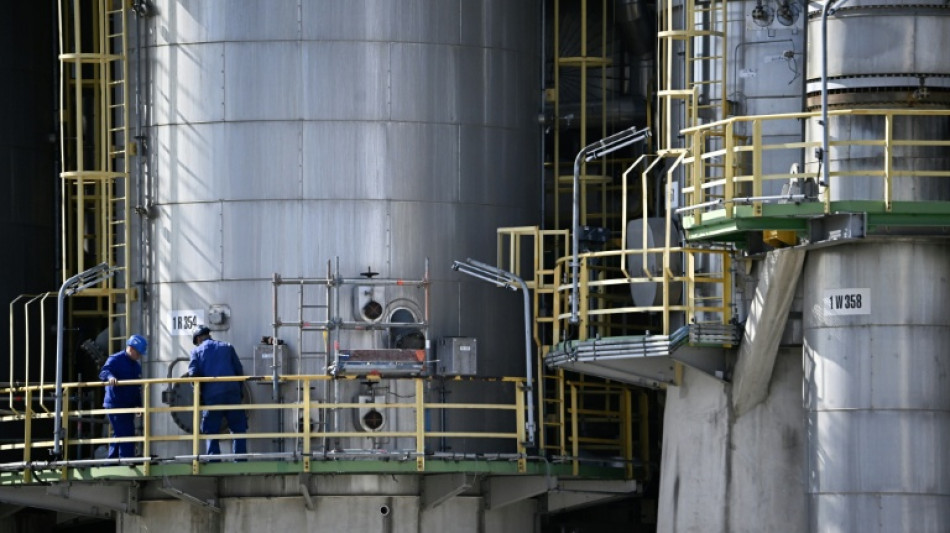
The refinery -- built in the 1960s in then communist-ruled East Germany -- is a maze of metal pipes, huge tanks and stone chimneys the size of more than 1,200 football fields.
The main task in recent years has been to find new crude supplies for the refinery, which supplies more than 90 percent of the petrol, diesel, kerosene and heating oil used in the German capital and surrounding Brandenburg state, including an international airport.
- 'Real uncertainty' -
After Russian oil stopped flowing, PCK initially used Kazakh crude transported through Russia, but Moscow halted those supplies in May, citing technical difficulties.
The Schwedt refinery has since taken increased deliveries via the Baltic sea ports of Rostock in Germany and Gdansk in Poland, and is now operating at 80 percent of capacity.
It nevertheless needs to modernise its infrastructure, particularly the link with Rostock, said Schairer.
But Brussels has so far refused to authorise 400 million euros ($465 million) in aid applied for in 2023 as Rosneft still owns 54 percent of the capital.
It is a situation that is "not exactly glorious", Schairer said. "A lot was promised to us, but of course we have received nothing yet."
Germany's far-left Die Linke party has called for the state to take over the refinery entirely -- but Berlin fears that full nationalisation could draw reprisals from the Kremlin.
Among employees, the ownership tangle is causing "real uncertainty", said Danny Ruthenberg, chairman of the works council.
An announcement of sanctions against Rosneft by US President Donald Trump last October did nothing to improve matters, even though Berlin negotiated an exemption with Washington for its German subsidiaries.
US software companies working with the refinery, such as Microsoft and Honeywell, had already announced their withdrawal for fear of sanctions, Ruthenberg said.
"A lot of things are completely beyond our control -- communication often takes place behind the scenes," he said, adding that refinery workers often learned more from the press than from management.
- 'Bridges burnt' -
The uncertainty is also complicating plans to turn the site into a refinery for synthetic fuels based on hydrogen.
The "divergent positions" of the other shareholders -- Britain's Shell, which wants to sell its 37.5-percent stake, and Italy's Eni, which owns eight percent -- "complicate the colossal investments" needed for the transition, Schairer said.
He also criticised the EU's new emissions trading system that will from 2028 require fuel suppliers, rather than end consumers such as households or motorists, to monitor and report their emissions.
"What concerns me is the European Union's go-it-alone approach," Schairer said, adding that he fears the result will be "capital flight and a lack of investment in Germany".
Many in the town, where the refinery has been the biggest employer, fear for the future.
The far-right and Moscow-friendly Alternative for Germany (AfD) has made strong gains, as it has elsewhere in the ex-communist east.
Schwedt's centre-left mayor Annekathrin Hoppe said "trust in the government has massively eroded" among her 34,000 constituents since the start of the Ukraine war.
Some people pine for the past, when Russian crude flowed freely, she said.
Asked if the end of the war in Ukraine could bring that about, Hoppe was downbeat. "For now, I have little hope," she said. "Too many bridges have been burned."
U.Ammann--NZN