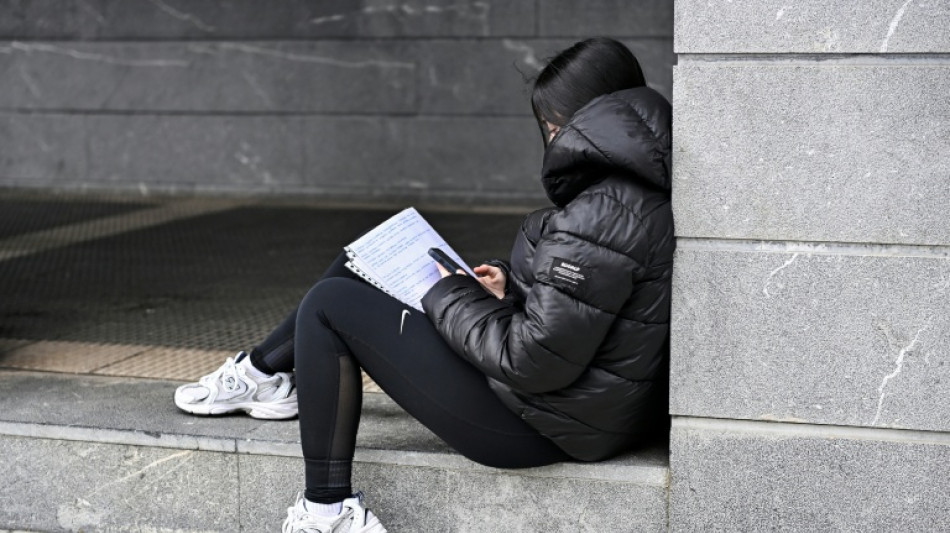
EU faces revolt over social media ban for children / Photo: ANDER GILLENEA - AFP
The European Union is poised for a big reveal of its plans to keep minors safe online -- but proposals to restrict their social media access and force age checks have drawn fire from children's rights groups and privacy defenders alike.
EU chief Ursula von der Leyen is set to outline how the 27-nation bloc plans to limit children's use of social media during a highly anticipated speech to the European Parliament next week.
Von der Leyen is weighing up social media restrictions on children under 13 -- which an expert panel has recommended -- or under 15, which France wants.
Her announcement will follow more than a year of pressure from many EU states including Denmark and Greece, and comes after Australia's world-leading ban in December 2025. Countries including Britain followed Canberra's example.
Social media critics have pointed to a rising body of evidence showing the negative effects of the platforms on children's mental and physical health.
Whatever the EU decides to do, the moves will be accompanied by the roll-out of an age-check system later this year to ensure the restrictions actually work.
But Brussels faces criticism from all sides over the plans: children's rights groups fear that social media limits will infringe on minors' freedoms, while digital rights groups raise concerns over age verification.
"To protect the fundamental rights of children, it is platforms that must be the focus of regulation, not children's access to online participation," Christian Cirhigiri of the Centre for Democracy and Technology (CDT) Europe said.
- 'Platforms should change' -
Civil society groups including children's rights activists worry about the consequences of limiting access, arguing it could deprive young people of social connections and resources that benefit their development.
Restrictions "would violate their rights to free expression and access to information, which are very essential rights covered even by the UN Charter" Cirhigiri told AFP.
Some 132 rights and mental health organisations and experts also oppose a blanket ban, and in a letter to von der Leyen shared with AFP, they urged the EU to force Big Tech to make platforms safer.
A potential ban has broad support among the 27 member states, but it is not unanimous.
"It is very hard to morally understand why access to information should be banned," Estonian digital minister Liisa-Ly Pakosta told AFP, arguing that "the platforms should change" instead.
The EU has already deployed its most potent legal weapon, an online content law called the Digital Services Act, to order Facebook, Instagram and TikTok this year to change their "addictive" design.
Simeon de Brouwer of digital rights group EDRi believes the core issue is not young people's online use per se -- but a failure to ensure the environment is made safe.
"The problem is that online spaces make young people easily accessible to predators, scammers, and others, and they can easily become addicted," he said.
- Concerns over age checks -
Australia's ban showed how teenagers could circumvent the ban through VPNs, or obfuscating their ages.
The EU hopes its age-check app will stop this -- with users able to verify their age with their passport, national ID, via reliable providers like a bank or in person at, for example, a post office.
Critics say such an app would endanger Europeans' privacy and would also restrict people's freedom online since all users will have to prove their age.
"We are concerned about the chilling effect that age verification will have on users' online speech," Cirhigiri told AFP, since some people might lack proper documentation, while others might be reluctant to provide their ID.
Brussels insists the "user-friendly" app preserves people's privacy as it only keeps information about a person's age and no details like names or birthdays.
The EU says the app would not share any data with digital platforms, and that the tools would only communicate to establish that a user is over a certain age.
The app is based on "zero knowledge proof", whereby a "yes" or "no" answer is given in a cryptographic way without providing any personal data.
Problems, however, appeared to be on show as soon as the EU launched the app's blueprint in April, with experts finding both privacy and security flaws.
Self-described security consultant Paul Moore demonstrated how he could "hack" it in "two minutes". In July he said on X he was able to bypass the app again.
Platforms do not have to use the EU's age verification app but it is seen as the benchmark and if not, they will have to use an alternative that satisfies Brussels.
D.Graf--NZN