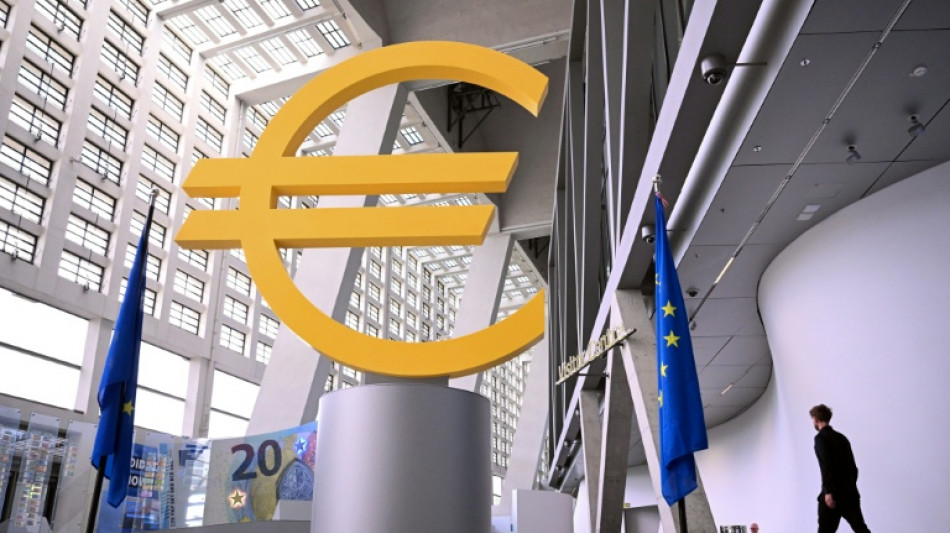
ECB hikes borrowing costs to combat Mideast energy shock / Photo: Kirill KUDRYAVTSEV - AFP
The European Central Bank raised interest rates Thursday for the second time this year as renewed fighting in the Middle East sends energy prices soaring, threatening to push widespread inflation higher.
As widely expected, the central bank for the 21 eurozone nations lifted its benchmark rate a quarter percentage point to 2.5 percent, its highest level since March last year.
It was the ECB's second increase this year after policymakers lifted borrowing costs in June for the first time since 2023 in response to the energy shock triggered by the US war on Iran.
"The conflict in the Middle East continues to generate inflation pressures, and inflation is set to remain well above target for an extended period," the ECB said in a statement.
"The outlook remains highly uncertain, with risks to the upside for inflation and to the downside for economic growth," it added.
The cental bank kept its inflation forecast for this year unchanged at three percent, but raised it slightly for next year, to 2.5 percent.
It also slightly raised its growth forecasts for this year, to 0.9 percent from 0.8 percent, and for next year to 1.4 percent from 1.2 percent.
All eyes will now be on President Christine Lagarde's press conference for hints on the bank's next move, with some analysts warning that further rate increases could weigh on the eurozone economy.
Fears of higher inflation, which hit 3.3 percent in August, above the ECB's two-percent target, are being fanned by a surge in global energy prices.
The Brent international oil benchmark has climbed back above $100 a barrel this week, while natural gas prices, a key energy cost for Europe, reached their highest level in more than three years.
The surge is being driven by an escalation in the US-Iran conflict as well as a flare-up in fighting between Saudi Arabia and Yemeni rebels, dimming prospects of Gulf energy shipments returning to normal.
- 'Inflation worsening' -
For households in the euro area, another rate hike means pricier mortgages, consumer credit and other loans.
The central bank, meeting this time in Berlin on one of its regular trips away from its Frankfurt headquarters, has faced criticism in some quarters for trying to tackle an energy supply shock with tighter monetary policy.
Rate hikes aim to slow inflation by dampening demand from consumers and businesses, but critics say they can do little to tackle the root cause of the current burst in price rises -- a shortage of energy.
And so far there has been little sign of eurozone inflation seeping more broadly through to the economy via higher costs for food, goods or services.
Some economists say the ECB is worried about a repeat of 2022, when the central bank was criticised for raising rates too slowly in response to the inflation surge following Russia's invasion of Ukraine.
Still, some analysts back more tightening and say the current energy surge might prompt the ECB to hike further.
"The inflation outlook has worsened over the summer," said Sylvain Broyer, chief economist for Europe, Middle East and Africa at S&P.
"Supply shocks are not only multiplying, but it is increasingly likely that demand is also adding to inflation," he said.
"In that context, the ECB may need to move into restrictive territory and cannot rule out further rate hikes at this stage."
O.Krasniqi--NZN