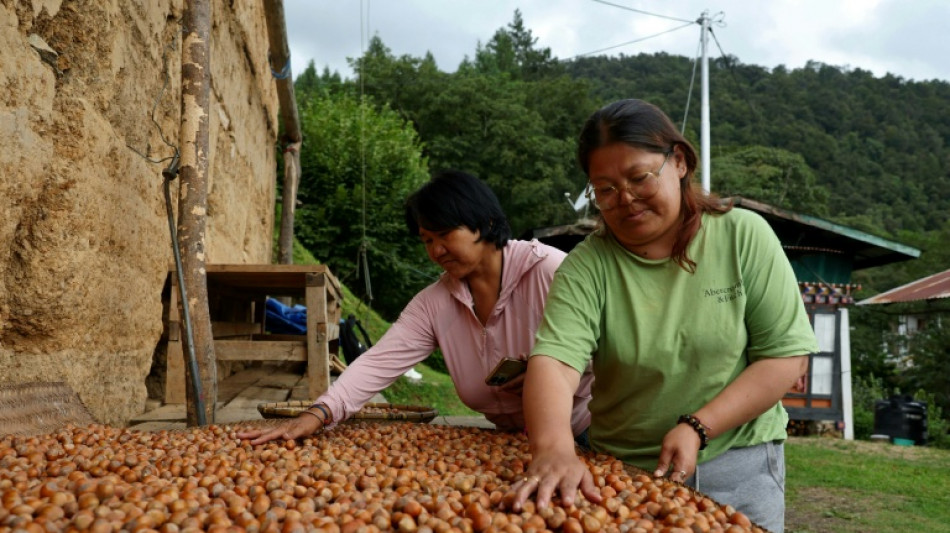
Bhutan business bets on hazelnuts for farming future / Photo: Niharika KULKARNI - AFP
Farmer Pema Dema had never even heard of hazelnuts when she was first recruited to begin growing them on her land in Bhutan's Thimphu region.
"I wondered what sort of a nut it was," the 58-year-old told AFP with a laugh, looking out over the deep valley and terraced rice fields that unfold below her farm.
Now she has more than 140 hazelnut trees on the steep slope overlooking her home, and incorporates them into Bhutan's traditional salted suja tea when guests visit.
Pema is one of thousands of Bhutanese growing hazelnuts as part of a social enterprise hoping to help subsistence farmers develop a high-value crop.
Mountain Hazelnuts began in 2009 as Bhutan's first 100-percent foreign direct investment project in the agriculture sector.
More than 40 percent of Bhutan's workforce is in agriculture, but production remains largely subsistence-based and is complicated by the country's mountainous terrain.
Steep slopes can be impossible to plough and prone to topsoil washing away in heavy rain.
Hazelnuts seemed to offer a solution.
They grow well at high altitudes and on mountainsides, require no ploughing and their roots can fix soil in place.
Hazelnuts are also a high-value crop with a growing market, and the trees can produce for decades.
That was what attracted Pema, who has been farming for 40 years.
"I thought hazelnuts would be better in terms of fetching a better price," she said.
"I hoped that it would benefit us in the future."
- Learning curves -
Mountain Hazelnuts distributed its first saplings in 2011, over 145,000 plants to 800 growers.
Each recruit's land was assessed for suitability and to ensure the crop was not displacing anything.
Growers can only use land that is fallow or degraded, with the goal of increasing Bhutan's overall farming output and improving the country's soil.
Dawa Dhendup, 82, was keen to put the trees on a steep stretch of his farm where he had struggled to grow potatoes.
"It was hard annual labour. But once the hazelnut trees are planted, it's permanent."
In sunglasses to protect his eyes after cataract surgery, he cut a sprightly figure as he harvested nuts from his 1,400 trees.
The company said it now has around 9,000 families growing hazelnuts on 6,000 acres of land across Bhutan.
But in some ways, the project is only just getting off the ground after a series of setbacks and learning curves.
A mismatch between production and polliniser saplings in early planting delayed fruiting, and had to be solved by mass grafting of polliniser plants into orchards.
The pandemic struck another blow, cutting farmers off from outreach officers who advise them on tending the crop.
And then there was climate change.
The hazelnut variety the company initially distributed needs around three months of cool temperatures to develop properly.
But climate change meant trees at lower altitudes were getting as little as six weeks of colder temperatures.
The company again turned to grafting, using stock from Georgia that required fewer "chill-hours" for plants growing between 1,600 and 2,400 metres (5,250 and 7,870 feet).
- 'Patient capital' -
In a best-case scenario, hazelnut trees take several years to fruit, and the various setbacks and extended waiting time meant some farmers simply abandoned the project.
But both Pema and Dawa said neighbours who had given up were now reconsidering.
"I'm harvesting and the price is increasing, and they're regretting their decision and feeling envious," Dawa said.
Still, like most growers, he does not yet generate significant income from the nuts.
The company has said it will be increasing the price it offers growers, and with trees reaching maturity and yields expected to increase, income should start to rise.
Investors have so far ploughed $36 million in Mountain Hazelnuts, and for now the company remains reliant on what CEO Sean Watson calls "patient capital".
It hopes to be "cash flow positive" by 2031, Watson said, and to reach 10,000 metric tons of production.
That is a long way from the current 30 metric tons, but "fruiting is starting to really kick in", and production is expected to at least double each year, Watson added.
Seated next to flat baskets full of drying hazelnuts, Pema said she had already benefited because the trees have stopped soil from sliding onto her home during heavy rain.
"Every year the yields are increasing," she said.
"If I had more land, I would have planted more."
W.Odermatt--NZN