Germany's crisis-hit rail operator looks to AI future / Photo: John MACDOUGALL - AFP/File
From AI-assisted trains to autonomous road shuttles, Germany's rail operator Deutsche Bahn -- long the country's laughingstock for its poor punctuality -- is working on the future of mobility.
But for now that transformation is complicated by red tape and the high costs of upgrading railway infrastructure.
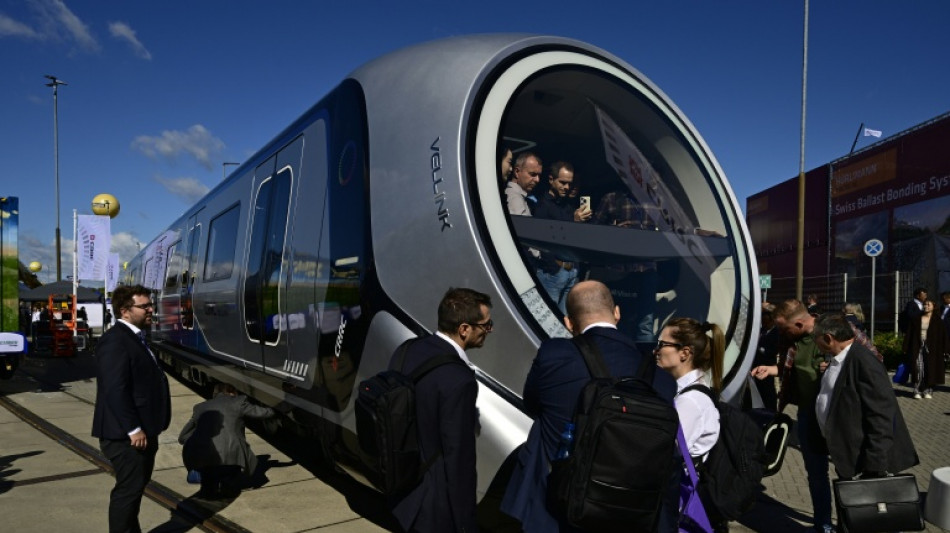
At the recent InnoTrans trade fair in Berlin, a meeting place for global rail giants, experts got a glimpse of the future: a brightly coloured train unit dubbed the "Automated Train" sat parked amid the stands.
It can travel driverless from a rail depot to a station at speeds of up to 40 kilometres per hour. Using LiDAR (laser radar technology), ultrasonic sensors and infrared cameras, it can detect hazards on the track and brake automatically.
The economy ministry has subsidised the programme with 42 million euros ($47 million) as part of a plan to spend 100 billion euros through 2030 on modernising Deutsche Bahn's dilapidated infrastructure after decades of underinvestment.
"Rail transport must get back to delivering high performance," Transport Minister Steffen Bilger said at the trade fair's opening.
In Germany, a country once known for precision, punctuality and trains that run on time, that is a work in progress.
In recent years, chronic delays on German trains have become a constant source of frustration and a punchline.
And works to upgrade the system for the future are sparking more trouble in the short term.
For example, a major rail corridor between Berlin and Hanover will soon be shuttered for 14 months for rebuilding work.
In the meantime, passengers will have to take longer alternate routes or switch to slower buses.
- Frustrated passengers -
At InnoTrans, industry heavyweights such as Germany's Siemens, China's CRRC and France's Alstom demonstrated how data could improve train operations and maintenance.
Deutsche Bahn meanwhile was showcasing a virtual passenger assistant that is set to launch this year.
However, progress in digitalisation -- the foundation for the deployment of AI -- remains limited in Germany.
The railway booster group Allianz Pro Schiene noted with regret that less than two percent of the national network was equipped with the European Train Control System (ETCS), a standardised protection technology, as of 2025, compared to a European average of nine percent.
Meanwhile, autonomous high-speed rail travel has been a reality in China since 2019, operating at speeds of 350 kph (220 mph).
In France, several cities have operated automated metro lines for years, whereas Germany has only one, in the midsize city of Nuremberg.
According to a study by the consulting firm BCG, AI in railways could save $36 billion to $79 billion in costs and add $20 billion to $50 billion in additional annual revenue worldwide.
However, the firm notes that "a large part of the sector is still struggling to turn these experiments into measurable results".
For the Spanish robotics start-up Ostirion, "the rail industry is quite conservative, and you really have to win it over", its technical manager Lidia Garcia said.
Targeting the German market, the company aims to "relieve" drivers of repetitive and arduous tasks through its AI solutions.
She said Ostirion could also help Deutsche Bahn improve its relations with passengers, who are "often frustrated" by inaccurate schedules and chaotic communications.
- Union sceptical -
Belgian start-up OTIV is working with Deutsche Bahn on assistance systems ranging from collision prevention to full automation.
At its stand at InnoTrans, visitors could remotely operate a freight train in the Netherlands using a full-scale dashboard.
Could this soon become a reality for passenger transport?
German regulations complicate matters, OTIV's chief Sam de Smet said, referring to bureaucratic burdens the government has repeatedly promised to ease.
"There is still a huge amount of work to be done regarding authorisations and evolving regulations so that we can truly start using these innovative technologies," he said.
Garcia at Ostirion agreed, saying that while innovations used to take decades to implement, "with AI and other robotic applications, everything is moving much faster".
Deutsche Bahn is considering replacing its regional bus lines with autonomous shuttles, but sees a possible rollout only toward 2045.
Private industry is moving much more quickly, with the US company Waymo planning to launch robotaxis in Munich by late 2027.
In Germany, the digital transformation also faces scepticism from the train drivers' union GDL.
Its president, Mario Reiss, told AFP that it would "watch very closely to see if the promise of simplification suddenly turns into an argument for further job cuts".
"We are really trying to address the staff shortage, not replace drivers," said Milo Belien, a software engineer at Futurail, a French-German start-up that automates trains.
kas/alf/fz/bst/js
T.L.Marti--NZN