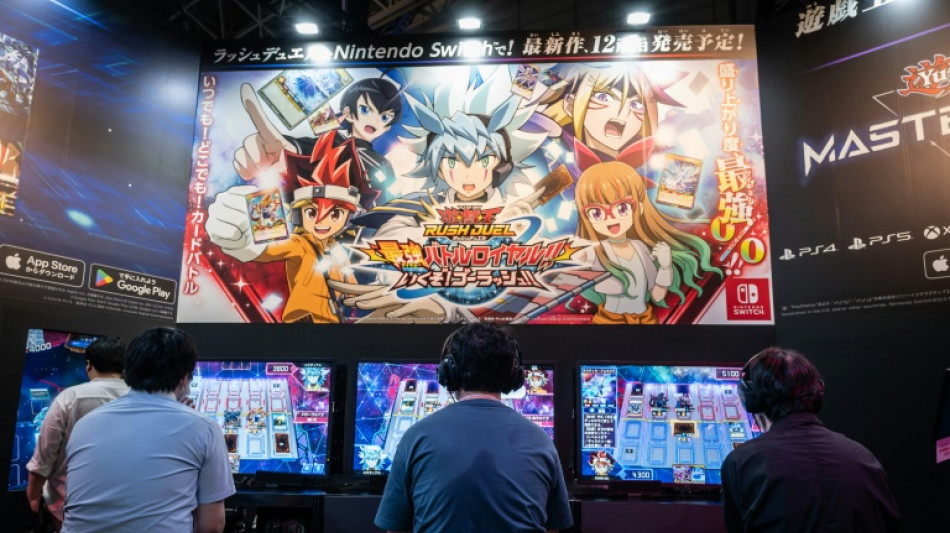
Video game hub Japan confronts problem of addiction / Photo: Yuichi YAMAZAKI - AFP/File
From Super Mario to Final Fantasy, Japan has long been synonymous with gaming, but some experts and parents fear a growing addiction problem is going unaddressed.
While nearby nations like China and South Korea have imposed drastic restrictions on youth gaming in recent years -- with mixed results -- some Japanese families feel they are being left to deal with the issue on their own.
Each month, a group meets in Tokyo to swap stories and strategies for tackling their children's gaming habits.
"My only comfort is that he has been keeping his promise to stay offline overnight," one father says, as another confides their child has been attending a rehab day camp.
The group's founder, Sakiko Kuroda, says children in Japan now start playing video games early in primary school, and pandemic restrictions mean many are playing for longer.
Many parents do not know how to deal with the issue, and there is "a lack of action by the government and the gaming industry," said Kuroda, who started the group in 2019 as an informal meet-up.
"People come from across the country to take part, as this kind of self-help gathering is rare in Japan."
The World Health Organization describes "gaming disorder" as behaviour that results in "significant impairment" of areas like relationships, education or work, and lasts at least a year.
As gaming can overlap with other online activities like social media use, it is hard to quantify the problem, though anecdotal evidence from doctors suggests more families in Japan are worried -- particularly since the pandemic.
- 'Playing all night' -
An education ministry survey this April showed that 17 percent of children aged six to 12 spend more than four hours a day gaming -- up from nine percent in 2017, with a similar jump seen among those aged 12 to 15.
"Games have clever systems to lure people into continuing to play... including constantly updated apps and virtual money," said Mia Itoshiro, who works with a group that gives seminars on preventing gaming addiction.
"Parents are increasingly consulting us saying 'my children can't go to school because they're tired after playing all night'."
China in November announced it had "solved" youth gaming addiction by limiting the time children can play online games to just three specified hours a week, enforced through facial recognition software and ID registration.
Meanwhile, South Korea last year removed a decade-long ban on PC-based online gaming for children under 16 between midnight and 6:00 am, which local media had branded outdated and ineffective.
Japan has had no similar rules, and even a much-debated 2020 local ordinance that banned under-18s from playing more than an hour on weekdays had no enforcement mechanism.
Parents and experts say gaming can tip into obsessive behaviour in children because of other problems, including Covid-related stress or bullying.
The mother of a 13-year-old girl told AFP that video games became a "lifeline" for her daughter when she was struggling at school.
When she tried to take away the girl's tablet, her daughter, then 10, replied: "If you deprive me of this, I'd want to die."
"I was shocked to hear her say something like that," the mother said.
Others who have experienced gaming addiction also say it became a lifeline for them during times of struggle.
- Underlying problems -
Takahisa Masuda, now a 46-year-old social worker, plunged into gaming as a bullied middle school student, and he believes the escape mechanism saved his life.
"I had thought about killing myself, but I wanted to finish Dragon Quest," Masuda told AFP.
By the time he had, he felt strong enough to face his tormentors, and he committed to his studies, eventually realising his goal of working in the gaming industry.
So, while parents are often inclined to ban gaming or remove devices, Susumu Higuchi, a doctor and director of the Kurihama Medical and Addiction Centre, instead offers children counselling to tackle underlying problems.
His clinic also provides offline activities from art and cooking to sports, intended to open patients up to other hobbies and social situations.
He wants the government and industry to do more to prevent children from becoming addicted in the first place.
"Discussing gaming and online tools requires a balance," Higuchi said.
"But at the moment it seems to me that measures to rein in the negative aspects are dwarfed by the promotion of gaming."
T.Gerber--NZN