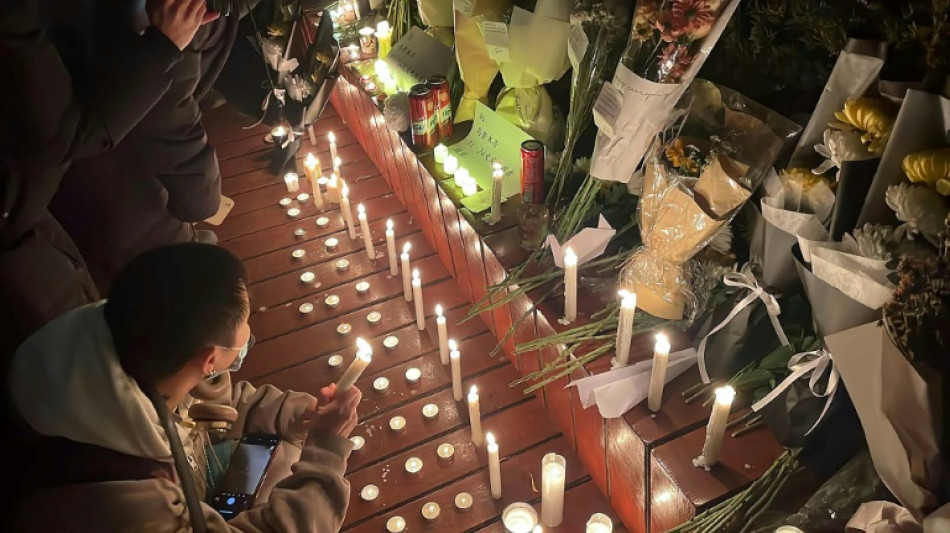
'Give me my youth back': students return to forefront of China protests / Photo: Michael Zhang - AFP
Students played a major role in recent nationwide rallies that sprouted up across China, upholding a long tradition of campus protest in the country and challenging the cliche that their generation is more apolitical than the last.
In cities and universities across China in late November, what began as vigils for victims of a deadly apartment blaze expanded into calls for an end to Covid restrictions and greater political freedoms.
The country has a long history of student movements triggering wider social unrest, including 1989 pro-democracy rallies which ended in bloodshed when the army moved in on peaceful protesters, most famously in Beijing's Tiananmen Square.
But China's current student cohort -- the first generation with no living memory of that crackdown -- have received a wholly patriotic education from birth, and are often characterised as less politically defiant than their predecessors.
That view has now been tested.
"I think today's Chinese students are a lot more knowledgeable about the world than they are sometimes given credit for," said Wen-Ti Sung, a political scientist at the Australian National University.
"They can be 'liberal nationalists', patriotic yes, but also exhibit typical middle class yearnings for civil liberty."
At the elite Tsinghua University in Beijing, students called for "freedom of expression, democracy and rule of law", while at rival Peking University, slogans echoing an earlier anti-government bridge protest were daubed on a wall.
At campuses nationwide, young people held up blank sheets of paper symbolising rejection of censorship.
The government abruptly abandoned its zero-Covid policy following the protests, in an apparent concession to the widespread public anger.
Long-term economic worries and the fact the virus was spreading rapidly despite the curbs, according to the World Health Organization, also played an important role.
And though authorities moved simultaneously to quash the demonstrations through intimidation and arrests, some believe the seeds of a greater political awareness were already sown.
"I think student participation is a symbol of hope, because it suggests that... young people still have a social conscience and political potential, and are willing and able to change current circumstances," one Tsinghua protester told AFP.
- 'First movers' -
Besides students, migrant workers and locked-down homeowners were involved in the rallies.
"We shouldn't overestimate students' role," the Tsinghua student said, contrasting the largely peaceful events on campuses to iPhone factory workers in Zhengzhou who physically clashed with authorities.
"The image of students in this wave of protests remains at the surface level."
Still, some universities in Beijing and Guangzhou, apparently spooked, sent students home early for the holidays.
Since the early 20th century, Chinese universities have been hotbeds of activism -- although this has been heavily suppressed since President Xi Jinping took power in 2012.
Historically, as well as the pivotal role played in 1989, the May Fourth anti-imperialist movement started by Beijing students in 1919 was a political awakening for many future Communist Party leaders.
More recently, Marxist student activists helped organise factory strikes in southern China in 2018, but suffered a heavy crackdown.
This year, many of the viral protest slogans and pictures originated at arts colleges before spreading to elite universities.
"There has historically been a tradition of art students using installations and other forms of art to engage with sensitive political issues such as censorship in China," said political scientist Dali Yang.
This generation's digital savvy and ability to circumvent internet firewalls -- likely gained from trips overseas -- makes them "great 'first movers' in sparking protests", ANU's Sung said.
- 'Time to express dissent' -
Students have experienced some of the strictest zero-Covid measures in China, with classes moved to online teaching, campuses closed to outsiders, frequent exam delays and home visits requiring written permission.
Graffiti reading "Give me my youth back" was written on testing booths at the Central Academy of Fine Arts in Beijing in November, reflecting the prevailing mood among students -- some of whom had been confined to campus for months.
"All of them have been feeling really sad and angry (since Covid)... All these things have been bubbling up for a long time," said Ting Guo, assistant professor at the University of Toronto, on a recent podcast.
"These emotions tie all these social differences together into what we're witnessing today."
Guo's colleague Diana Fu said the protests "reflect a consensus among Gen-Z that it is time to express dissent".
"(They) show that patriotic education has not completely wiped away yearnings for freedom," she said.
Even after the loosening of restrictions, sporadic protests erupted at campuses, including at Wuhan University by students still prevented from going home.
Last week, medical students in Jiangsu and Sichuan demonstrated over unequal pay and working conditions, as more toil in frontline shifts to battle a surge in Covid cases.
"Perhaps the impact (of the protests) is that everyone realised they can begin to act and take a small first step, and it wasn't that hard," the Tsinghua student said.
Y.Keller--NZN