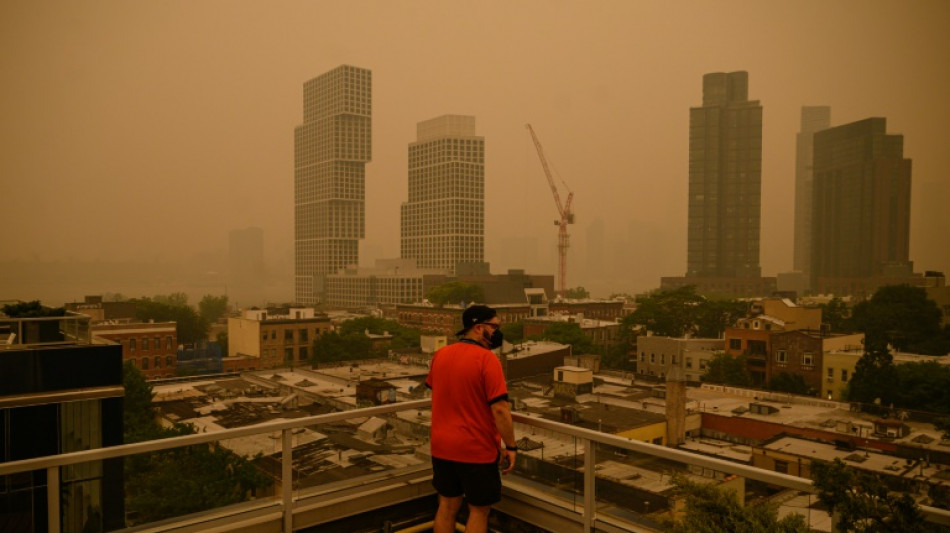
As wildfires multiply, a new era of air pollution / Photo: Ed JONES - AFP/File
From Quebec to British Columbia to Hawaii, North America is facing an extraordinary wildfire season -- and regions both near and far have found themselves increasingly blighted by smoke exposure.
Here's what you should know about air pollution from these blazes.
- What we know -
One of the defining aspects of smoke from wildfires is "particulate matter" -- toxins that, in their numbers, can make smoke visible.
Particulate matter of 2.5 micron diameter, PM2.5, is "particularly dangerous for human health and emitted in really large quantities," Rebecca Hornbrook, an atmospheric chemist at the National Center for Atmospheric Research, who flies in planes through smoke for her research, told AFP.
"Typically if you are downwind of a wildfire, that's the thing that's causing the majority of the darkening of the sky and the lack of visibility," she said, such as the shrouded skies seen in New York as a result of fires hundreds of miles away in Quebec earlier this year.
PM2.5 penetrates deep inside the lungs and potentially even the bloodstream.
The average American had already been exposed to 450 micrograms of smoke per cubic meter by early July, worse that the entirety of the years from 2006-2022, economist Marshall Burke at Stanford posted on X recently, citing calculations made by the university's Environmental Change and Human Outcomes Lab.
Also of concern are invisible substances known as volatile organic compounds such as butane. These cause eye and throat irritation, while some are known carcinogens.
When VOCs mix with nitrogen oxides -- which are produced by wildfires but also are abundant in urban areas from burning fossil fuels -- they help form ozone which can exacerbate coughing, asthma, sore throat and difficulty breathing.
- What we don't know -
Automobile ownership exploded after World War II, and in the decades since scientists have gained insights on how it impacts humans -- from the onset of asthma in childhood to increased risk of heart attacks and even dementia later on in life.
That breadth of knowledge is lacking for wildfire smoke, explained Christopher Carlsten, director of the Air Pollution Exposure Laboratory at the University of British Columbia.
Based on the two dozen studies published "there seems to be a greater proportion of respiratory versus cardiovascular effects of smoke as compared to traffic pollution," he told AFP.
The reason might be that nitric oxides are more prominent in traffic pollution.
Carlsten's lab has begun conducting human experiments with wood smoke to gain more clarity.
Medical interventions exist, said Carlsten, who is also a physician, including inhaled steroids, non-steroid inflammatories, and air filters -- but research is urgently needed to know how best to use them.
- Will it spur action? -
The warming planet also impacts our psychological wellbeing in myriad ways, Joshua Wertzel, chair of the American Psychiatric Association's committee on climate change in mental health, told AFP.
One response is distress, "anger, grief, anxiety, in the face of the natural disasters they expect to come," with these rates far higher in younger people than older.
Another is mental "acclimatization," a byproduct of evolution that helps us cope with new stressors, but if we're not careful can inure us to dangers, much like the proverbial frog in boiling water.
For Hornbrook, who is based in Colorado, what eastern North America experienced in 2023 is what the western side of the continent has already been dealing with for many years -- and the global picture is only set to worsen given humanity's appetite for burning fossil fuels.
While historic pollution regulations helped rein in emissions from cars and industry, climate action will be needed to tackle the wildfire scourge, she said.
"It gets frustrating knowing that we've been ringing the warning bell for years and years, and we're now seeing what we've been warning about," she said, but added there was still hope. "Maybe now people are actually starting to notice and we'll see some change."
O.Meier--NZN