Zürcher Nachrichten - US woman with rare double uterus gives birth to twin girls

EUR -
AED 4.351869
AFN 77.023985
ALL 96.63237
AMD 452.823666
ANG 2.121224
AOA 1086.634242
ARS 1714.678669
AUD 1.704125
AWG 2.135942
AZN 2.016552
BAM 1.955039
BBD 2.405763
BDT 145.96316
BGN 1.990034
BHD 0.448925
BIF 3538.721986
BMD 1.184989
BND 1.512711
BOB 8.253786
BRL 6.228891
BSD 1.194435
BTN 109.687287
BWP 15.628914
BYN 3.402075
BYR 23225.775647
BZD 2.402265
CAD 1.612331
CDF 2683.999101
CHF 0.915765
CLF 0.026002
CLP 1026.709185
CNY 8.237744
CNH 8.246608
COP 4348.606608
CRC 591.469676
CUC 1.184989
CUP 31.402197
CVE 110.222078
CZK 24.343237
DJF 212.697174
DKK 7.467211
DOP 75.200716
DZD 154.410871
EGP 55.902865
ERN 17.774828
ETB 185.552144
FJD 2.612485
FKP 0.865555
GBP 0.865271
GEL 3.193574
GGP 0.865555
GHS 13.084905
GIP 0.865555
GMD 86.504497
GNF 10480.918624
GTQ 9.161432
GYD 249.892689
HKD 9.256278
HNL 31.526723
HRK 7.534037
HTG 156.319128
HUF 380.877851
IDR 19876.405501
ILS 3.662095
IMP 0.865555
INR 108.656932
IQD 1564.790655
IRR 49917.642999
ISK 144.93564
JEP 0.865555
JMD 187.177111
JOD 0.840116
JPY 183.471566
KES 154.209949
KGS 103.627087
KHR 4803.129613
KMF 491.769793
KPW 1066.4897
KRW 1719.182195
KWD 0.363696
KYD 0.995412
KZT 600.736067
LAK 25704.990216
LBP 106962.747619
LKR 369.386157
LRD 215.296161
LSL 18.965415
LTL 3.498963
LVL 0.716788
LYD 7.495081
MAD 10.834781
MDL 20.090177
MGA 5337.921359
MKD 61.616006
MMK 2488.865218
MNT 4226.121106
MOP 9.60526
MRU 47.658441
MUR 53.834423
MVR 18.319442
MWK 2071.193456
MXN 20.620577
MYR 4.671242
MZN 75.555046
NAD 18.965415
NGN 1642.962557
NIO 43.952884
NOK 11.418882
NPR 175.499659
NZD 1.97076
OMR 0.457862
PAB 1.194435
PEN 3.993545
PGK 5.113009
PHP 69.813597
PKR 334.176468
PLN 4.213363
PYG 8000.884374
QAR 4.354904
RON 5.095326
RSD 117.354301
RUB 90.534923
RWF 1742.721367
SAR 4.44571
SBD 9.54107
SCR 17.197303
SDG 712.773565
SEK 10.560067
SGD 1.50588
SHP 0.889048
SLE 28.824866
SLL 24848.616602
SOS 682.634175
SRD 45.089405
STD 24526.870573
STN 24.490463
SVC 10.45093
SYP 13105.469656
SZL 18.959617
THB 37.213986
TJS 11.150158
TMT 4.14746
TND 3.431864
TOP 2.853168
TRY 51.538109
TTD 8.109842
TWD 37.443255
TZS 3075.70229
UAH 51.194065
UGX 4270.337087
USD 1.184989
UYU 46.35195
UZS 14602.313711
VES 409.936611
VND 30738.603075
VUV 140.766514
WST 3.212244
XAF 655.701663
XAG 0.013999
XAU 0.000244
XCD 3.202491
XCG 2.152662
XDR 0.815482
XOF 655.701663
XPF 119.331742
YER 282.412399
ZAR 19.100534
ZMK 10666.318069
ZMW 23.440872
ZWL 381.565831
  • SCS

    0.0200

    16.14

    +0.12%

  • RBGPF

    1.3800

    83.78

    +1.65%

  • BTI

    0.4600

    60.68

    +0.76%

  • RIO

    -4.1000

    91.03

    -4.5%

  • AZN

    0.1800

    92.77

    +0.19%

  • CMSC

    0.0500

    23.76

    +0.21%

  • NGG

    0.2000

    85.27

    +0.23%

  • BP

    -0.1600

    37.88

    -0.42%

  • BCC

    0.5100

    80.81

    +0.63%

  • GSK

    0.9400

    51.6

    +1.82%

  • BCE

    0.3700

    25.86

    +1.43%

  • RELX

    -0.3700

    35.8

    -1.03%

  • CMSD

    -0.0400

    24.05

    -0.17%

  • JRI

    0.1400

    13.08

    +1.07%

  • RYCEF

    -0.4300

    16

    -2.69%

  • VOD

    -0.0600

    14.65

    -0.41%

US woman with rare double uterus gives birth to twin girls
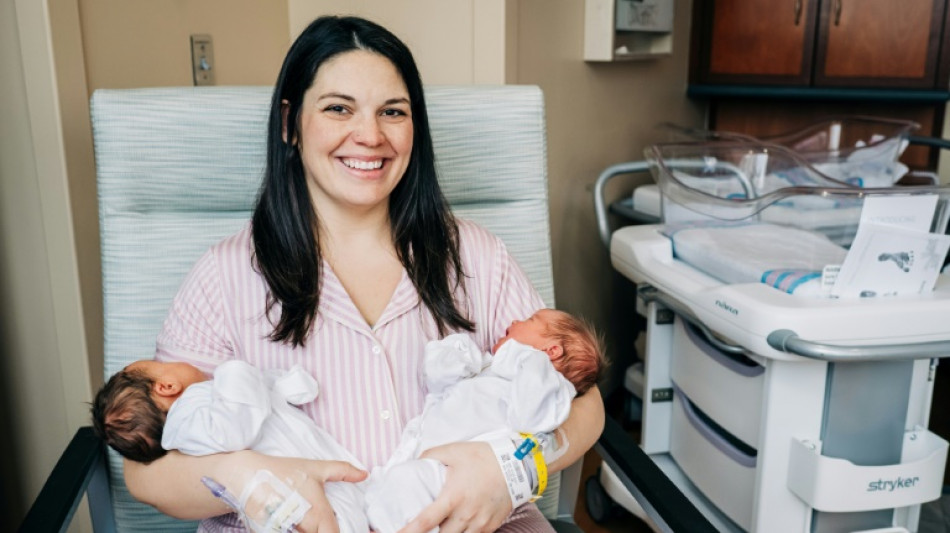
US woman with rare double uterus gives birth to twin girls / Photo: ANDREA MABRY - University of Alabama Birmingham/AFP

US woman with rare double uterus gives birth to twin girls

A 32-year-old woman from Alabama who was born with two uteruses and became pregnant in both gave birth to twin girls on different days, she announced on Friday.

Text size:

"Our miracle babies were born!" Kelsey Hatcher, who is documenting her story on her Instagram account "doubleuhatchlings," wrote in a post.

She added that the girls "decided they were rare enough statistically that they should just go ahead and have their own birthdays too."

The first one, named Roxi Layla, was born on Tuesday at 7:49 pm (0149 GMT Wednesday). She was joined by Rebel Laken on Wednesday at 6:09 am. Each weighed over seven pounds (3.2 kilos).

Doctors had estimated a Christmas due date. But following 20 hours of combined labor after Hatcher was induced at 39 weeks, the sisters arrived just in time to be at home for the holidays with their siblings.

The mother and daughters have been discharged from the hospital, with Hatcher promising to share details about the delivery in future.

Hatcher knew from the age of 17 that she had "uterus didelphys," a rare congenital condition thought to affect about 0.3 percent of females. In such cases, each uterus has only one ovary and one fallopian tube.

It was during a routine eight-week ultrasound visit in May that Hatcher, a massage therapist and then-mother-of-three, learned not only that she was having twins this time, but that a fetus was present in each of her uteruses.

"As soon as she (the technician) moved the wand to the other uterus, I gasped," Kelsey recalled, according to a statement by University of Alabama at Birmingham Hospital.

"Sure enough, there was another baby. We just could not believe it."

Pregnancies in both uteruses are exceedingly rare, according to Shweta Patel, the obstetrician-gynecologist who cared for Hatcher at UAB's Women & Infants Center.

Patel was Hatcher's doctor during her third pregnancy. "But that was only one baby -- two babies in two uteri were a true medical surprise," she said in the statement, noting she received additional help from UAB experts in high-risk obstetrics.

Richard Davis, professor at the hospital's Division of Maternal-Fetal Medicine, said the congenital anomaly of Hatcher's dicavitary twin pregnancy meant her babies were not forced to share a single, cramped womb, a condition that would have made pre-term birth a high possibility.

"With Kelsey's babies, they each had their own womb, sac, placenta and umbilical cord, allowing them extra space to grow and develop," Davis said in the statement, which was accompanied by a hospital-produced video about Hatcher's pregnancy and delivery.

Hatcher said she was told the odds of a double pregnancy in double wombs were one in 50 million -- with the last widely known case in Bangladesh in 2019, when Arifa Sultana, then 20, gave birth to healthy babies 26 days apart.

T.Furrer--NZN