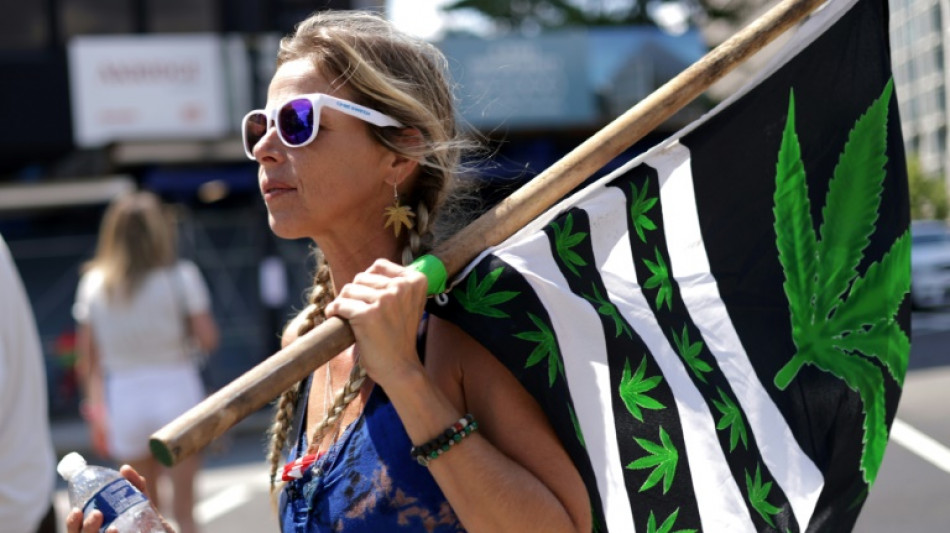
US to reclassify cannabis as low-risk drug, in major shift / Photo: ALEX WONG - GETTY IMAGES NORTH AMERICA/AFP/File
US President Joe Biden's administration is set to reclassify marijuana as a less dangerous drug, a source said Tuesday -- a historic shift that would bring federal policy more in line with public opinion.
The US Department of Justice was expected to send a recommendation to the White House on Tuesday to "reschedule marijuana," the source told AFP on condition of anonymity.
It comes after Joe Biden became the first president to initiate a federal review into the matter in 2022.
The issue is seen as a potential vote winner for Biden as he faces Republican Donald Trump in a tough election rematch this November, especially among younger people whom the Democratic incumbent is struggling to court.
Marijuana has been classified since 1970 as a so-called "Schedule I" drug along with heroin, ecstasy and LSD, meaning it is deemed to have no accepted medical use and a high potential for abuse.
But it would be downgraded to a Schedule III drug under the proposal, along with drugs like ketamine and painkillers containing codeine, with a moderate to low likelihood of dependence, the source said.
"This is the next step in the formal rescheduling process," the source said. The process would still require a long period for public comments and finalization.
Commenting on the impending move, Paul Armentano, deputy direction of the advocacy group NORML, said: "It is significant for these federal agencies, and the DEA and FDA in particular, to acknowledge publicly for the first time what many patients and advocates have known for decades: that cannabis is a safe and effective therapeutic agent for tens of millions of Americans."
But he added that reclassifying the substance did not go far enough and it should be removed from the Controlled Substances Act altogether, which would require legislation.
A Pew Research Center survey last month found 88 percent of Americans said marijuana should be legal for medical or recreational use. Just 11 percent said it should not be legal at all.
- Multibillion dollar business -
Cannabis was first outlawed at the federal level in 1937, a decision that critics say was made largely along racist reasoning, as the drug was perceived as being intimately tied to jazz music and to Mexican immigrants.
The 1970s brought the "War on Drugs," which likewise disproportionately hit minorities -- before the medical marijuana movement took root in the 1990s, and in 2012, US states began to make recreational cannabis legal for adults.
Cannabis is today a multi-billion-dollar business in the United States, with more than half of all states having legalized recreational and medicinal cannabis use, including California and New York.
But since the drug remains a controlled substance at the national level, everyone involved is still technically breaking the law of the land.
The ban makes it difficult for businesses to access banking services, stops federal funding for medical marijuana research and prevents interstate commerce, as well as federal regulation on best practices and protocols for marijuana.
After Canada fully legalized cannabis in 2018, US Customs and Border Patrol officers began issuing lifetime entry bans to Canadians who answered "yes" when asked at checkpoints if they had ever consumed the drug.
The same agency warned residents in New Mexico that it would continue to prosecute offenders caught with the substance at highway checkpoints, even after the state had legalized it.
Native American lands also experience raids carried out by the federal Bureau of Indian Affairs, despite the fact they live on nominally self-governing territories.
Cannabis advocates warn that without legislation, a future presidential administration unsympathetic to legalization could go after businesses and consumers even in states where the plant is legal.
Former president Trump's first attorney general Jeff Sessions threatened to do this, but federal prosecutors ultimately decided it was a waste of their time.
F.Schneider--NZN