Zürcher Nachrichten - US reports 2nd human case of bird flu tied to dairy cow outbreak

EUR -
AED 4.244974
AFN 72.820821
ALL 95.679468
AMD 435.069847
ANG 2.069125
AOA 1059.943556
ARS 1608.41038
AUD 1.649033
AWG 2.083477
AZN 1.960828
BAM 1.950286
BBD 2.324029
BDT 141.589657
BGN 1.975759
BHD 0.435868
BIF 3415.542608
BMD 1.155882
BND 1.475727
BOB 7.973455
BRL 6.141665
BSD 1.153937
BTN 107.875982
BWP 15.734511
BYN 3.500901
BYR 22655.282549
BZD 2.320738
CAD 1.585043
CDF 2629.631372
CHF 0.910875
CLF 0.027167
CLP 1072.7165
CNY 7.959867
CNH 7.977497
COP 4241.407488
CRC 538.976054
CUC 1.155882
CUP 30.630867
CVE 109.954107
CZK 24.487528
DJF 205.479011
DKK 7.47136
DOP 68.496328
DZD 152.86307
EGP 59.999466
ERN 17.338226
ETB 181.855905
FJD 2.559642
FKP 0.866441
GBP 0.867079
GEL 3.138222
GGP 0.866441
GHS 12.578435
GIP 0.866441
GMD 84.954116
GNF 10114.40169
GTQ 8.839008
GYD 241.417396
HKD 9.05505
HNL 30.542641
HRK 7.533347
HTG 151.38197
HUF 393.178948
IDR 19599.362345
ILS 3.593781
IMP 0.866441
INR 108.66508
IQD 1511.625902
IRR 1520706.944273
ISK 143.64086
JEP 0.866441
JMD 181.287413
JOD 0.819536
JPY 183.919854
KES 149.487327
KGS 101.07943
KHR 4610.962577
KMF 493.56122
KPW 1040.327809
KRW 1739.960935
KWD 0.354359
KYD 0.961581
KZT 554.761421
LAK 24778.937947
LBP 103341.603261
LKR 359.962213
LRD 211.16294
LSL 19.465661
LTL 3.413019
LVL 0.699181
LYD 7.387113
MAD 10.782612
MDL 20.095181
MGA 4811.395855
MKD 61.466205
MMK 2425.983079
MNT 4124.393548
MOP 9.314164
MRU 46.190397
MUR 53.760182
MVR 17.870088
MWK 2000.942367
MXN 20.733739
MYR 4.552987
MZN 73.846768
NAD 19.465661
NGN 1567.66451
NIO 42.459945
NOK 11.070054
NPR 172.601971
NZD 1.98137
OMR 0.444436
PAB 1.153937
PEN 3.98942
PGK 4.980917
PHP 69.526124
PKR 322.168873
PLN 4.275387
PYG 7536.690129
QAR 4.219569
RON 5.087616
RSD 117.118848
RUB 96.006653
RWF 1678.952788
SAR 4.339939
SBD 9.306767
SCR 15.832933
SDG 694.685214
SEK 10.812147
SGD 1.481684
SHP 0.867211
SLE 28.405845
SLL 24238.275136
SOS 659.435457
SRD 43.331121
STD 23924.418772
STN 24.430922
SVC 10.096452
SYP 127.969146
SZL 19.471943
THB 38.037761
TJS 11.083163
TMT 4.057145
TND 3.407964
TOP 2.783085
TRY 51.2244
TTD 7.828864
TWD 37.030636
TZS 3000.117216
UAH 50.55027
UGX 4361.667455
USD 1.155882
UYU 46.498526
UZS 14068.222325
VES 525.568607
VND 30413.56094
VUV 137.376492
WST 3.153027
XAF 654.107521
XAG 0.017125
XAU 0.00026
XCD 3.123828
XCG 2.07962
XDR 0.8135
XOF 654.107521
XPF 119.331742
YER 275.797228
ZAR 19.734312
ZMK 10404.320537
ZMW 22.530296
ZWL 372.193456
  • RBGPF

    -13.5000

    69

    -19.57%

  • NGG

    -3.5400

    81.99

    -4.32%

  • RELX

    -0.4600

    33.36

    -1.38%

  • GSK

    -0.5300

    51.84

    -1.02%

  • BTI

    -1.3500

    57.37

    -2.35%

  • AZN

    -5.3300

    183.6

    -2.9%

  • RIO

    -2.5000

    83.15

    -3.01%

  • RYCEF

    -1.2600

    15.34

    -8.21%

  • CMSC

    -0.2000

    22.65

    -0.88%

  • BP

    -1.0800

    44.78

    -2.41%

  • VOD

    -0.0900

    14.33

    -0.63%

  • BCE

    0.0600

    25.79

    +0.23%

  • CMSD

    -0.2420

    22.658

    -1.07%

  • BCC

    -1.5600

    68.3

    -2.28%

  • JRI

    -0.3900

    11.77

    -3.31%

US reports 2nd human case of bird flu tied to dairy cow outbreak
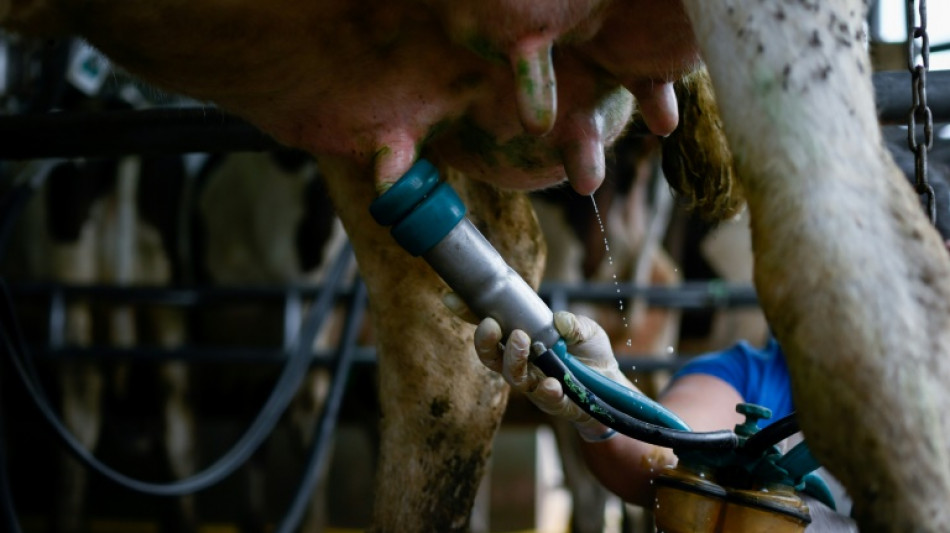
US reports 2nd human case of bird flu tied to dairy cow outbreak / Photo: Luis ROBAYO - AFP/File

US reports 2nd human case of bird flu tied to dairy cow outbreak

A second case of bird flu has been found in a human, US health authorities announced Wednesday, less then two months after the first one as an outbreak of the disease circulates widely among dairy cows.

Text size:

Both individuals infected with the virus called H5N1 -- the first in Texas, the second in Michigan -- were dairy farm workers who suffered only minor symptoms and have recovered, according to authorities.

Despite the second infection, the US Centers for Disease Control and Prevention said its risk assessment for the general public remained "low," but it did suggest it expects more cases.

Given the high levels of the virus "in raw milk from infected cows, and the extent of the spread of this virus in dairy cows, similar additional human cases could be identified," the CDC said.

However, "sporadic human infections with no ongoing spread will not change the CDC risk assessment for the US general public, which CDC considers to be low."

The latest case in Michigan was detected in "a worker on a dairy farm where H5N1 virus has been identified in cows," the agency said.

According to Michigan Health and Human Services, the worker had only mild symptoms and has recovered.

Two specimens were collected from the worker -- one from the nose and the other from the eye -- with only the eye specimen testing positive.

Additionally, "similar to the Texas case, the patient only reported eye symptoms," the CDC said.

- Chickens, cows, humans -

As of Wednesday a total of 52 US herds were infected with bird flu across nine of the 50 states.

The US Department of Agriculture said it has identified spread between cows within the same herd and between dairies associated with cattle movements.

When treated, sick cows can recover "with little to no associated mortality," the department said in a statement in late April.

It added: "It is important to remember that thus far, we have not found changes to the virus that would make it more transmissible to humans and between people."

The USDA has made financial aid available to help affected farms, for example by providing protective equipment for their employees.

According to the CDC, "people with close or prolonged, unprotected exposures to infected birds or other animals (including livestock)... are at greater risk of infection."

Though the current H5N1 strain has killed millions of poultry during the present wave, affected cows have not fallen severely sick.

Cows and goats joined the list of victims in March, surprising experts because the animals were not thought to be susceptible to this type of influenza.

Virus fragments meanwhile have been found in pasteurized milk, but health authorities say milk sold in US stores is safe because pasteurization effectively kills the disease.

There is no evidence of human-to-human transmission at present but health officials fear that if the virus were to eventually spread widely it could mutate into a form that could pass between humans.

Avian influenza A(H5N1) first emerged in 1996 but since 2020, the number of outbreaks in birds has grown exponentially, alongside an increase in the number of infected mammals.

I.Widmer--NZN