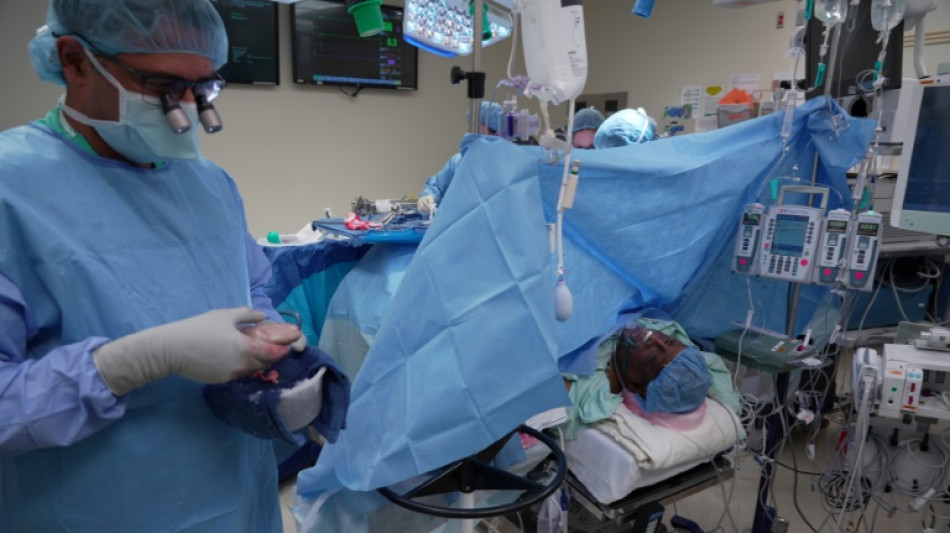
Could awake kidney transplants become the norm? / Photo: Handout - Northwestern Medicine/AFP
"I saw everything," says 74-year-old Harry Stackhouse from Illinois, who was awake during his recent kidney transplant. He felt no pain as he chatted with doctors, examined the donor organ, and watched the surgical team staple him back up.
Stackhouse was discharged just 36 hours after the procedure at Northwestern Medicine, which aims to make transplants without risky general anesthesia commonplace.
Performed in a little over an hour on July 15, this was the second such surgery led by Satish Nadig, director of the Chicago-based hospital system's Comprehensive Transplant Center. He has since carried out a third.
"We're at an inflection point in transplantation today in being able to use the technologies that we have around us to really push us into this next era," Nadig told AFP.
It may sound off-putting or even scary, but the medical benefits of using a spinal anesthetic for kidney transplants -- similar to what's already done during cesarean sections -- are well established.
General anesthesia requires intubation, which can damage the vocal cords, delay bowel function, and cause "brain fog" that persists, particularly in older patients.
But while the medical literature mentions a smattering of awake kidney transplants going back decades across several countries, it's never been fully embraced.
This year marks only the 70th anniversary of the first successful live donor human kidney transplant, Nadig points out, and there's been reluctance to challenge the status quo.
"However, now the outcomes for kidney transplantation are fantastic and it's time that we question the paradigms that we have historically stuck to."
- Life restoring -
Stackhouse, a father-of-six who worked as a painter and decorator, says he first fell ill in December 2019 with flu-like symptoms, which worsened to the point he could barely walk.
A few months later he ended up in the emergency room, where he learned he not only had Covid-19 during the most dangerous early phase of the pandemic, but one of his kidneys had failed and the other was functioning at only two percent.
He resigned himself to thrice-weekly dialysis sessions, but as the ports began failing and his veins started closing up, his daughter Trewaunda urged him to consider a transplant, offering to get herself tested as a donor.
Initially reluctant to "intrude" on his children's lives, Stackhouse finally agreed.
After meeting with Nadig and learning about the AWAKE Kidney Program, which uses accelerated surgery without general anesthesia in kidney transplantation, he decided to go ahead with the procedure.
"Believe it or not, I didn't feel a thing -- it was amazing," Stackhouse told AFP.
He conversed with the medical team during the operation, and when the doctor offered to show him the donor kidney, he didn't hesitate. "Man, I didn't think a kidney is that big!" he exclaimed.
Given his age, Stackhouse was discharged 36 hours later -- slightly longer than the first awake patient Nadig operated on in May, who left after 24 hours, but still much shorter than the US average of five to seven days for sedated patients.
- Who will be eligible? -
Nadig credited the success to advances like targeted anesthetic blocks in the abdomen and spine, avoiding opioid narcotics, and encouraging early eating, which had already helped Northwestern Medicine reduce patients' average length-of-stay even before the AWAKE program began.
Stackhouse has mounted an excellent recovery, reporting that he's walking, mowing his lawn, and preparing his boat for an overdue fishing trip. His recovery was even faster than 45-year-old Trewaunda's, who was under general anesthesia.
"It's just a gift that you can give someone, just to think where he was spiraling to, it wasn't looking good," the preschool teacher told AFP. "You're restoring somebody's life."
Christopher Sonnenday, director of the Transplant Center at University of Michigan Health, praised the Northwestern Medicine team for their "important innovation in our field."
"Limiting exposure to general anesthesia has been shown to accelerate recovery across all surgical disciplines, and I am certain that benefit may be realized in kidney transplantation as well," he told AFP.
But experience will determine how broadly applicable such procedures will become, including whether they will extend to patients with underlying conditions such as obesity or cardiac disease.
N.Zaugg--NZN