Zürcher Nachrichten - Brain implant turns thoughts into speech in near real-time

EUR -
AED 4.243598
AFN 76.263586
ALL 93.252722
AMD 423.077847
AOA 1060.756747
ARS 1729.009179
AUD 1.63715
AWG 2.082804
AZN 1.965146
BAM 1.957373
BBD 2.326069
BDT 142.954868
BHD 0.435742
BIF 3457.859125
BMD 1.155508
BND 1.48089
BOB 14.025967
BRL 5.938617
BSD 1.154928
BTN 109.794748
BWP 15.661517
BYN 3.415745
BYR 22647.966202
BZD 2.322716
CAD 1.618749
CDF 2612.604653
CHF 0.93223
CLF 0.026748
CLP 1056.157931
CNY 7.799775
CNH 7.796366
COP 3677.625283
CRC 523.720823
CUC 1.155508
CUP 30.620975
CVE 110.577359
CZK 24.184522
DJF 205.35721
DKK 7.475388
DOP 67.30804
DZD 153.466204
EGP 57.550907
ERN 17.332627
ETB 184.823403
FJD 2.553308
FKP 0.858801
GBP 0.857994
GEL 3.021622
GGP 0.858801
GHS 13.548336
GIP 0.858801
GMD 84.931759
GNF 10148.261152
GTQ 8.809078
GYD 241.584711
HKD 9.063364
HNL 31.036971
HRK 7.533572
HTG 151.001333
HUF 361.860769
IDR 20659.336108
ILS 3.470858
IMP 0.858801
INR 109.864533
IQD 1514.293863
IRR 1588593.057877
ISK 141.815325
JEP 0.858801
JMD 183.527469
JOD 0.819276
JPY 182.208653
KES 149.488533
KGS 101.048565
KHR 4682.700886
KMF 493.401915
KRW 1644.196411
KWD 0.357306
KYD 0.962469
KZT 541.953128
LAK 26120.269022
LBP 103475.784612
LKR 387.551407
LRD 209.436313
LSL 18.846604
LTL 3.411917
LVL 0.698955
LYD 7.354819
MAD 10.762117
MDL 20.066037
MGA 4971.568067
MKD 61.524919
MMK 2425.761657
MNT 4157.747973
MOP 9.330357
MRU 46.312797
MUR 54.285874
MVR 17.852389
MWK 2007.117959
MXN 19.919233
MYR 4.724922
MZN 73.848488
NAD 18.858
NGN 1574.334577
NIO 42.504153
NOK 11.010667
NPR 175.672918
NZD 1.962891
OMR 0.444286
PAB 1.154903
PEN 3.9114
PGK 5.111391
PHP 70.137026
PKR 321.001615
PLN 4.301566
PYG 6887.534304
QAR 4.212695
RON 5.246245
RSD 117.344628
RUB 93.568896
RWF 1693.975431
SAR 4.336079
SBD 9.323045
SCR 16.772158
SDG 693.886139
SEK 10.959647
SGD 1.480021
SLE 28.422197
SOS 693.885368
SRD 43.525699
STD 23916.692567
STN 24.843432
SVC 10.10512
SZL 18.846478
THB 38.224452
TJS 10.659434
TMT 4.04428
TND 3.367128
TRY 54.991339
TTD 7.834295
TWD 37.299582
TZS 3062.095139
UAH 51.681828
UGX 4307.461152
USD 1.155508
UYU 46.437314
UZS 13790.993709
VES 871.497494
VND 30333.2531
VUV 138.157226
WST 3.162341
XAF 656.481659
XAG 0.018569
XAU 0.000271
XCD 3.122819
XCG 2.081381
XDR 0.817469
XOF 656.91048
XPF 119.331742
YER 273.71111
ZAR 18.847672
ZMK 10400.959138
ZMW 22.046238
ZWL 372.073259
  • RBGPF

    -1.2500

    69.74

    -1.79%

  • CMSC

    -0.0600

    21.73

    -0.28%

  • NGG

    -0.1600

    80.26

    -0.2%

  • CMSD

    0.0200

    22.04

    +0.09%

  • VOD

    -0.3800

    15.31

    -2.48%

  • RYCEF

    0.6500

    21

    +3.1%

  • RIO

    2.5000

    101.51

    +2.46%

  • BCE

    0.0600

    22.06

    +0.27%

  • BCC

    -1.6900

    84.8

    -1.99%

  • BTI

    0.1500

    59.27

    +0.25%

  • RELX

    -0.1900

    36.61

    -0.52%

  • GSK

    -0.0700

    51.46

    -0.14%

  • AZN

    5.8800

    161.5

    +3.64%

  • JRI

    -0.0500

    12.67

    -0.39%

  • BP

    -1.2300

    41.21

    -2.98%

Brain implant turns thoughts into speech in near real-time
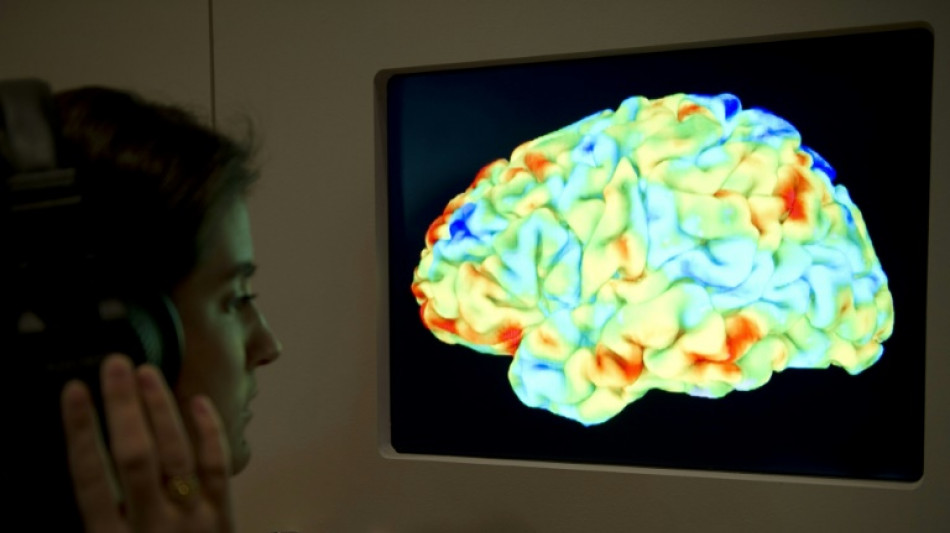
Brain implant turns thoughts into speech in near real-time / Photo: MIGUEL MEDINA - AFP/File

Brain implant turns thoughts into speech in near real-time

A brain implant using artificial intelligence was able to turn a paralysed woman's thoughts into speech almost simultaneously, US researchers said Monday.

Text size:

Though still at the experimental stage, the latest achievement using an implant linking brains and computers raised hopes that these devices could allow people who have lost the ability to communicate to regain their voice.

The California-based team of researchers had previously used a brain-computer interface (BCI) to decode the thoughts of Ann, a 47-year-old with quadriplegia, and translate them into speech.

However there was an eight-second delay between her thoughts and the speech being read aloud by a computer.

This meant a flowing conversation was still out of reach for Ann, a former high school math teacher who has not been able to speak since suffering a stroke 18 years ago.

But the team's new model, revealed in the journal Nature Neuroscience, turned Ann's thoughts into a version of her old speaking voice in 80-millisecond increments.

"Our new streaming approach converts her brain signals to her customised voice in real time, within a second of her intent to speak," senior study author Gopala Anumanchipalli of the University of California, Berkeley told AFP.

Ann's eventual goal is to become a university counsellor, he added.

"While we are still far from enabling that for Ann, this milestone takes us closer to drastically improving the quality of life of individuals with vocal paralysis."

- 'Excited to hear her voice' -

For the research, Ann was shown sentences on a screen -- such as "You love me then" -- which she would say to herself in her mind.

Then her thoughts would be converted into her voice, which the researchers built up from recordings of her speaking before she was injured.

Ann was "very excited to hear her voice, and reported a sense of embodiment," Anumanchipalli said.

The BCI intercepts brain signals "after we've decided what to say, after we've decided what words to use and how to move our vocal tract muscles," study co-author Cheol Jun Cho explained in a statement.

The model uses an artificial intelligence method called deep learning that was trained on Ann previously attempting to silently speak thousands of sentences.

It was not always accurate -- and still has a limited vocabulary of 1,024 words.

Patrick Degenaar, a neuroprosthetics professor at the UK's Newcastle University not involved in the study, told AFP that this is "very early proof of principle" research.

But it is still "very cool", he added.

Degenaar pointed out that this system uses an array of electrodes that do not penetrate the brain, unlike the BCI used by billionaire Elon Musk's Neuralink firm.

The surgery for installing these arrays is relatively common in hospitals for diagnosing epilepsy, which means this technology would be easier to roll out en masse, he added.

With proper funding, Anumanchipalli estimated the technology could be helping people communicate in five to 10 years.

X.Blaser--NZN