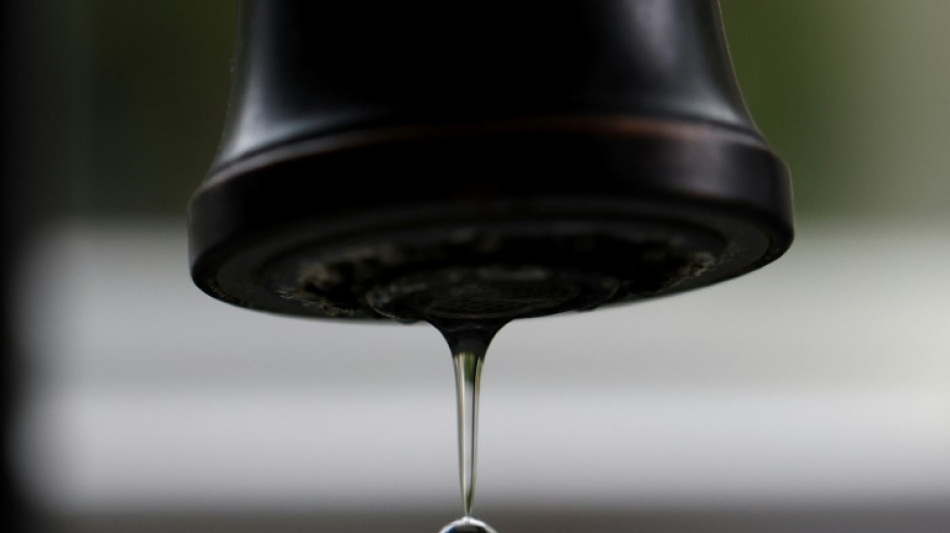
Trump admin axes safeguards against 'forever chemicals' in drinking water / Photo: JUSTIN SULLIVAN - GETTY IMAGES NORTH AMERICA/AFP/File
President Donald Trump's administration on Wednesday moved to scrap limits on several toxic "forever chemicals" in drinking water, reversing what had been hailed as a landmark public health victory.
The Environmental Protection Agency said it would retain maximum contaminant levels for just two of the most notorious compounds from the so-called PFAS class of chemicals, while removing limits for four others known to cause harm.
At least 158 million people across the United States have drinking water contaminated with per- and polyfluoroalkyl substances, which accumulate in the body and have been linked to cancers, birth defects, decreased fertility and behavioral disorders even at very low levels.
The original rules, imposed by then president Joe Biden's administration in April 2024, were celebrated as a long-overdue response to decades of industry deception and government inaction.
But under the changes announced by EPA Administrator Lee Zeldin, the limits would now apply only to PFOA and PFOS -- two legacy chemicals historically used in products such as nonstick Teflon pans, fabric protectors like 3M's Scotchgard, and firefighting foams -- while exempting newer-generation PFAS developed as replacements.
The EPA would also extend the compliance deadline for these two chemicals from 2029 to 2031, and stop the agency from assessing cumulative risks from mixtures of PFAS chemicals.
"We are on a path to uphold the agency's nationwide standards to protect Americans from PFOA and PFOS in their water," said Zeldin. "At the same time, we will work to provide common-sense flexibility in the form of additional time for compliance."
The move -- part of a broader deregulatory push under Zeldin, who has recast his agency's role as prioritizing the "unleashing" of American industry over environmental stewardship -- was welcomed by water utilities but sharply criticized by advocacy groups.
"This is a huge step backwards, and it's really a betrayal of the promise this administration made to provide clean drinking water and clean air, and to make America healthy again," Melanie Benesh of the nonprofit Environmental Working Group told AFP.
"With a stroke of the pen, the EPA is making a mockery of the Trump administration's promise to deliver clean water for Americans," added Eric Olson and Anna Reade of the Natural Resources Defense Council.
Benesh noted that the excluded chemicals were developed as substitutes, but the EPA's own research has linked some of them -- including GenX, which contaminated a swath of North Carolina's water supply -- to harm to the liver, kidneys, immune system, fetal development, and cancer.
- Planet-wide contamination -
PFAS earned the nickname "forever chemicals" because they can take millions of years to break down in the environment.
First synthesized in the 1930s, PFAS contain carbon-fluorine bonds -- the strongest in chemistry -- giving them extraordinary heat resistance and liquid-repellent properties. Today, they blanket the planet, from the Tibetan Plateau to the ocean floor, and circulate in the blood of nearly every American.
Internal documents cited by researchers show that manufacturers such as DuPont and 3M knew for decades about PFAS dangers yet worked to cloud the science and delay regulation.
In recent years, companies have paid billions of dollars to settle lawsuits with water utilities and affected communities -- even as next‑generation PFAS continue to appear in clothing, cookware, and cosmetics.
Water systems will eventually have to install granular-activated carbon systems, but the newer-generation PFAS, which have shorter molecular chains, clog filters more quickly, raising operating costs.
"This commonsense decision provides the additional time that water system managers need to identify affordable treatment technologies and make sure they are on a sustainable path to compliance," said National Rural Water Association CEO Matthew Holmes, welcoming the delay.
The rollback is likely to face legal challenges. Under the Safe Drinking Water Act, any change to existing standards must be equally or more protective of health.
Activists are also calling on states -- which are free to set stricter standards -- to step in and fill the gap left by federal inaction.
A.Wyss--NZN